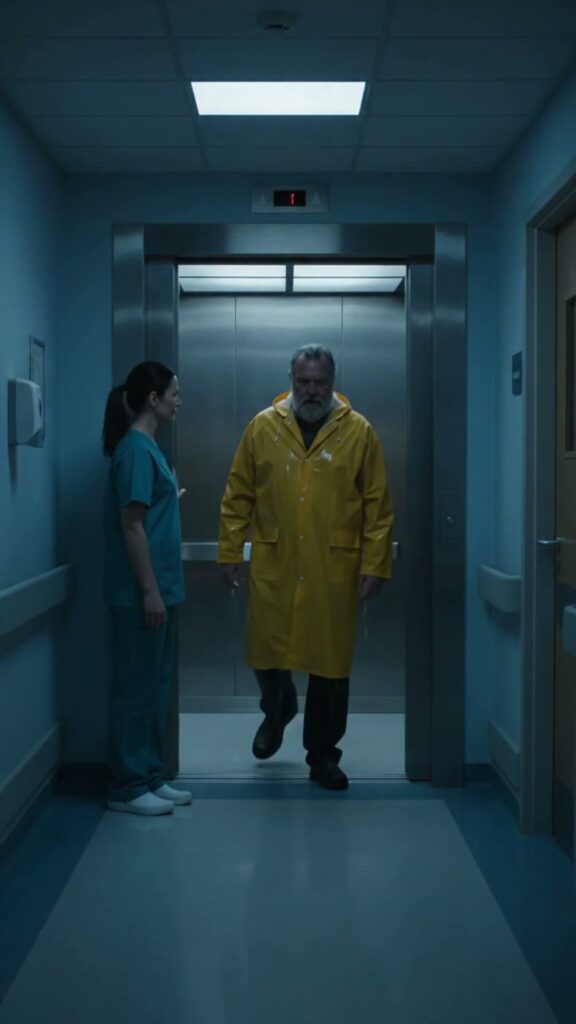
I’m Priya, forty-one, a night nurse on the maternity ward at St. Brigid’s. In nineteen years I have learned that the loneliest patients never complain. They just answer “no one” when you ask who they’d like us to call.
That night a young woman named Anna gave birth to a beautiful little girl at 2:10 a.m., after a long labor, entirely alone. No partner, no mother, no friend. On the line for emergency contact she had drawn a firm dash. Her phone had not buzzed once.
At three I came in with warm blankets and found her holding a creased photograph against her daughter’s cheek. A man on a small fishing boat, a little girl in a yellow life jacket on his knee, both squinting into the sun. “My dad,” Anna said. “We haven’t spoken in six years. After Mom passed, he said things. I said worse. He’s too proud, and so am I.”
I sat on the edge of the bed. I told her the rules: I could never call anyone without her say-so. I told her that the rules said nothing about how badly I wanted to. And then I asked, very gently, whether she wanted me to try. She looked at her daughter for a long time. “He won’t come,” she said. “Then it costs us nothing,” I said. She recited the number from memory.
I dialed it from the desk phone at 3:06. It rang eleven times. A rough voice answered, “Who is this? Is she hurt?” I told him his daughter was safe and well and that she had something to show him. There was a silence so long I thought the line had dropped. Then he said, “I’m two hours away,” and hung up.
He made it in one hour and fifty minutes. At 4:58 the elevator opened and out stepped a huge, grey-bearded man in a dripping yellow raincoat, his hands hanging at his sides. He stopped three steps from Anna’s door. “What if she doesn’t want me here?” he asked me. I opened the door a few inches. Anna sat up in the soft lamplight, the tiny bundle in her arms, and she said one word. It wasn’t “Dad.” It was the name she had chosen, and it made that enormous man grab the door frame to stay on his feet: “Rosalind.”
Rosalind was his wife’s name. Anna’s mother’s name. He lowered himself onto the visitor’s chair, raincoat still dripping onto my clean floor, and for a moment he couldn’t speak at all.
“You named her after your mother,” he said at last.
“I hoped you’d come to hear it,” Anna said.
I placed the baby in his arms. She stirred, opened one fist, and the tiny hand found his thick, scarred finger and held on. He made a sound I will never forget, half laugh and half sob, and bent his grey head until his forehead touched hers.
It came out slowly, the way these things do. After his wife passed, the medical bills swallowed everything. He sold the little house and the garden Anna’s mother had planted without asking her, because he couldn’t face telling her how bad it was. Anna heard it as betrayal. He heard her silence as blame. Six years of pride on both sides, and not one of them was worth it. “I drove down your street every Sunday,” he confessed, staring at the baby. “I never once found the nerve to stop.”
“You stopped now,” said Anna, and she was crying too, and smiling.
I stayed thirty minutes past the end of my shift and pretended I was charting. When the day nurses came in I signed out, walked to my car in the pale morning, and sat there with my hands over my face for a long time.
Three months later a package arrived at the ward, heavy and awkward, wrapped in brown paper. It was a rocking chair made of pale oak, hand-built, sanded silky smooth, with a small carved wave along the back. The card read: “For the nurse who dialed the number. From Rosalind’s grandfather.”
He builds boats, it turns out. He has since built eleven more chairs, one for every room on the ward. Under each seat is a small brass plate, and if you kneel and read it, it says only: “Ask if they’d like a call.” The staff call it the Rosalind Rule. Nobody on my ward answers “no one” anymore without a gentle question first.

Join the conversation