I’m Julian Carrow. I own eleven hotels, and I have a rule about my house: nothing with fur, nothing with claws, nothing that leaves footprints. My wife Helen used to laugh at that rule. She has been gone four years now, and the rule is one of the few things still standing.
My son Milo is six. Since his mother passed he has been very quiet, and he draws a lot, mostly cats, for some reason I have never understood.
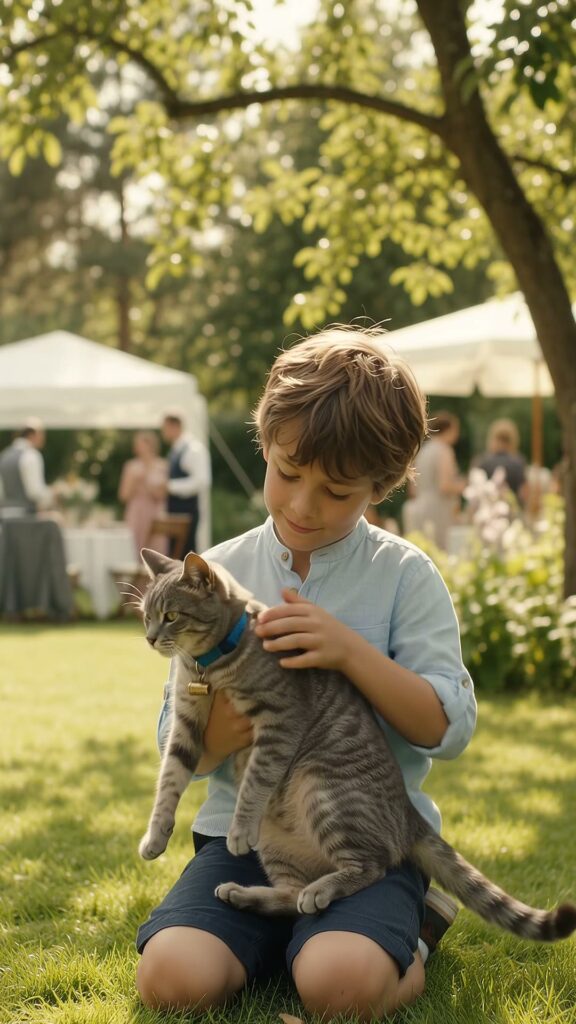
Last Saturday I hosted a garden party for forty people: my board, my investors, the kind of afternoon where the hedges are trimmed with scissors. In the middle of it a thin grey tabby with a torn ear walked out from under the roses, crossed the lawn between the ladies in their hats, and sat down at my son’s feet.
Milo picked it up. I hadn’t seen him smile like that since the spring Helen left us. “Dad, look. He knows me.”
“Put it down, Milo,” I said. “It’s a stray. It’ll have fleas, and it doesn’t belong to us.”
“He belongs to someone,” Milo said. “He’s got a collar.”
Everyone was watching. My board chairman raised an eyebrow. I said it again, more firmly. Milo didn’t put the cat down. Instead he turned the faded blue collar around with his small fingers and found something I hadn’t noticed: a tiny brass barrel, no bigger than a lipstick, hanging from a loop of thread. He twisted the cap. It came open with a little click.
Inside was a rolled scrap of paper. Milo unrolled it as carefully as he handles his drawings. It was an old photograph, creased white at the folds, of an elderly woman laughing with the same grey cat on her lap. Milo held it up to me. “Dad,” he said, “it’s Rosa.” I looked at that small face, at the kind creased eyes I had passed in my own hallway every morning for three years, and the lawn seemed to tilt beneath my shoes.
Behind me the kitchen door opened. Rosa Delgado, sixty-six, our housekeeper, stood on the step with a tray of lemonade in her hands. She had heard my son’s voice and come out to see what the fuss was about. She looked at the cat. The tray began to shake so hard the ice rang against the jug.
“Pimienta,” she whispered. “Pimienta, mi vida.”
The cat leapt out of Milo’s arms and crossed the grass in three bounds, and Rosa went down on her knees in her grey uniform, right there in front of my investors, and gathered him up. She wept the way people weep when they have run out of ways to be strong. The cat pushed his torn ear against her chin and purred so loudly I could hear it from ten feet away.
I learned the story later, sitting on the back step while the guests quietly found their coats. Three years ago the river flooded the lower town. Rosa’s building was one of the first to go. She lost her furniture, her photographs, her husband’s tools, and her cat, who had run out into the storm through an open window. She searched shelters for months. She never told a soul in my house, because she had just started working for me and she did not want to seem like a woman with troubles.
Her late husband had made that little brass barrel out of an old lamp fitting, so that if the cat was ever lost, whoever found him could learn where he belonged. Rosa had put her own photograph inside, not an address, since she no longer had one, but her face, so that the cat would always have something to come back to.
Pimienta had been living rough by the river all this time, fed by a night watchman at the old pump house. When the weather turned cold, the watchman told me, he simply set off up the hill, following something only he could smell. It led him to my back door, to the mat Rosa shakes out every morning. It led him, in the middle of forty strangers, to the only child in my house who had been waiting for a cat.
I stood on my own lawn and understood that a woman had swept my floors for three years and I had never asked her a single question about her own life.
“Rosa,” I said. My voice didn’t work properly. “I’m afraid I’m going to have to revise the rule.”
The guests laughed softly, and then some of them applauded. Milo tugged at my sleeve. “Dad said he can stay,” he announced to the whole garden. The sunny room at the end of the east wing has been Rosa’s since that evening, with a window seat and a very large cushion.
Milo still draws cats. But lately there are always two other people in every picture, one very short and one wearing an apron, and somewhere at the bottom of every page, a small grey tabby with a torn ear, sitting on the biggest lap.

Join the conversation