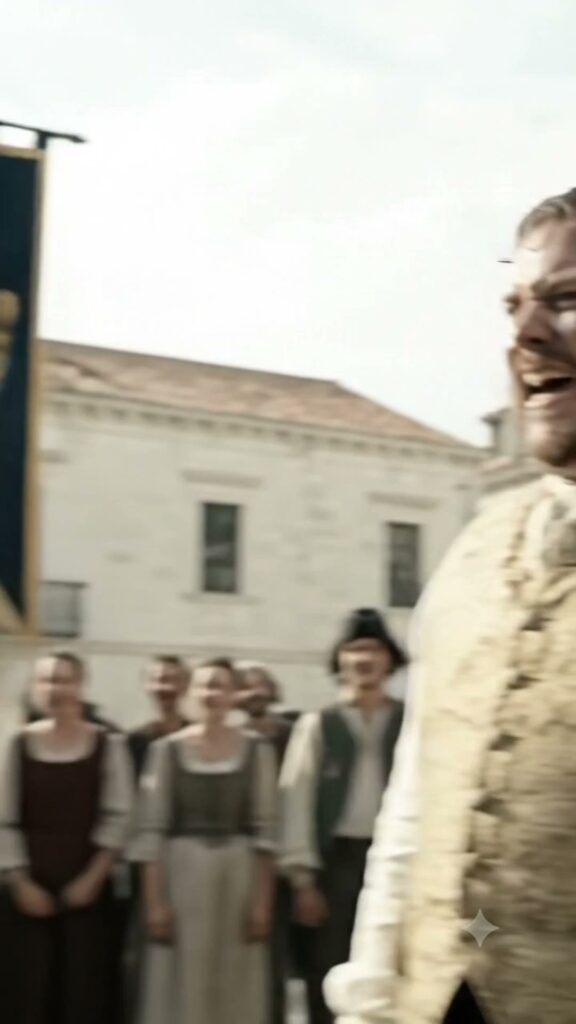
My name is Tamsin Pryce, and by the time I had the rope in my hands the laughing had stopped, because everyone in Marrowgate square could see something was about to happen. I did not feel brave. My palms were bleeding into the hemp and my knees were shaking, but I had spent forty years hauling wet nets against the tide, and my body knew exactly what to do with a rope.
The bell did not move. It weighed more than every man in that square, and the first footman had already recovered. He caught my apron strap and heaved backward, and my boots skidded on the wet stones. I felt the rope burn through my fingers and I nearly let go.
Then a hand the size of a shovel closed on the rope above mine.
It was old Corwin Bell, the bellkeeper, seventy-three years old, the only person in the square who had not laughed. He had run the whole length of the quay in his leather apron, and he was gasping so hard he could barely speak. “Not with your arms, girl,” he said. “With your back. Like a long haul. On my count.”
A long haul is how we bring the heavy nets up the slip: a slow pull, a slack, then a pull that puts the whole body behind it. Every fishing family on Marrowgate knows that rhythm in their sleep. Corwin knew it too, because his father had rung this bell in the old days, and it had never been about strength. It was about timing.
“Heave,” said Corwin.
We pulled. The bell groaned in its frame, a deep, ugly, grinding sound, and swayed the width of a hand. A cascade of dust and pigeon feathers poured down from the belfry. One of the footmen started laughing again, but it was a thin laugh, and it died halfway out.
“Slack.” We let the rope rise. “Heave!”
The bell swayed further. Then a fisherman named Doyle ran in from the crowd and grabbed the rope behind Corwin. Then his brother. Then a woman with a baby on her hip handed the baby to a stranger and took the rope. I heard boots on the flagstones, dozens, then more, and suddenly the whole square was surging forward, fishwives and ferrymen, deckhands and bakers, hand over hand along the rope until it stretched thirty people long. Even one of the footmen quietly slipped his hands onto the end of the rope.
“Heave! Slack! Heave!”
Lord Vane stood in the middle of it all in his gold waistcoat, red in the face. “Stop this,” he shouted. “That bell is a monument. It will tear the tower down.” Nobody looked at him. Nobody even turned their head. He stepped forward to seize the nearest man’s collar, and the crowd swung on the next heave like one enormous animal, and Lord Vane went sprawling backward across the stones. His hat rolled away under the wheels of a fish cart.
On the fifth heave the bell swung all the way over, and something inside it that had been stuck for forty years finally broke free.
It struck.
I have never heard a sound like it, before or since. It was not loud so much as enormous, a deep golden note that rolled out of that square and across the harbour and out into the fog. At the same moment the morning sun burned through a crack in the white, and a great blazing shaft of gold light came sweeping across the rooftops and through the belfry, lighting the falling dust and the feathers like a rain of sparks. Every pigeon in Marrowgate exploded out of the tower at once, a roaring grey cloud spiralling into the light. Someone in the crowd screamed with joy. Someone else began to sob.
“Again!” Corwin roared.
We rang her nine times. On the seventh, a thin, faint sound came back out of the fog, so quiet I thought I had imagined it. A ship’s horn. Then another. Then, shapeless at first, a dark hull sliding out of the white, and another behind it, and another, forty-one boats coming home one after the other toward the sound of the bell, with their crews standing on the decks shouting and waving their caps.
That was when I felt the crowd close around me. Doyle grabbed my waist and, before I could protest, they lifted me up onto their shoulders, split apron and bleeding palms and all, and carried me twice around the square while the bell went on ringing over our heads.
Lord Vane was still sitting in the dirt where he had fallen. When they finally set me down, he stood up, brushed off his waistcoat and walked toward me with his ruined hat in his hands. I braced myself. Instead, he looked past me at the bell, and I saw that his eyes were wet. “My grandfather stopped that bell,” he said quietly. “He said it was too loud for his guests. I have been ashamed of it my whole life, and I laughed at you because I could not bear to hear you say so.”
Then, in front of all of Marrowgate, Lord Haskell Vane took hold of the bell rope, blistering his soft hands on the same hemp that had torn mine, and pulled with the rest of us.
They rang the fog bell every foggy morning after that. I ring it myself on the last Sunday of the month, with Corwin counting the hauls beside me, and every time it strikes I look up at that shaft of golden light and think about how close I came to walking away.



Join the conversation