My name is Dorothy Hale. I turned eighty-three last Sunday, and for thirty-one of my birthdays I have received a card from a woman I have never met.
Her name is Maeve Doyle, and she lives in a small stone house outside Galway. We began writing in 1993, when a magazine listed her among readers looking for a pen friend across the ocean. I was fifty-two and my husband Frank had just retired, and I wanted someone who would tell me what the weather was like on the other side of the world.
That was thirty-three years of letters, two a month, and birthday cards that never once arrived late. Maeve drew a shamrock in green ink on the envelope every time. She sent me pressed flowers from her garden, a recipe for brown bread, and a photograph of her hands, thin and freckled, holding a teacup. I sent her Ohio in return: cardinals and cornfields and my husband’s terrible jokes.
We never met. Maeve was afraid of flying, and after Frank passed I was afraid of everything past my own front porch. We agreed, the way old friends do, that there was plenty of time.
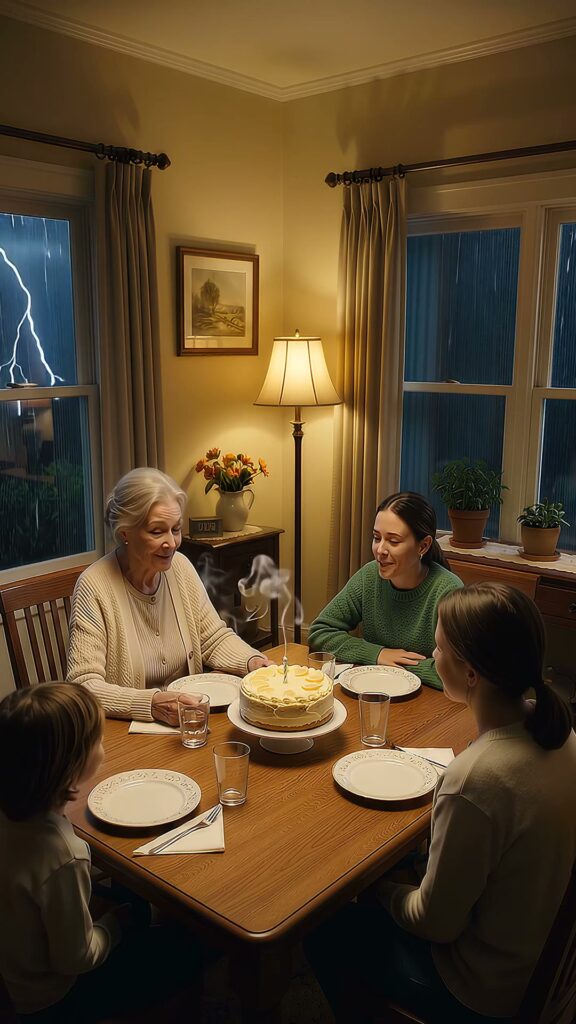
This year my birthday came and went, and the mailbox was empty. I checked at ten, at noon, at four. I told myself the Atlantic is wide and the post is slow. My daughter Carol drove over with a cake, watched me at the window, and said gently, “Mom, come sit down. Please.”
I sat at the head of my own table, with Carol and her husband and my two grandsons and a lemon cake with eighty-three candles I did not want to blow out. I made a wish anyway. It was the same wish I had made for three decades: that someday I would hear her voice.
At 6:40 the doorbell rang. Nobody rings my doorbell at that hour, and it was raining hard.
I opened the door. On the step stood a tiny woman in a wet green coat, leaning on a walking frame, with a young man holding an umbrella over her head. She held a birthday card in one trembling hand, a shamrock drawn on the envelope in green ink. In a voice I had heard only in my head for thirty-one years, she said, “Dorothy Hale, I’m so sorry I’m late. The post was too slow, so I brought the card myself.”
I do not remember crossing the hall. I remember that my arms went around a person smaller than a coat rack, that she smelled of lavender and rain, and that neither of us said a word for what felt like an hour. Behind her, the young man, her grandson Cian, was crying openly into the umbrella.
It turned out she had flown. Maeve Doyle, eighty-four years old, who had never set foot on an airplane, had booked her ticket in April and told nobody but Cian, because she was afraid she would lose her nerve. Nine hours over the Atlantic, holding his hand and a rosary. She missed her connection in Chicago, rented a car, and drove through the storm because she had promised herself she would not be late again.
We sat in my kitchen until midnight. Carol made tea. My grandsons, who had never seen me talk so fast, sat on the floor and listened as two women who had written thirty-three years of letters told each other, out loud, everything the letters had left out. At one point Maeve took my hand and turned it over. “I knew them, you know,” she said quietly. “Your hands. I sent you a photograph of mine, and you sent me yours, and I have looked at them every day.”
She stayed three weeks in the spare room under the quilt Frank’s mother made. Every morning we walked down to the mailbox together out of habit, and every morning we found nothing, and every morning we laughed harder about it.
On her last evening she gave me the card. The envelope had a shamrock in green ink. Inside, in her careful hand, it said: Dear Dorothy, I will see you on the next one.
Next spring it is my turn. I have a passport for the first time in my life, and Carol says I have lost my mind. I say a friend who crossed an ocean in a storm has already taught me everything about being brave. All I have to do is follow the shamrocks.



Join the conversation