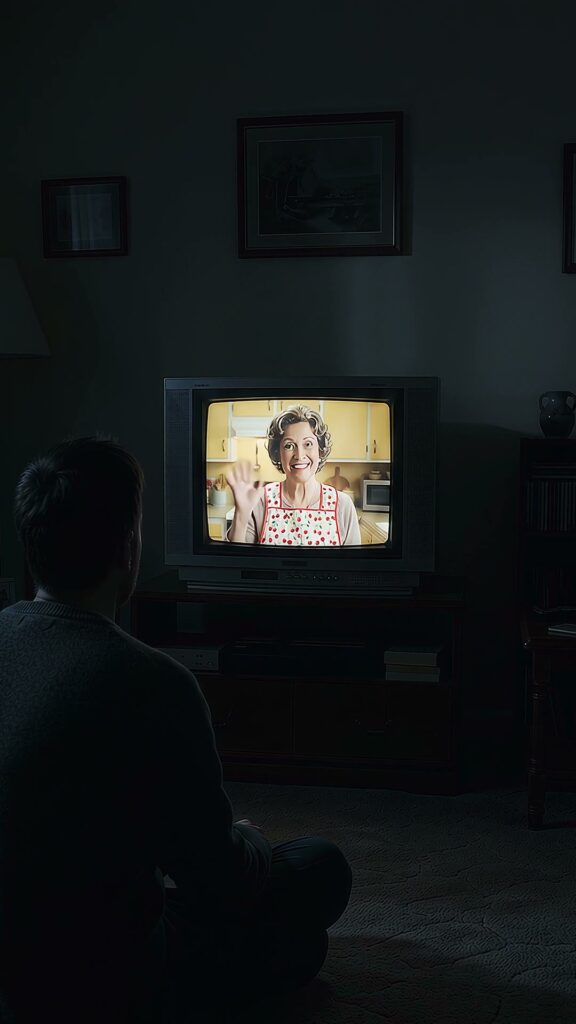
My name is Ben. I’m thirty-eight, and eleven weeks ago I lost my mother. Since then I’ve driven to her little yellow house every weekend to fill boxes. The realtor says the market is good. The neighbor says the roses need pruning. I say nothing. I just carry boxes.
The house is very quiet now. Mom hummed while she cooked. She hummed in every room. The silence has the exact shape of that humming.
Last Saturday, at the bottom of her sewing tin, under the buttons and the thread, I found a tape. Her handwriting was on the label: For Ben, when the house is quiet. I sat on the living room floor for ten minutes just holding it.
Dad’s old camcorder was in the hall closet, and Mom’s ancient television still had its cable dangling. It took me forty minutes to wire everything up. Then I sat on the carpet in the dusk, pressed play, and there she was.
Mom, thinner than I’d let myself remember, in her yellow kitchen, in the apron with the faded cherries. She waved at the camera, laughed at herself for not knowing where the lens was, and finally found it. “Hello, my darling,” she said. “If you’re watching this, the house is quiet, and you’re deciding whether to sell it. I don’t mind. It’s only walls. But before you decide anything, I need you to do one small thing for me.”
She smiled the way she did at every school play. “Ben, love, go to the front window and look out. Don’t be cross with me, I planned this.”
I paused the tape. My heart was thudding. I got up off the carpet, walked down the hall in my socks, and pulled back the curtain.
At the curb, under the streetlight, sat a dusty blue pickup with its engine off. A man was in the driver’s seat, both hands on the wheel, looking straight ahead at my mother’s front door as if it might bite him. He held something small and rectangular on the dashboard. A tape.
It was my brother Sam. Forty-one years old. I hadn’t spoken to him in eight years.
It started the week after Dad passed. Sam wanted to sell Dad’s workshop, and I called him a vulture. He called me a martyr. We said every unforgivable thing brothers can say, and then, because we were both proud and both grieving, we never said another word. Mom tried for years. Every Christmas she set three places at the table, and every Christmas two of us sent our apologies.
I went back to the television and pressed play. “I told Sam to come at six,” Mom said, laughing softly. “I bet he’s been out there since four. He’s as stubborn as you are. Go and get him, Benny. I’ll wait.”
I walked down the path and knocked on the window of the truck. Sam rolled it down slowly. He looked older. He had Dad’s jaw. “She’s got a tape for you too,” I said. He nodded, unable to speak. “She got both of us,” he said. “Didn’t she?”
We sat side by side on that old couch with a bowl of the stale popcorn from the cupboard between us, and we watched the rest together. Mom taught us her Sunday stew, step by step, waving a wooden spoon at the camera. Onions first, low and slow. Then the beef. Then a spoonful of something she wouldn’t name. “The secret ingredient,” she said, “is that it takes two people arguing about the salt. Every good pot does. That’s all a family is, my loves. Two people, one pot, and a lot of noise.”
At the end she blew a kiss and said, “Cook it together. Love, Mom. P.S. Your father says the workshop was never about the wood.” The screen went to grey static, and Sam put his face in his hands, and I put my arm around his shoulders for the first time since we were boys.
We cooked that night, the two of us in Mom’s yellow kitchen, in her cherry apron and Dad’s old one. Sam burned the onions. I put in too much salt. He said I’d ruined it; I said he’d ruined it first. We laughed until we couldn’t stand up, and I swear I heard someone humming from the hallway.
We didn’t sell the house. Sam moved his tools into the workshop, and I do the roses. Every Sunday at six, two men, one pot, and a lot of noise. The table has three places. Nobody sends their apologies.






Join the conversation