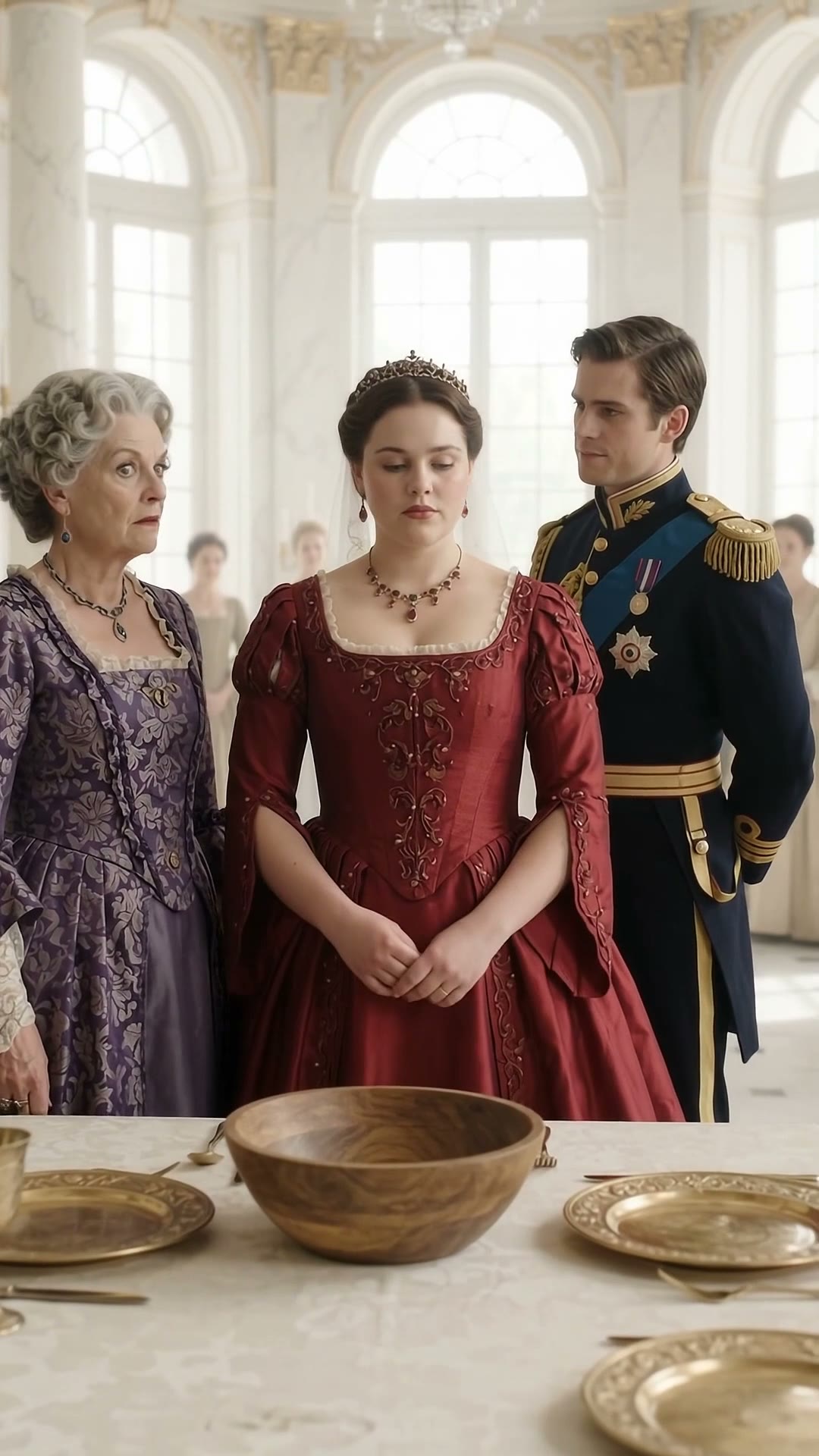
"Name one queen who did, Your Highness. Just one." Tess Merrow said it softly at her own wedding breakfast, but every person at the long white table heard her.
Two months earlier she had been a miller's daughter with flour in her hair. Now she was Prince Lucien's wife, and the court had smiled through the vows. The real test came at the breakfast. Every guest ate from gold plates, every guest but one. Princess Ermentrude, the King's own sister, pushed the bride's gold plate aside and set a plain wooden bowl down in front of her, hard.
"Village brides eat from wood their first year. Royal custom."
The ladies hid their smiles behind their fans. A year of wooden bowls at every feast, in front of everyone, so no one would ever forget where she came from. Tess felt her cheeks burn, and her crimson silk suddenly seemed very heavy. But she did not lower her eyes. She laid two fingers on the rim of the bowl and slid it slowly back across the cloth until it stopped in front of the Princess. Then she lifted her chin.
"Name one queen who did, Your Highness. Just one."
The Princess opened her mouth, and closed it again. She could not name one.
Prince Lucien stepped forward. He looked at his aunt for a long moment, and when he spoke, his voice was very quiet.
"None did, Aunt. Your own mother was a fisherman's daughter."
The table froze. The Princess went white to the lips, staring down at the wooden bowl that now sat beside her own gold plate. For once in her life, she had nothing to say.
Tess did not gloat. She folded her hands in her lap, and for the first time since the vows the whole room seemed to breathe again. Under the cloth, Lucien found her fingers and held them, and no one at that table needed to be told whose side he had chosen.
To understand why those words hit so hard, you have to go back forty years, to a missing page in the royal birth register. Lucien had met Tess at her father's mill during a summer storm, when his horse threw a shoe on the lane and he came in to wait out the rain. He liked her plain speech and her steady hands. He courted her through the spring, and the court was scandalized from the first week. His aunt was the loudest voice of all.
Tess heard every rumor. Some said she had charmed the prince with bread and honey, others said her father had sold her to the palace to settle a mill debt. She answered none of them. Her father had taught her that a plain answer outlasts a loud one, and she waited patiently for the truth to speak for her.
Ermentrude had spent her whole life guarding a secret. The King's mother, Queen Elinor, had been born in Saltmere, a fishing village on the northern coast. As a young woman she had waded into the surf and dragged the young king out of the sea when his boat overturned. The old nobles despised the match that followed, and they made sure the new queen never forgot it. Elinor bore her humiliation with dignity, and she raised her children to be strong.
For a while the old nobles let the matter rest. But the clerks who had kept the register had long since retired, and the royal archive held only a short gap where a single page had been. Only a few old servants in the north tower remembered the fisherman's daughter who had once laughed on the palace steps, and they were too frightened to say her name.
Once Ermentrude was grown, she made a choice. She tore her mother's entry out of the royal birth register and spent the rest of her life inventing customs to shame every common-born bride who came to court. Wooden bowls, seating rules, tedious ceremonies about who could speak first at dinner. If every bride was made to feel like an intruder, no one would look too closely at her own blood.
Lucien learned the truth from letters his grandmother had left him in secret before she died. Elinor wrote them in a plain, careful hand. She told him where the missing page had gone and why. He kept them for years, waiting for the right moment. The wedding breakfast, with his aunt's wooden bowl in front of his bride, was a moment he could no longer ignore.
After the words had sunk in, Lucien turned to the rest of the table and asked who else knew. Several older lords looked down at their plates. A few had kept Ermentrude's secret for decades, and the silence in the hall told the prince everything he needed to know. He did not raise his voice. He did not need to.
The King acted within the week. He took away his sister's seat at the royal table for a year, and he sent her to Saltmere to run the girls' school that now carries her mother's name. She would not return to court until the year was over, and the palace whispered about her for far longer than that. The nobles who had once laughed at Tess now found their own dinners very quiet.
Ermentrude did not write to her brother during her year in the north. When the year was over, she stayed in Saltmere, where the schoolgirls learned her mother's name every morning and no one at court asked her to come back.
The wooden bowl stayed in the palace kitchens, a reminder that no one needs to be shamed to be loved. Tess ate from gold beside her husband from that day on. Each spring she and Lucien travel north to Saltmere, where she sits with the schoolgirls, listens to their stories of fishing boats and grandmothers, and tells them that their families are nothing to hide.