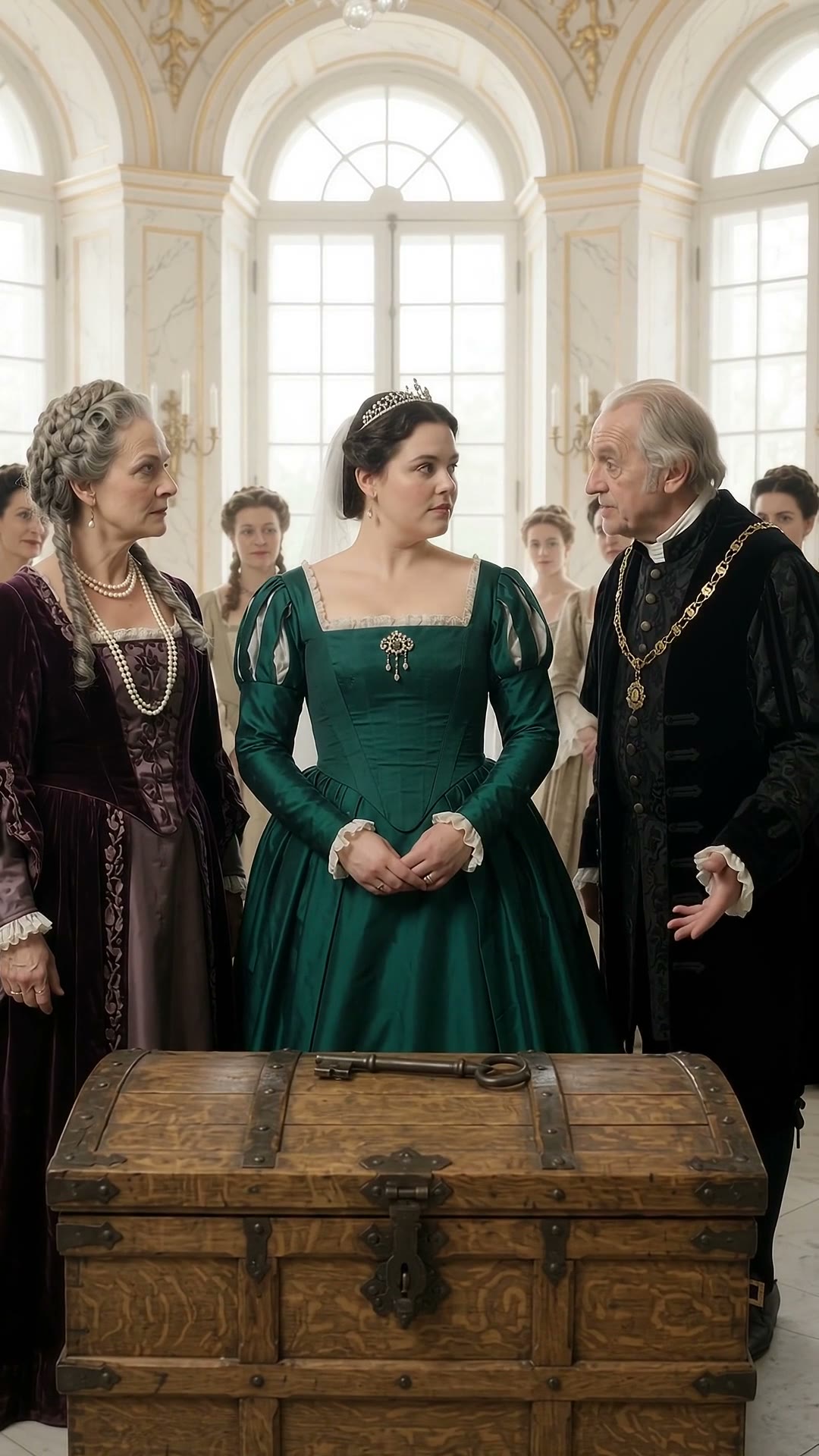
On the morning of her wedding, Lettie Fairburn stood in the white marble hall of Ravensworth Palace in an emerald silk gown, and the whole court watched her. The Duchess, Mildred of Ravensworth, had not looked at her once during the vows. But after the ceremony, the Duchess had an old oak chest with brass corners carried in and set down before the new bride. Then she placed a heavy iron key on its lid, hard.
"Only a true bride opens this chest. Go on."
The ladies leaned in behind their fans. Everyone knew the family tradition: every Ravensworth bride opens the chest on her wedding day, and a bride who cannot is no true bride at all. Lettie fitted the key into the lock and turned it with both hands. It would not move. She tried again, harder, until her knuckles went white. Somewhere behind her a laugh started and spread down the row of ladies like a ripple.
Lettie did not blush, and she did not beg for another try. She drew the key out slowly, laid it on the lid, and looked the Duchess in the eye.
"My lady, has this key ever opened it?"
Before the Duchess could answer, old Chamberlain Edmund stepped forward and bent over the key. His white eyebrows rose. "That's my wine cellar key, Your Grace. Missing since yesterday."
The hall went silent. The Duchess's face turned the color of the marble floor, and every head in the room turned slowly toward her.
To understand why that small key mattered so much, you have to go back eleven years, to the death of the old Duke of Ravensworth. Lettie was a child in a village then, and no one in the family knew her name. Years later she came to the palace as a laundress. For six years she worked in the palace yards, her arms red to the elbow and her hair always smelling of soap. She knew the linen, the scullery gossip and the back stairs, but she never expected to stand as a bride in that hall.
Ambrose, the Duke's only son, noticed her when he cut through the yards on his way to the stables. He did not care that her hands were raw. He asked her to walk with him along the river wall, and by spring they were in love. When he asked her to marry him, the Duchess made her opposition plain to everyone who would listen, but Ambrose would not be moved.
What the court did not know was the secret locked inside the chest. When the old Duke died, he left a will, and he kept it with the family papers in that oak chest. The true key had hung from the Duchess's own belt chain ever since the funeral. No Ravensworth bride had opened that chest in eleven years, and the Duchess made sure of it. She told the household the chest held nothing but old estate accounts, and she kept every servant away from it.
Inside was the Duke's last testament. It gave the house, the household keys and the family jewels to his son's wife on her wedding day, and it left the Duchess only a small dower cottage in the north. On the day Ambrose married, that meant the whole estate would pass to Lettie the moment the lid was lifted and the will was read.
The Duchess understood this as well as anyone, and her plan was simple and cruel. The day before the wedding she quietly took Edmund's cellar key from the chamberlain's ring. On the morning of the ceremony she carried it into the hall and set it on the lid of the chest. She knew a wrong key would never turn, and she knew the whole court would see the failure and call the bride a fraud. If Lettie was shamed as a false bride, the will could stay sealed, and the Duchess would keep her house.
She had not counted on Edmund. He had noticed the gap on his key ring the day before and had gone straight to the treasury. The treasury master key opens the family strongroom and every chest the old Duke owned, and it had been entrusted to Edmund for exactly such a day. He carried it inside his coat.
When Lettie's attempt failed, Edmund reached in and brought out his ring. He knelt before the chest, turned the master key in the lock, and the heavy lid rose with a groan that silenced the whole hall. The family solicitor read the Duke's will aloud, word by word. The house, the keys and the jewels went to Lettie Fairburn, Ambrose's wife.
The Duchess's protests fell flat. The court had seen her set that cellar key on the lid, and the chamberlain had made sure they knew where it came from. By evening she had surrendered every key of the house, including the chain she had worn at her belt for eleven years. She was packed off to the dower cottage in the north and barred from court for a year.
Lettie became mistress of Ravensworth before the candles were lit, but she did not forget the laundry yards. She asked Edmund to teach her the house accounts, and she invited the palace laundresses to dine at her table on the first Sunday of every month. Some of them had worked beside her for years without anyone asking their names.
That evening, Ambrose found her standing alone in the hall where the chest had been. He took her hand. "You asked the right question," he said.
Lettie smiled. "I only asked what everyone was thinking."