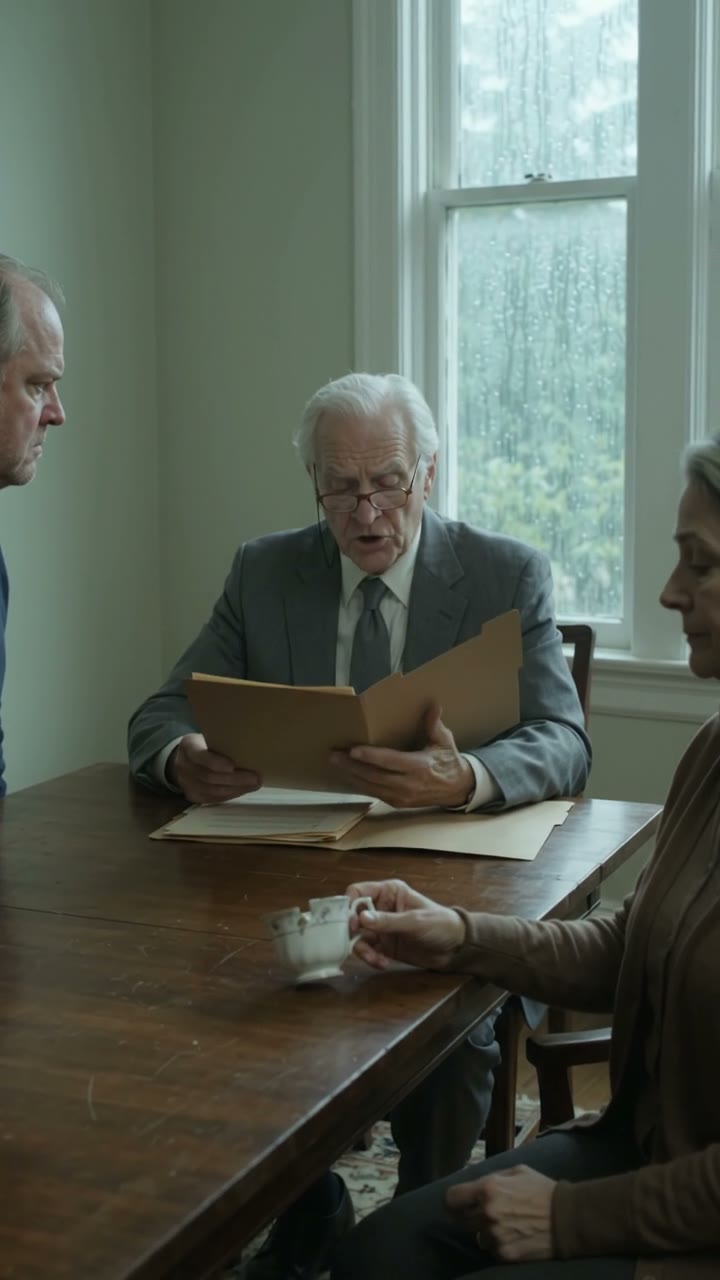
"Mother's gone. You're done here. Pack your teacups and leave."
Two of Vivian's china teacups hit the dining room floor and broke clean in half. My old brown suitcase went off the end of the table after them and burst open on the rug.
Douglas Ashford had cleared my side of the table with one arm, while the family lawyer was still taking his folder out of his briefcase.
I am fifty-one years old. For three years I lived in the small back bedroom of Vivian Ashford's house in Savannah. I was her companion. That was the word she chose. I cooked her grits, drove her to chemotherapy, and every afternoon at four I made her tea in those cups.
She died in September, at sixty-eight. Her sons came for the funeral and stayed for the will.
Douglas is the older one, a banker in Atlanta. Keith is four years younger and sells boats in Florida. In three years they visited twice. Both times Douglas looked in the silver drawer before he kissed his mother.
I had packed my suitcase the night before. I knew they would want me gone. I set it on the table only to wrap the cups. Vivian had given them to me in the spring and told me to take them when it was time.
Douglas saw his mother's china in a stranger's suitcase and decided I was a thief.
Keith looked at the floor. Theodore Marsh, who had been Vivian's lawyer since before either son was born, did not look up from his papers.
I picked up the broken handle of one cup and held it in my palm. "I'll go after the reading. She asked me to stay."
Douglas laughed. "Why on earth would she want the help at her will?"
Mr. Marsh put on his reading glasses, opened the folder and began without even glancing at him.
"First clause. To my daughter Lorraine, whom I gave up at seventeen."
For a moment nobody in the room breathed. Then Douglas said, "That's not funny, Theo."
"It isn't meant to be," Mr. Marsh said. "Your mother and I drew this up in March. She was very clear."
Keith sat down slowly. He looked at my hands, my nose, the gray streak over my left eye, as if he were seeing them for the first time. Vivian had the same streak. She used to dye hers.
So I told them, because Vivian never could.
In 1975 she was a junior in high school in Macon, and she was pregnant by a boy who had already left for the army. Her father drove her to a home for unwed mothers in Tennessee. She held me for one hour. Then a nurse took me out of the room, and she never saw me again.
A mail carrier and a schoolteacher named Hargrove adopted me. They were good people. I had a good life. I worked thirty years at the county library and never went looking for anybody.
Four years ago my niece gave me a DNA kit for Christmas, as a joke. A match came back from a woman in Savannah. I wrote her a short letter. She wrote back within a week, eleven pages, in purple ink.
We met at a diner off the interstate. She cried before I even sat down. She asked me for one thing: to keep it between us. She was ashamed of her father's house, of herself at seventeen, and most of all of what her boys would think.
When she got sick, she called me. "Come stay with me," she said. "We'll tell them you're my companion. Let me have you for whatever time I've got."
I retired early and came.
Mr. Marsh read the rest. The house and everything in it went to me. The investment accounts were split three ways, equally, among her three children. There was a letter for each of us.
"We'll contest it," Douglas said.
"She expected that," Mr. Marsh said, and turned a page. "The DNA results are attached, along with the records from the home in Tennessee. And anyone who contests this will forfeits his share."
Douglas sat down hard.
Then he looked at the broken china on the floor, and something went out of his face. Those cups had been his grandmother's. Vivian drank from them as a girl. He had just smashed the last gift his mother ever gave.
Keith got down on his knees and started picking up the pieces. "She used to hum when she drank from these," he said quietly. "I never knew who she was humming for."
Keith stayed a week. He helped me glue the cups back together at the kitchen table, piece by piece. We found out we both take our coffee black and both hate okra. He calls me Sis now, mostly to be funny, and then it stopped being funny.
Douglas left that afternoon without a word. In March a letter came from Atlanta. Two lines. He was sorry, and could he come for Easter.
He came. He stood at the door with his hat in his hands and asked if he could see his mother's room. I made tea at four in the glued cups. He held his so carefully, like it might break again.
We don't talk about the will. We talk about her.
Would you have let Douglas back into that house?