"This table is for family. The hired help eats in the kitchen."
My little gift box hit the dock boards and bounced into the lake grass. My place card went after it, fluttering down like a moth.
Diane Kessler, the mother of the bride, had swept both off the family table with the back of her hand, just as the guests were sitting down to dinner.
I'm twenty-nine. For four years I've been the live-in caregiver for her mother, Evelyn Kessler. I cook her oatmeal, count her pills, and read her the obituaries every morning, because she likes to see who she has outlived.
The wedding was at Evelyn's lake house, the one her husband built in 1968. Evelyn wanted to come more than anything. Two days before, Diane told everyone she was too frail to travel and told me to come alone and "represent her."
Evelyn insisted I sit at the family table. She made my place card herself, in her shaky hand, and made me promise to give the bride her gift. Inside the box was a little book I had put together: every recipe Evelyn had taught me in four years, copied out for her granddaughter Lily.
Diane didn't know any of that. She saw a caregiver in a navy dress from the outlet mall, sitting between the bride's uncle and the groom's grandmother.
Nobody said a word. Lily was across the lawn having photos taken and didn't see a thing.
I picked up my purse. "I'll go. I only came because she asked me to."
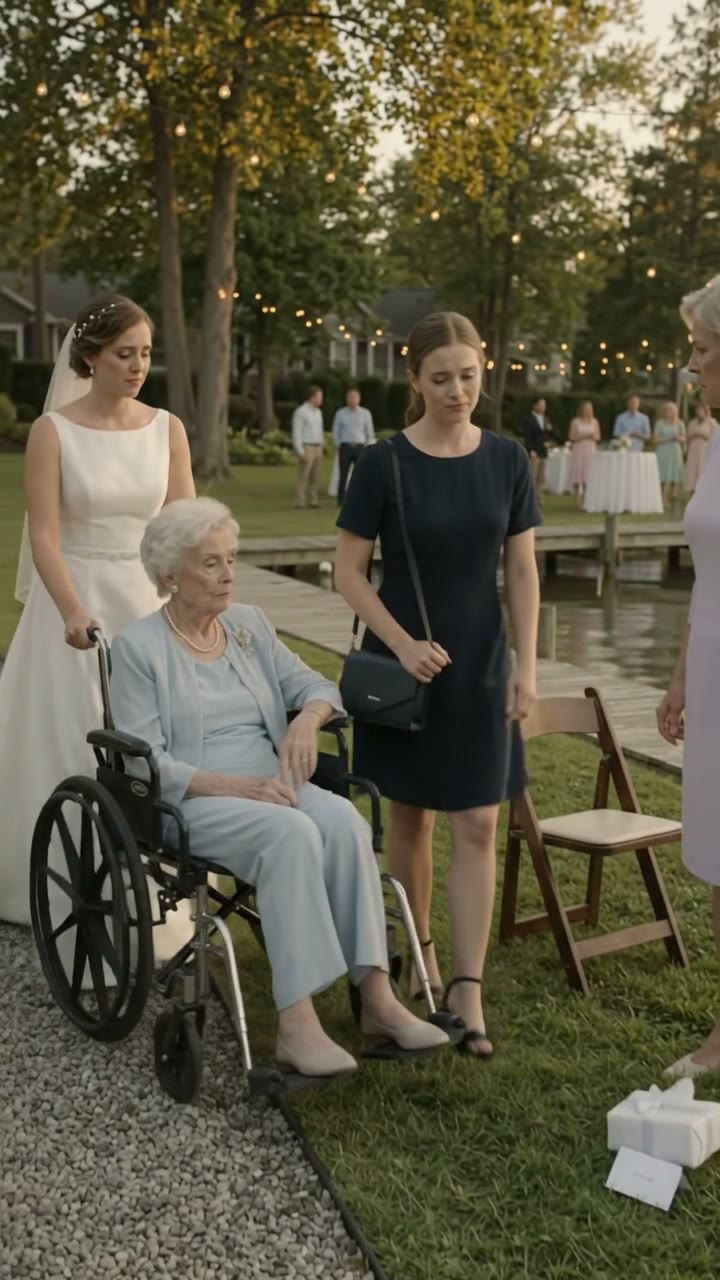
Then the gravel path behind the tent crunched. Lily was coming down toward the dock, still in her wedding dress, her train looped over one arm, pushing a wheelchair.
Evelyn sat in it, in her good blue suit, with her pearls on. She looked at the box in the grass, then up at her daughter.
"Pick that card up, Diane. You just threw out my granddaughter."
Diane went white, then red. "Mother, you're confused. You shouldn't even be here."
"I'm eighty-seven, not confused," Evelyn said. "And I'm here because the bride called me this morning and asked why her grandma wasn't coming."
Lily set the brake on the chair. "Mom said Grandma couldn't travel. I called the house, and Grandma said nobody had even asked her. So Ben drove four hours to get her." Ben was the groom. He stood behind them with his tie loose and road dust on his shoes.
Then Evelyn told the table something I had never heard in four years of mornings.
Her eldest son, Michael, fell in love at twenty-two with a waitress from the diner in town. Evelyn's husband, Frank, said no son of his would marry a girl who poured coffee for a living. Michael married her anyway. Frank cut him off and forbade anyone in the family to speak his name.
Michael and his wife moved to Ohio. Evelyn wrote to him for years. Frank burned the replies before she ever saw them.
Michael died on an icy road when his little girl was five. Frank refused to go to the funeral. Evelyn wasn't even told.
She found out only after Frank died, when she cleaned out his desk and found a bundle of letters he had never thrown away. In one of them was a school photo of a little girl with Michael's ears.
I stopped breathing. My father's name was Michael. I barely remembered him: a tall man who sang in the car. After he died, my mother went back to her maiden name, Brooks, and gave it to me too. She said his family had never wanted us, and she never said another word about them. She died when I was nineteen.
"I hired a man to find you," Evelyn said to me. "He found you working for a home-care agency in Columbus. So I called the agency and asked for you by name."
"Why didn't you just tell me?" I whispered.
"Because I wanted to know you before you knew me," she said. "I wanted to see if you'd be kind to an old woman who had nothing to give you. You were kind every single day."
Then she turned to her daughter. Diane had known about the letters. She had found them first, a year before, and said nothing. She had been pushing her mother to sign over power of attorney and to sell the lake house before winter.
"Last spring I changed my will," Evelyn said. "Michael's share goes to his daughter. This house was always meant to be his. Now it belongs to Hannah."
Diane looked around at the tent, the string lights, the dock. Her daughter's wedding was taking place on my land, and she had just sent me to the kitchen.
She bent down slowly and picked up the card. Then she got the box out of the grass, wiped the lake water off the paper with her napkin, and handed it to Lily without a word.
Lily opened it right there. When she saw the first page, her grandmother's peach cobbler, she started to cry and ruined her makeup. Then she pulled my chair back up to the table and sat me next to her.
"So you're my cousin," she said. "You're dancing with me after Ben."
Diane didn't apologize that night. She did it at Christmas, at the lake house, with a small photo of Michael at twelve that she had kept in her wallet for forty years.
"I was jealous of him my whole life," she said, "and then I missed him my whole life. I took it out on you."
I still make Evelyn's oatmeal every morning. Now she reads the obituaries to me.
Should I have forgiven my aunt that Christmas, or was it too soon?