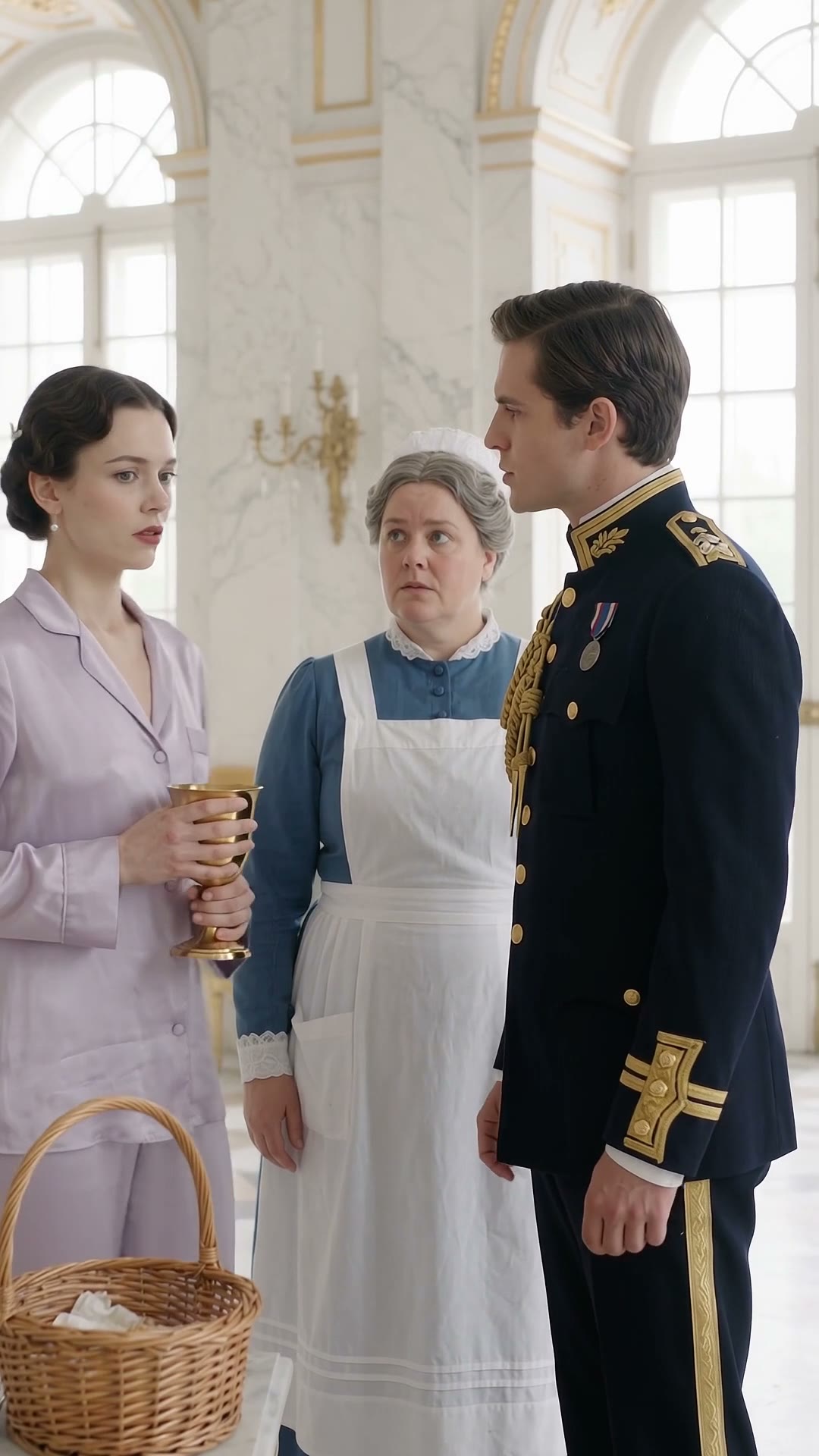
That morning Lady Verena Marsh swept into the royal nursery hall with half the court behind her. She wore lavender silk and carried herself like a woman who expected applause. She went straight to the worn sewing basket of the nursemaid, Martha Bell, reached inside, and lifted out a heavy gold cup. It was the late Queen's christening cup, the most precious thing in the nursery.
"Your mother's gold cup, Highness. In the nursemaid's basket!"
The ladies gasped. Someone whispered "thief," and two footmen moved toward the door. Martha's round face went white, but her hands did not shake. She stood beside the table, opened her empty hands, and looked straight at the prince.
"Search my room too, Highness. I have nothing to hide."
Lady Verena lifted her chin and smiled at the court as if the matter were already settled. Prince Lucien had said nothing at all. He had only watched. Now he stepped forward, glanced at the cup, and then at the lady holding it.
"Who told you it was missing, my lady? I told no one."
The silence hit the room like a slammed door. Lady Verena opened her mouth, and nothing came out. The color drained from her face, and her fingers tightened around the cup as if she had only now understood what she was holding. The ladies behind her slowly stepped away, because the prince was right. No one in the palace had been told the cup was gone.
Martha did not move. She kept her hands open and her eyes on the prince, with the calm of a woman who had nothing to fear from the truth. The footmen, who had been ready to drag her out, looked uncertainly at one another. Two young nursery maids began to cry quietly, because they loved Martha and had seen her sit up through the night with sick children more times than anyone could count.
Martha had worked in the royal nursery for twenty-two years. She had rocked Prince Lucien to sleep when he was a baby, and now she cared for his little sister, singing her the same old songs every evening. She was a plump, rosy-faced woman of about forty-five, with grey-streaked hair in a neat bun, a plain blue dress and a white apron. The children adored her, and the court had never once given her a reason to doubt her honesty.
The answer to the prince's question began before dawn. A goldsmith in the lower town, Master Tobias Reed, had been approached by a veiled lady who wanted to sell a gold cup bearing the late Queen's crest. The price she asked was far below the cup's worth, and she begged him not to write her name in his book. He refused her. Master Reed knew that crest well, since his shop had mended the palace plate for years, and he did not want to be blamed for keeping a stolen treasure out of sight. At first light he sent a note to the palace, addressed to Prince Lucien.
The prince went to the nursery shelf himself and found the cup gone. He told no one. He had known that a thief who believes she is safe will keep reaching for more, and that a hasty accusation could let the real hand behind the theft slip away with the cup. So he waited. He wanted to see who would come forward, and who would be foolish enough to step into the light.
The veiled lady was Lady Verena. For months she had been buried in gambling debts, and creditors were closing in on her family. She had taken the cup from the nursery shelf and tried to sell it, but once the goldsmith refused and the prince began to ask questions, she grew frightened. Her plan was to make the cup vanish into someone else's hands. She slipped it into the basket of the nursemaid, the one servant whose quiet ways no one would ever question, and then she staged the discovery in front of the court.
Her trap failed the moment the prince opened his mouth. When he held out his hand for the cup, he asked his one more question: who had given her the cup to hide? Lady Verena had no answer she could give him in that hall. She only stood there, pale and silent, while every eye turned from the nursemaid to the lady in lavender.
That afternoon Master Reed came to the palace in person. He identified the lady in lavender as the veiled woman who had tried to sell him the Queen's cup. The truth could no longer be buried under her family's name. Lady Verena was dismissed from the royal household that same day, and her family lost its place at court. Her creditors, who had been waiting for her for months, were left to collect from a house that no longer protected her.
The prince then made his own decision, and it was just as public as the accusation had been. Martha had been shamed in front of the entire court, and he would not let that stand. He named her head of the royal nursery, the post she had earned through twenty-two years of patience and kindness. The ladies who had stepped away from her that morning now bowed to her in the hall, and the footmen who had reached for the door stood straighter when she passed.
That evening Martha climbed the stairs to sing the little princess to sleep. Her hands were steady now. The old songs sounded as sweet as they always had, and Prince Lucien stood in the doorway listening, just as he had done as a boy, long before anyone had tried to shame the woman who raised him. Martha did not gloat, and she did not need to. She had told the truth, and in the end the truth had been enough.