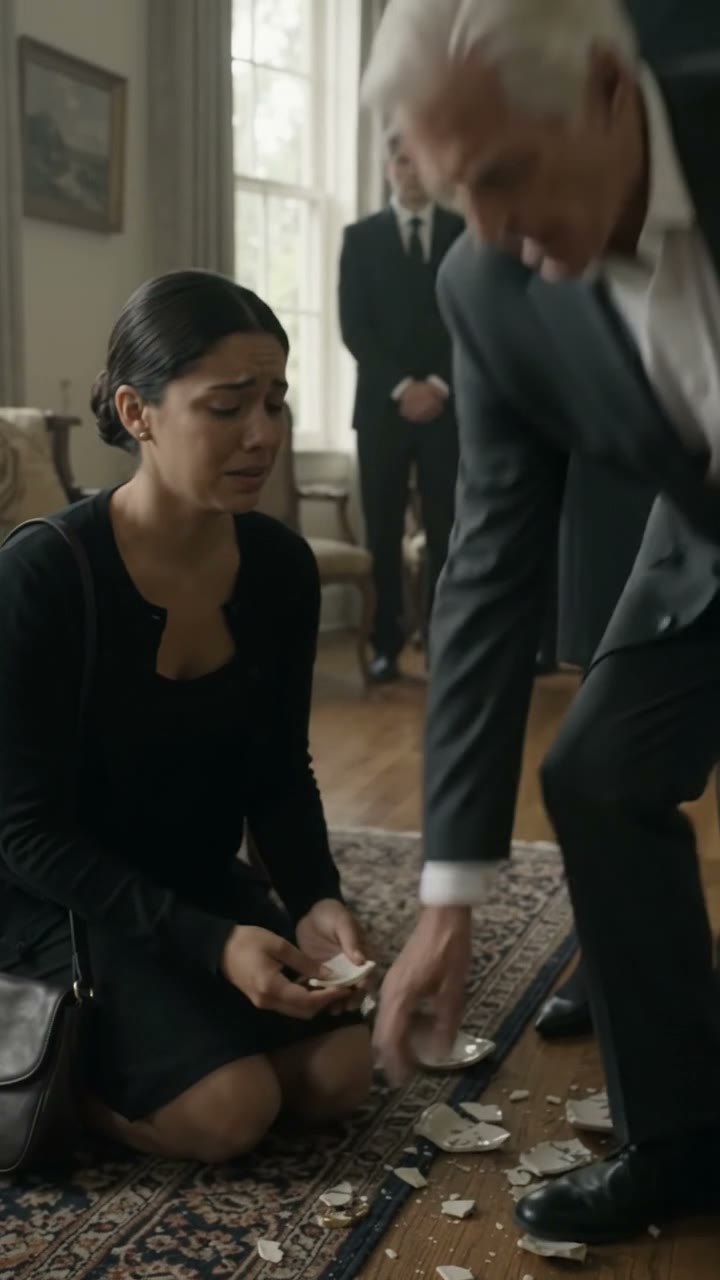
"The help doesn't bring food to this family's funeral. Get out."
My green chile casserole hit the hardwood floor, and the dish cracked in two. A framed photo slid off the buffet after it and landed face down in the beans.
Celeste Whitfield had cleared the end of the table with one sweep of her arm, in front of sixty people dressed in black.
I'm thirty-one. My mother, Marisol, kept house for Harold Whitfield for twenty years. I grew up in the two rooms over his garage. He taught me to ride a bike on his driveway. He paid for my nursing school, called it a loan, and never once asked for it back.
Mom died three years ago. Harold stood at her grave longer than anyone. Last Tuesday he had a stroke at his desk, and on Saturday we buried him.
Celeste married him eight years ago. In all that time she never said my name. I was "the housekeeper's girl," even after the housekeeper was gone.
I brought the casserole because it was Mom's recipe and Harold's favorite. I brought the photo because it was the only one I had of us: Harold and me at eight, on his dock, holding up a trout the size of a pencil.
When the dish broke, my purse slipped off my shoulder and spilled across the rug. Car keys, a lipstick, and the little velvet pouch I always carry.
Nobody moved. Celeste's two grown sons watched from the fireplace with drinks in their hands.
I knelt and started picking up the pieces. "I only came to say goodbye to him."
Gordon Pike, Harold's lawyer for forty years, bent down beside me. He picked up the plain gold ring that had rolled out of the pouch. He turned it over once, and his hand began to shake.
"Celeste, stop. Harold gave this ring to one person. His firstborn."
Celeste actually laughed. "Harold never had children, Gordon. You of all people know that."
"I know exactly what Harold had," Gordon said. He stood up slowly, still holding the ring. "That was his grandfather's wedding band. It has gone from father to eldest child for three generations. For thirty years he kept it in a drawer in his study. Then one day it was gone, and he told me it was in the right hands."
I remembered that day. My eighteenth birthday, in the garage. Harold pressed it into my palm and closed my fingers over it. "Keep this safe for me," he said. "Don't wear it yet. You'll know when." I thought it was a keepsake from a kind old man who had watched me grow up.
The room had gone so quiet I could hear the ice melting in the glasses.
Gordon turned to me, and his voice went gentle. "Rosa, I'm sorry you're hearing it like this. Harold meant to tell you himself, on his birthday next month."
Then he told all of us.
Thirty-two years ago Harold was running his father's company and fell in love with the young woman who cleaned its offices at night. His father found out and swore he would cut Harold off and ruin her family. My mother left town without a word. She was already pregnant with me.
Harold searched for nine years. When he finally found us, in a rented room in Tucson, Mom made him promise three things. He could be near me, but I would not carry his name. He would not tell me while his father was alive. And he would never give us money that looked like charity.
So he gave her a job, and he gave me a home above his cars. His father lived to ninety-four. By then Mom was sick, and she asked for more time. Then she was gone, and Harold kept waiting for the right moment. A stroke doesn't wait for anyone.
"There was a DNA test fifteen years ago, with Marisol's consent," Gordon said. "It's in my safe with his will. The house, his shares and his father's land go to his child. The will describes that child as the person who holds his grandfather's ring."
Celeste sat down on the stairs in her black dress. Her sons set their glasses on the mantel and quietly walked out to the cars.
"The prenuptial agreement stands," Gordon told her, not unkindly. "You'll have the Scottsdale condo and a generous income for life. Harold made sure of that."
She looked at me as if she had never seen me before. Maybe she hadn't.
I didn't feel like I had won anything. I felt like I had been handed my father and lost him in the same minute. I sat on the rug and turned the photo over. The glass had cracked right between the two of us. He was smiling at the camera. I was smiling at him.
Gordon gave me a sealed envelope Harold had left with the will. I read it that night in my old bedroom. Most of it was apologies. The last line said, "You were the first thing I ever did right, and the only thing I never got to say out loud."
The will was read on Monday. I asked Gordon to let Celeste stay in the house through the winter. She had lived there eight years. It was her grief too, even if she had a strange way of showing it.
Two weeks later she knocked on my door holding a baking dish. It was green chile, and it was terrible. She had found Mom's recipe card in the pantry and tried it three times.
"I was cruel to you for years," she said, "because he loved you and I couldn't understand why. Now I do."
I taught her the recipe that evening in my father's kitchen. She burned the tortillas. We ate it anyway, standing at the counter.
I wear the ring now, on a chain, because it's too big for my finger. Celeste moved to the condo in April. She still calls every Sunday to ask how the house is doing.
Should I have let her stay in that house all winter after the way she treated me?