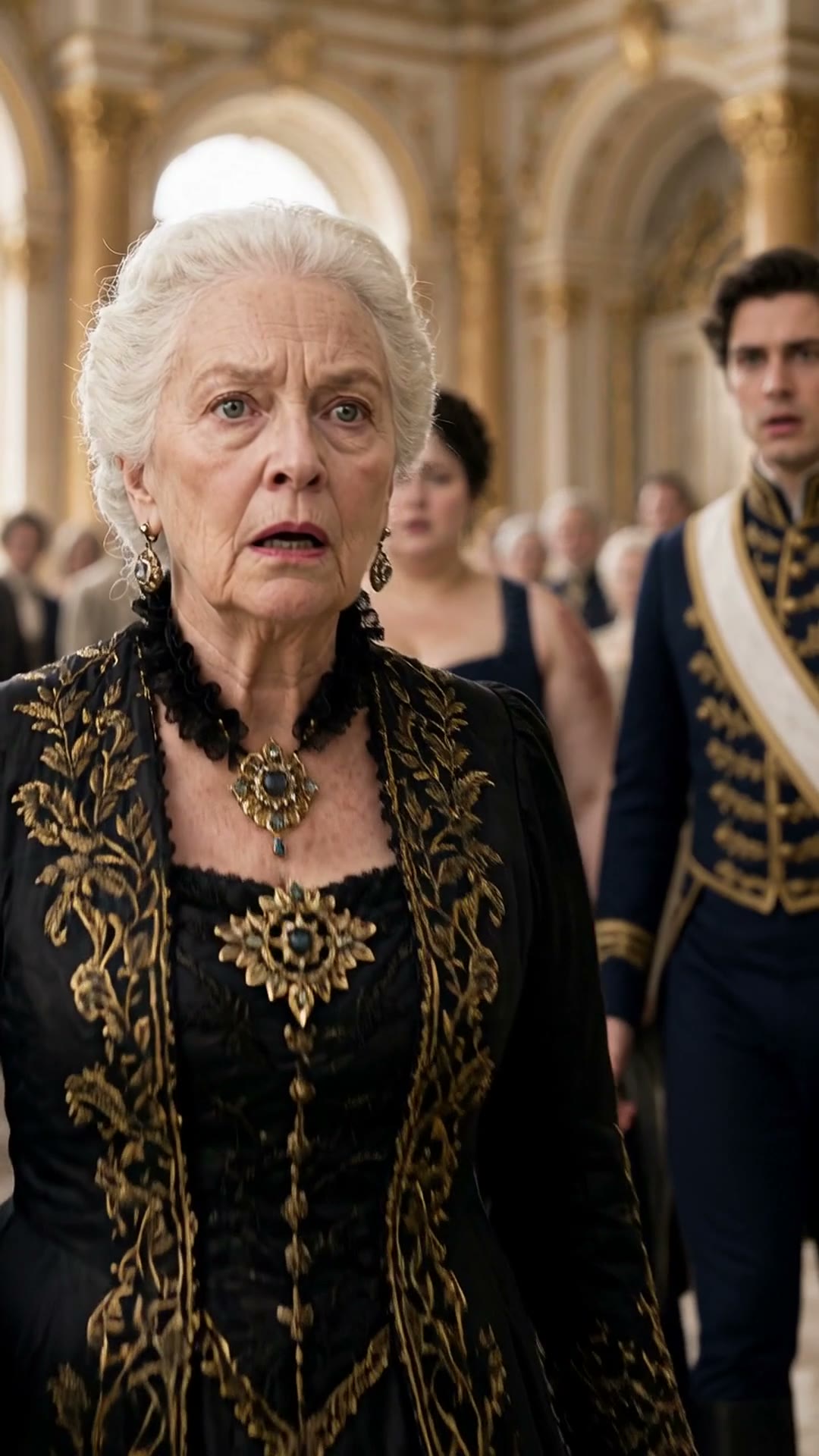
Nobody at court could remember Duchess Honora Wexley without her shawl. It was heavy grey wool, far too warm for the bright white-and-gold halls of the palace, and she wore it wrapped tight around her shoulders and left arm in every season. The young ladies joked that she slept in it. The Dowager Queen Beatrix did not joke. She simply could not stand the sight of it.
That afternoon the whole court had gathered in the great hall for Prince Frederick's twenty-sixth birthday. Honora, nearly seventy and a little slow on her feet, had found a place near the pillars, where she always stood. The Dowager saw her, and in front of everyone said with a cold smile: "Hide under that shawl, Duchess. No one wants to see you."
The ladies laughed. Honora had heard worse for twenty years and never answered. But something in her broke that day, quietly. Perhaps it was the birthday. Perhaps it was the man standing at the prince's side, Lord Ambrose Kell, the Dowager's brother, who had been toasted that morning for the hundredth time as "the man who saved our prince."
She unwound the shawl. From wrist to shoulder, her arm was covered in an old burn scar.
"I got this scar pulling your grandson out of the fire."
The prince stared at her. "It was you that night?"
Twenty years earlier, a candle had fallen in the east wing of the summer palace in the middle of the night. The fire climbed the old wooden panels in minutes. Six-year-old Frederick was asleep in the nursery at the end of the corridor. His nurse had fled. The guards were fighting the flames at the stairs.
Honora, then a widow of forty-eight and a lady of the household, had a room two doors away. She did not wait for anyone. She wrapped her own shawl over her head, ran through the smoke, found the little boy crying under his bed, wrapped him in the shawl, and carried him out through the burning doorway. A falling beam caught her arm. She did not let go of him.
She fainted on the lawn. When she woke three days later, in pain and fever, the story had already been told. Lord Ambrose Kell, the Dowager's younger brother, had arrived at the lawn first and lifted the boy from her arms, and the Dowager announced to the court that her brother had gone into the fire for the prince. Within the year Lord Ambrose had a seat on the royal council and the guardianship of the young prince.
When Honora tried to speak, the Dowager came to her bedside alone. Honora's widowed daughter had a place at court as a lady-in-waiting, and two little grandchildren. "If you love them," said the Dowager, "you will remember nothing." So Honora covered her arm and remembered nothing. For twenty years.
Now, in the great hall, Prince Frederick took a step toward her. He had never remembered a face from that night. But he remembered other things. Rough wool against his cheek that smelled of lavender. A woman's voice singing an old country song in his ear, over and over, while everything around them roared.
"Sing it," he said.
Honora's voice shook, but she sang the first line. The prince closed his eyes. Then he turned and looked at Lord Ambrose, who had gone grey, and at his grandmother, who would not meet his eyes.
Lord Ambrose confessed before the week was out. He had reached the lawn after the fire was over, taken the child from an unconscious woman, and let his sister tell the rest. He was stripped of his council seat, the guardianship pension, and the honors he had worn for twenty years, and he left court for good.
The Dowager Queen was not exiled. Frederick could not bring himself to do that to his grandmother. But she was removed from the council, and she retired to the dower house in the country, where no one came to visit and no one asked her opinion of anyone's clothes again.
At the birthday feast that night, there was an empty chair at the prince's right hand. He walked down the hall himself, offered his arm to the old Duchess, and led her to it. When she sat down, she reached for her shawl out of habit. Then she stopped, folded it, and laid it on her lap.
She never wore it again. And whenever a young lady at court stared too long at her arm, someone older would lean over and tell her, quietly, exactly how Duchess Wexley got that scar.