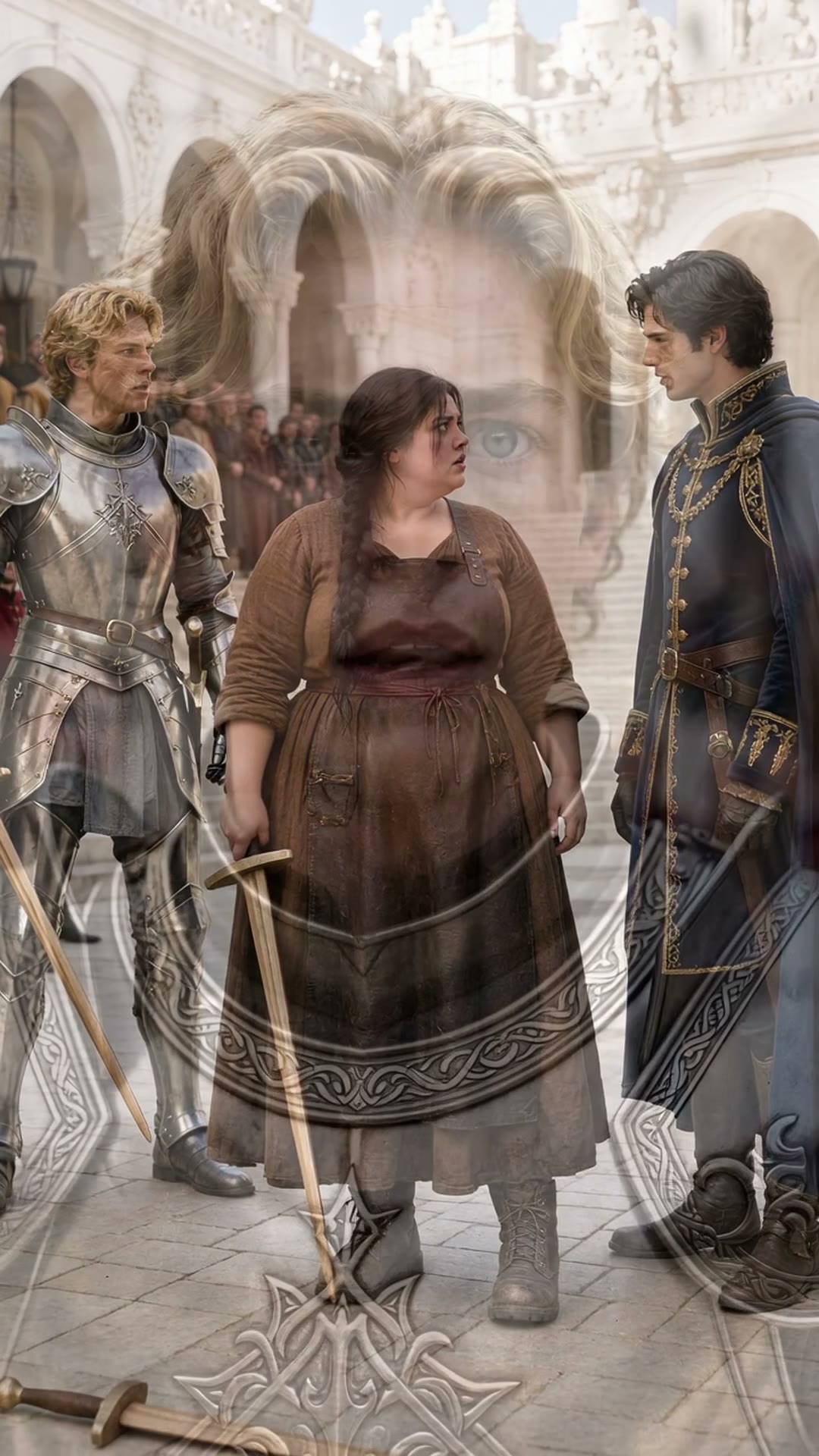
The new swords for the king's guard were finished on a Tuesday, and on Wednesday morning Bess Thorne carried them up to the palace herself. Her father's back was bad that winter, and the river forge could not afford a cart and a boy. So Bess, twenty-six, broad-shouldered and freckled, with a copper braid down her back and a leather apron over her plain dress, walked into the white-and-gold hall of the palace with a crate of steel.
The courtiers noticed her at once, and not kindly. The ladies whispered about her size. The young knights laughed at the soot on her arms. And Sir Roderick Vane, the loudest of them, drew one of her swords from the crate and declared it fit for slicing bread.
"Fight me, blacksmith girl," he said, holding a blade out to her. "If you can lift it."
Everyone laughed. Everyone expected her to blush and back away. Instead Bess wiped her hands, took the sword, and set her feet.
Sir Roderick lunged. One small turn of her wrist, a ring of steel, and his sword was out of his hand. The hall fell silent.
Prince Henry rose. He had seen that turn of the wrist before. He had seen it when he was seven years old, through the window of a carriage, on the worst night of his life.
"Only the king's guard fights like that," he said. "Who trained you?"
Bess was silent for a long time. Then she said: "My father. His name is Walter Thorne. But it wasn't always."
Fifteen years earlier, the royal carriage had been ambushed on the forest road to the summer palace. The King was away at war; inside the carriage were the Queen and her small son. The captain of the escort was Walter Ashby, Captain of the King's Guard, the finest swordsman in the kingdom. He fought off four men at the carriage door, pulled the boy out, and carried him through the forest on foot to the nearest village. The Queen was saved by the rear guard.
But by morning a different story had reached the palace. Lord Vane, who commanded the road garrison that night, reported that Captain Ashby had abandoned his post and fled when the attack began, and that it was Lord Vane's own men who had rescued the prince. A seven-year-old boy in shock could not say otherwise. Walter was stripped of his rank and declared a deserter. He knew no one would believe a disgraced captain against a lord. So he took his little daughter, changed his name, and became a blacksmith on the river.
He never stopped being a soldier. Every evening, behind the forge, he taught Bess the forms of the king's guard, with a stick at first and later with the swords he made. "So that one day," he told her, "somebody will see it and remember." And every evening he made her promise never to tell anyone who had taught her.
Prince Henry remembered. Not the face, but the voice: a man telling him to hold on tight and not look back. That afternoon he rode to the river forge himself. Walter Thorne opened the door, saw the prince, and went down on one knee. Henry lifted him up before he could finish.
The truth came quickly after that. The garrison's old pay ledgers, kept in the treasury archive, showed that on the night of the ambush the road guard had been sent away on Lord Vane's written order, and that a month later Lord Vane had received a large payment from a foreign merchant who was later hanged for spying. Lord Vane was dead by then. His son Sir Roderick was not.
Sir Roderick had not known his father's secret. But he had known how to mock a woman for her size in front of the whole court, and Prince Henry did not forget that either. The Vane family lost the command of the road garrison and the lands that came with it. Sir Roderick was stripped of his spurs and sent to serve as an ordinary soldier on the northern border, where he would learn what the guard's work really was.
Walter Ashby's name was read out in the great hall, restored to the rolls of the King's Guard with full honor and fifteen years of back pay. He was too old to command again, but he was given the training yard, and the young guardsmen soon learned to fear his stick.
And Bess? Prince Henry made her Royal Armorer, the first woman ever to hold the title. Every sword the king's guard carries now comes from her forge. And on the last day of every month, the whole court can watch her in the training yard, in her leather apron, disarming young knights one after another, while her father stands by the fence and smiles.