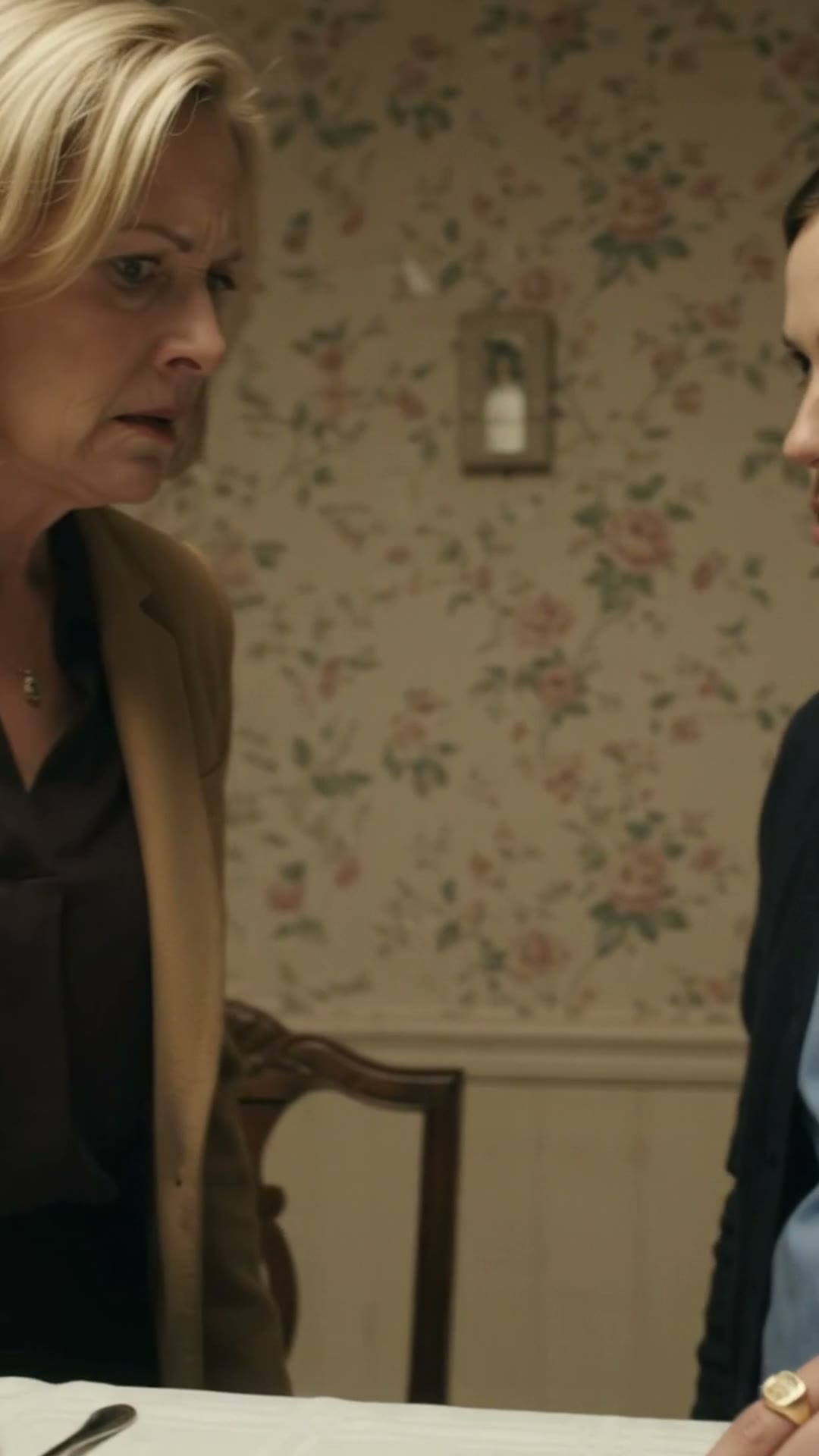
"You wipe bedpans for a living — you'll never raise my grandchild!"
My mother-in-law Diane screamed it across her own Sunday dinner table in Fort Wayne, Indiana, in front of her sister. Then she swept her arm down the table and sent the good china plates, the garlic bread basket and a big glass bowl of baked ziti crashing onto the hardwood floor. Not one noodle touched me. She wanted the noise, not the mess on my clothes.
I'm a nursing aide at a hospice on the south side. I'm also four months pregnant with her first grandchild. My husband Ryan and I got married at the courthouse in June because Diane said she would never "pay for a trailer-park wedding." Since then every Sunday has been a list of everything wrong with me — my job, my accent, my mother, my hands.
That night Ryan had just told everyone about the baby. Diane didn't congratulate us. She stood up and said my child would be raised by her, not by "a woman who changes diapers on old men."
I didn't cry. I reached into my cardigan pocket, took out a heavy old gold signet ring, and set it down on the white tablecloth right in front of her plate.
"Before you decide that, look at this ring. Look closely."
Diane laughed. Then her older sister Carol came out of the kitchen with the pie, stopped, and the pie dish nearly slipped out of her hands.
"That's Daddy's ring. Where did she get Daddy's ring?"
Diane and Carol's father is Harold Lindqvist. He was a tool-and-die man who built a small machine shop out of nothing, and Diane hadn't spoken to him in twenty-six years. The family story, the one Ryan grew up with, was that Harold was a cold, stingy old man who disowned his daughter. Ryan had never met his grandfather. He thought he might already be dead.
He wasn't. He was in room 14 at my hospice.
He came to us in August with lung failure and nobody listed as family. I was his aide five nights a week. I shaved him, read him the box scores, and sat with him when he couldn't breathe and was too proud to say he was scared. One night he asked me about my husband, and when I showed him a picture of Ryan on my phone, Harold stared at it for a long time and then started crying. He knew that chin. He knew that name.
He told me the real story. Diane had cut him off when he refused to sign the shop over to her husband at the time, a man who had already burned through her savings. Harold had sent birthday presents to Ryan every year until Ryan was ten. They all came back unopened. He had no idea his grandson thought he was a monster.
Two weeks before that Sunday, Harold took the ring off his finger, the one his own father had worn, and pressed it into my palm. "When she's cruel to you, and she will be," he said, "put this in front of her. She'll know what it means. Tell her I'm still waiting."
So that's what I told them, at that table, with the ziti all over the floor. Harold was alive. He had maybe a few weeks. He wanted to meet his grandson before he died, and he wanted to meet his daughter, if she would come.
Ryan didn't say anything. He picked up the ring and turned it over and saw the initials inside, H.L., the same initials engraved on the pocketknife his mother kept in her jewelry box and never explained. Then he stood up, took my hand, and said, "We're going to see him tonight."
Diane said nobody was going anywhere. Carol put the pie down on the counter and picked up her car keys.
The three of us sat at Harold's bedside until after midnight. Ryan held his grandfather's hand and Harold kept calling him "the boy," over and over, like he was ten again. Carol cried and said she was sorry she believed her sister for so long. Diane didn't come.
She came four days later. I was on shift. She stood in the doorway of room 14 in her good camel coat, and her father said, "Hello, Dee," and she broke. I closed the door and left them alone. I don't know everything they said. I know she stayed until morning.
Harold died nine days after that, holding Ryan's hand, with Diane on the other side of the bed. There was no big inheritance fight, no money twist. His shop had been sold years ago to pay for his care. What he left was simpler: he asked that the ring go to his first great-grandchild.
Diane drove me home from the funeral. In the parking lot she said, quietly, "You took care of my father when I wouldn't." It isn't an apology, not the whole one. But the next Sunday there was a place set for me at her table, and she asked me how my shift went, and she listened to the answer.
Our son was born in the spring. His name is Harold. The ring is in a little box on his dresser, waiting for him to grow into it.
Would you have let Diane anywhere near your baby after that dinner, or does a deathbed change everything?