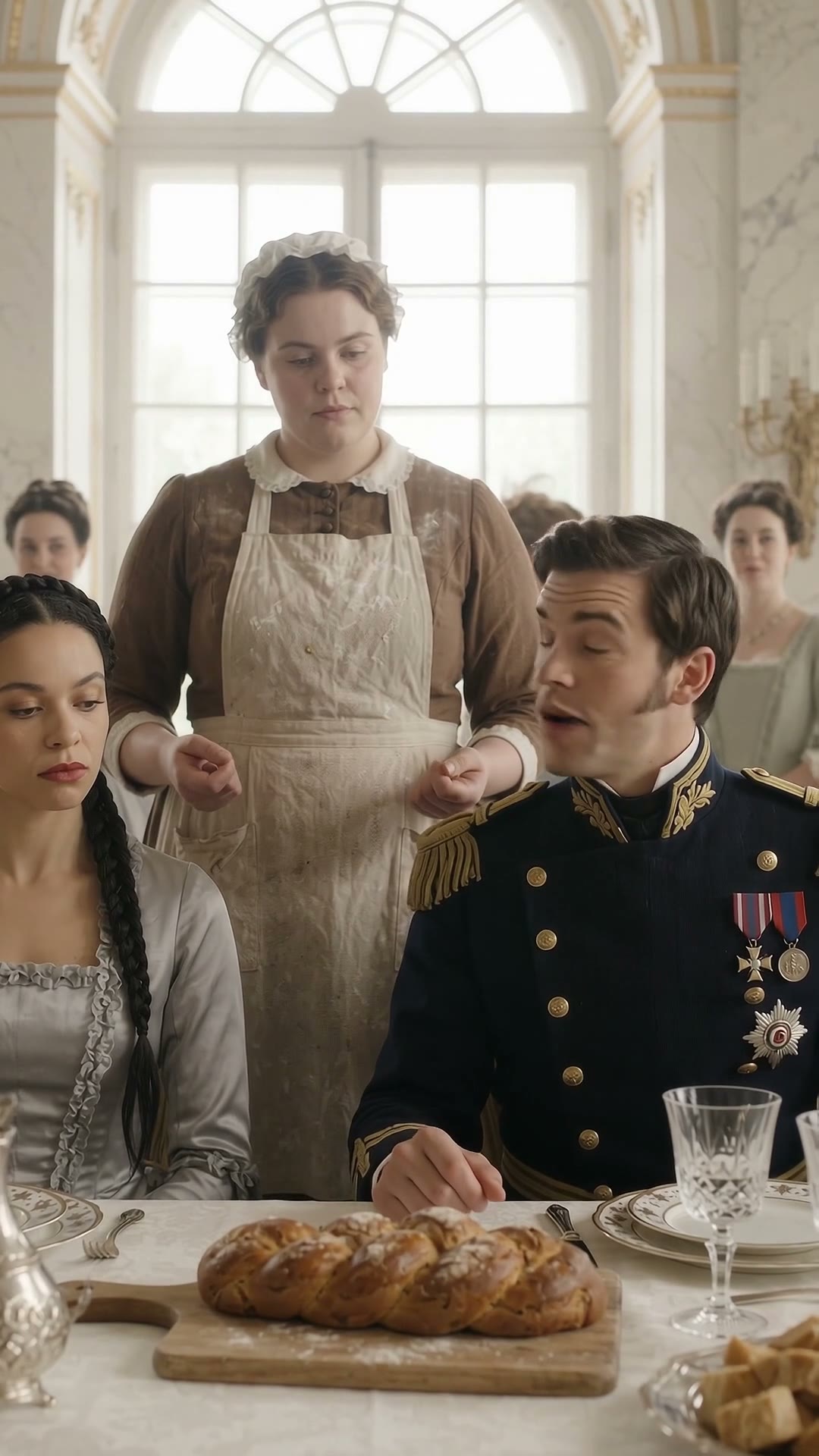
Let His Highness taste it first, my lady.
The kitchen maid said it without raising her voice, and somehow the whole banquet hall heard her. Peg Alder had carried a round braided loaf into the dining hall on a wooden board, and the court had been watching her every step. Countess Imelda Strand sat at the prince's right hand, in the seat every lady at court wanted. When Peg reached the table, the Countess pushed the board back with the tip of her closed fan.
"Peasant bread at a royal table? Take it away."
A few ladies giggled, and Peg's cheeks went red. But she did not leave, and she did not apologize. She set the board down firmly on the white tablecloth, right in front of the prince.
"Let His Highness taste it first, my lady."
The Countess rolled her eyes. Prince Lucien tore off a small piece of crust and tasted it, and then he stopped chewing. For a long moment he only stared at the loaf. Then he lifted his eyes to the girl in the floury apron, and his voice went soft.
"Honey and rye. You left this at our gate all winter."
Nobody in the hall moved. Everyone remembered the siege winter, and everyone knew the soldiers at the north gate had somehow survived it. The prince pushed back his chair and stood up, and Countess Imelda went as pale as the tablecloth. Her fan slipped from her fingers.
Peg was the plumpest girl in the palace kitchens, and the court never let her forget it. She kneaded the bread before dawn every day, in a corner nobody visited, and most of the ladies never bothered to learn her name. Before she ever wore a kitchen apron, though, Peg was a baker's daughter in the town below the walls, and she had a secret she had never told.
That was the winter the north gate garrison, under the young prince, was cut off from supplies. The carts stopped coming. The granaries ran low, and the soldiers stood watch in the snow with empty stomachs. Every night, someone left warm loaves of honey-and-rye bread at the postern door. Nobody saw who brought them. The bread was Peg's. She baked it from her family's last flour, rising before dawn, and left the loaves at the gate without a name, because she wanted the soldiers to eat and did not want anyone to owe her anything.
When the siege ended, the palace needed kitchen hands, and Peg took the work. She never mentioned the gate to anyone.
Imelda had grown up believing that a seat beside the prince was owed to her by birth and polish. She had learned to smile at the right people and to look away from the kitchen doors. When her father's story was praised in the great hall, she accepted it as easily as she accepted her own reflection in a silver mirror, and she never once asked who had really baked the bread.
Count Strand, the royal quartermaster and Imelda's father, had been responsible for the garrison's supplies that winter. When the siege was over, he claimed that his own house had fed the soldiers at the north gate. He was believed. He received a royal reward, and his daughter was given the seat beside the prince. The Strands became the family everyone admired, and no one asked where the bread had come from.
The soldiers at the north gate spoke about that bread for years. One sergeant, who had lost the feeling in two fingers to the frost, told the young prince that he would never taste anything so good again, and he was right. Lucien remembered those words long after the siege ended, and he remembered that the loaves had arrived every night without fail, even when the gate itself seemed forgotten by the world.
Lucien never forgot the taste. For months he had been quietly sending for bread from every oven in the city, searching for the honey and rye he remembered. That was why he asked for a loaf from the palace kitchen that afternoon, and why he had not yet said a word about it to anyone. The Countess had no idea he was waiting for her to speak.
One bite was enough. The prince did not need witnesses or letters. He knew the bread that had kept his men alive, and he knew it had not come from the Strand house.
Peg stood quietly by the table with flour still on her apron. She did not smile, and she did not gloat. She only folded her hands and waited, as she had waited all winter for word from the north gate, and when the prince finally turned to her and spoke her name, she answered him as calmly as she had answered the Countess.
Once he had made his judgment, he laid the truth before the whole court. The reward the Strands had received was taken back. Count Strand lost his post as royal quartermaster, and the family was sent away from court. Imelda lost her seat beside the prince, along with every place she had once enjoyed among the ladies who had laughed at the kitchen maid.
Peg was named mistress of the royal bakehouse. The loaf she had carried into the hall on a wooden board became the bread served at the prince's table, and he now comes down to the bakehouse before dawn, when the ovens are hot and the flour is still on everyone's hands. He thanks her for the bread that kept his soldiers alive, and he always asks for the honey and rye. Nobody in that bakehouse laughs at her anymore. Her bread speaks for itself, and the girl who once sat in the back corner of the kitchen now stands at the center of the royal kitchen with her head high.