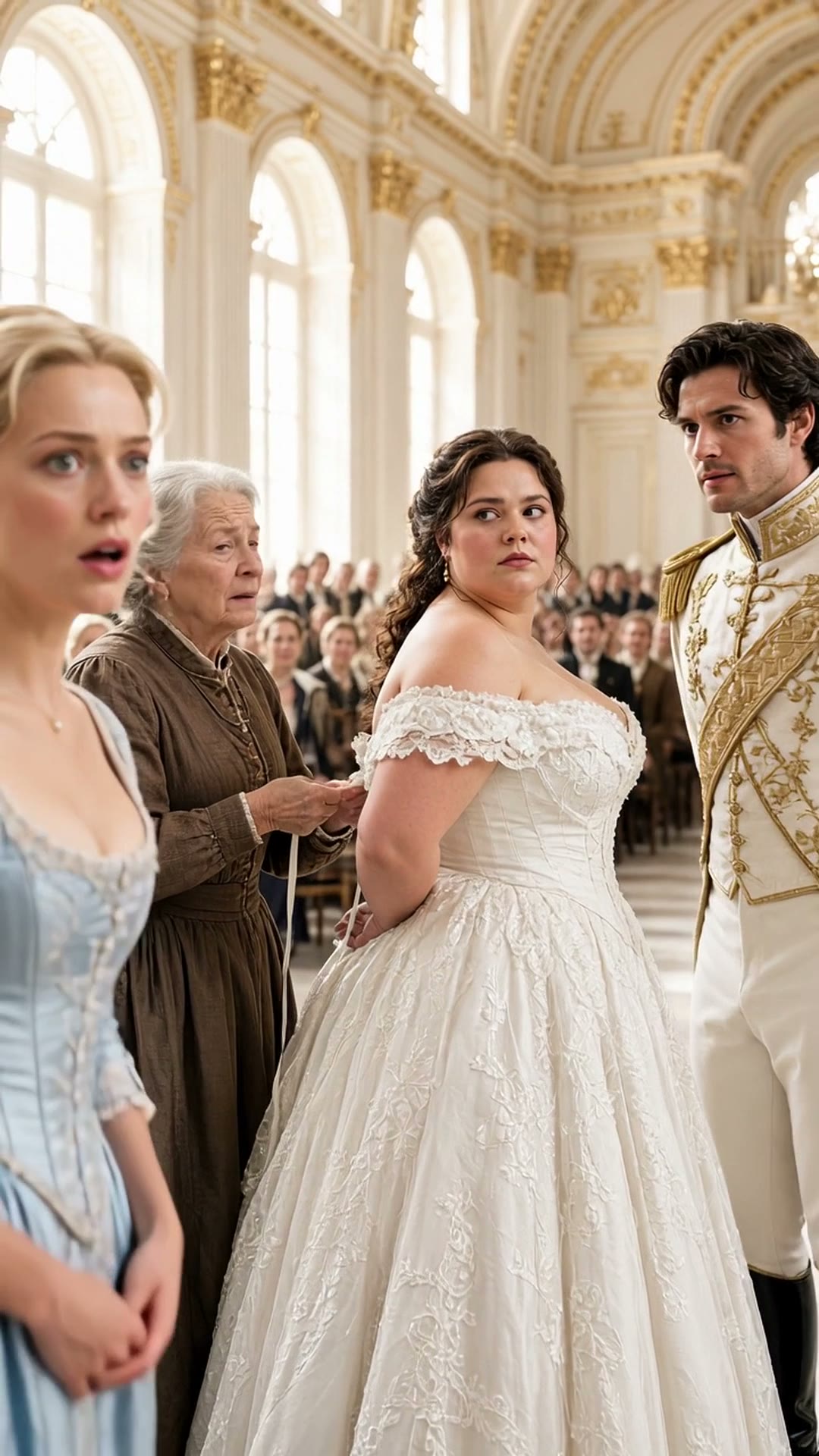
The morning of the royal wedding was so bright that the white marble of the great hall seemed to shine from within. Gold leaf ran up every pillar, sunlight poured through the tall arched windows, and the court stood in two long rows of silk and jewels, waiting for the bride.
Lady Beatrix Hale had never belonged in rooms like this, and the people in them made sure she knew it. She was the daughter of a modest northern baron, with a round, kind face, strong shoulders and a full figure that no dressmaker in the capital had ever been asked to flatter. Prince Frederick had met her two summers earlier at a harvest fair, where she was arguing a grain merchant out of cheating a widow, and winning. He laughed, followed her through the market, and never quite stopped following her.
The court had expected him to marry Lady Vivienne Ashcombe, his slender, golden-haired cousin, raised from the cradle to wear a crown. Her mother had spoken of the match for ten years as if it were already signed. When Frederick announced his betrothal to "the baron's girl," Vivienne smiled, kissed Beatrix on both cheeks, and offered to help with the gown. Beatrix, who had no sisters and no friends at court, was grateful.
On the wedding morning the maids laced her into ivory silk, the bodice closed at the back with long silk cords. Then they were sent down for the veil and the flowers, and for a quarter of an hour the dressing room stood empty while Beatrix sat by the window trying to steady her breathing. She remembered afterwards only a trace of orange-blossom perfume in the air.
At the doors of the great hall, with every eye upon her, the laces gave way one after another. The bodice slid at her back. Laughter cracked along the rows like ice.
"Look," a lady said behind her fan, "the dress gave up on her."
For one terrible heartbeat Beatrix wanted to run. Then she thought of her father in the third row, who had sold his best horses to pay for her journey, and of Frederick waiting for her. She pressed the loose silk to her chest and said, "Then I will walk holding it."
And she walked. Down the whole length of the hall, holding her wedding dress together with her own hands, until the only sound left was the whisper of her train on the marble.
Frederick came to meet her. He took one broken cord between his fingers. Silk that snaps under strain frays into a soft brush of threads. These ends were flat and clean, every one, all at the same height.
"These laces were cut with scissors," he said. Then he turned to the court. "Who dressed my bride this morning?"
No one breathed. From the side aisle, Chamberlain Edmund stepped forward in his white gloves and raised a small pearl bracelet into the light. He had found it an hour earlier on the dressing-room floor, tangled in a scrap of ivory cord, and had said nothing, waiting to see who would come looking for it.
Lady Vivienne had been looking for it all morning.
The whole court knew that bracelet. The Queen had given it to Vivienne on her sixteenth birthday, and she had worn it at every ball for eight years. In the empty dressing room, while she worked a pair of embroidery scissors halfway through each cord so the laces would hold just long enough to fail before the court, the clasp had caught on the silk and slipped from her wrist.
She stood in the front row in her diamond tiara, one hand pressed to her bare wrist, and could not say a word.
The King did not raise his voice. He ordered that Lady Vivienne be escorted from the hall and gone from the capital before nightfall, to her family's estate in the far west, where she was to stay. Her place among the Queen's ladies was given away that same week. Her mother, who had planned the match for ten years, was never invited to court again.
The wedding did not stop. New cords were brought, and the Queen herself, who had laughed with the others only minutes before, knelt behind the bride and laced her up with her own hands, in front of everyone, as an apology.
At the altar, Frederick took both of Beatrix's hands.
"You held yourself together the whole length of that hall," he said quietly. "That is the only kind of queen I ever wanted."
Years later the ladies of the court still told the story. Not of the cut laces, or the bracelet, or the lady who left before dark, but of the bride who refused to run.