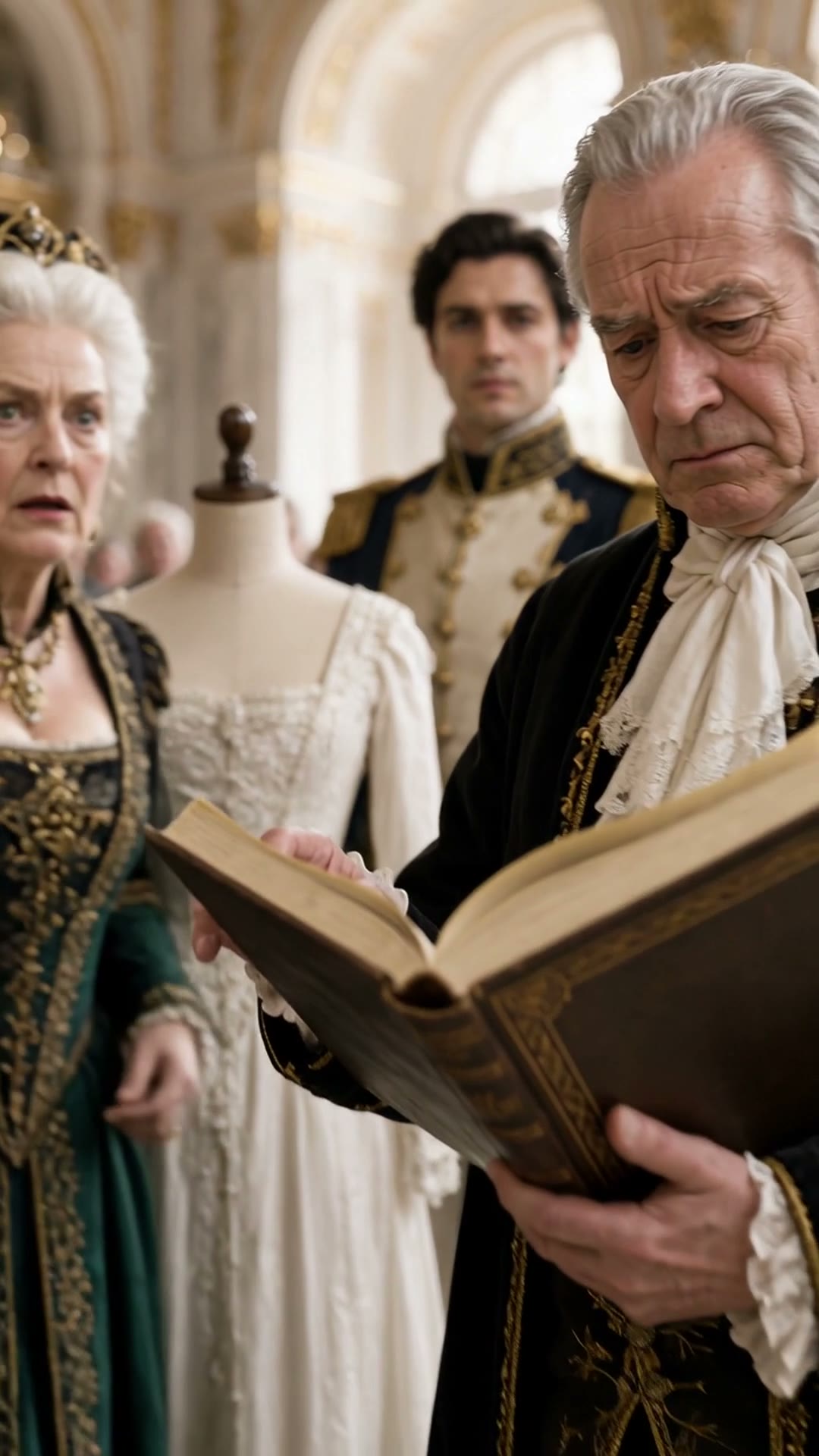
The ancestral wedding gown stood on its stand in the middle of the great hall like a ghost in the sunlight. It was pale ivory silk, a little yellowed at the seams, with a bodice so narrow that it seemed to belong to another century. Which, of course, it did.
Clara Wynn stood beside it in emerald-green silk and tried not to look at it.
She was thirty, the daughter of a printer from the lower town, and she was going to marry Prince Alaric in six weeks. They had met in her father's shop, where he had come to have an old map restored, and he had stayed three hours talking to her about books. She was warm and quick and round, with dark curls she could never keep pinned, and the prince loved every bit of her. The court did not. And the Dowager Agatha, the prince's grandmother, had decided the wedding would not happen.
"The royal bride must fit the ancestral gown," she announced to the gathered court. "That is the law."
Everyone looked at the tiny bodice. Everyone looked at Clara. The meaning was clear: go away quietly, before we humiliate you in front of the whole kingdom.
But Clara had grown up with books, and she knew one thing for certain. A real law is written down.
"Then show me where it is written," she said.
No one had ever asked the Dowager for proof of anything. Agatha's mouth tightened, and she turned to the old man behind her. "Edmund, show us the law."
Chamberlain Edmund had served the crown for fifty years. He carried the great leather book of royal law under his arm wherever he went, and he knew every page. He did not open it. His hands trembled on the cover.
"Your Highness," he said at last, "it was never in the law."
Here is what Edmund had kept to himself for thirty years.
Long ago, Agatha's elder son, the heir at the time, had fallen in love with a miller's daughter named Bess. She was tall and broad-shouldered and laughed too loudly for the palace, and Agatha could not bear the idea of her on the throne. So she invented a tradition. She announced that every royal bride must fit the ancestral gown, and she ordered Edmund, then a young clerk desperate to keep his position, to confirm it in front of the court. He did. Bess tried on the gown, could not close it, and left the palace in tears. The prince never married. He died young, and the crown passed sideways to Agatha's younger son.
And there was something worse. The gown had not always been so small. The first queen who wore it, two hundred years earlier, had been a big, strong woman famous for riding to war beside her husband. The gown had been taken in, again and again, by later queens. Agatha herself had ordered the last alteration, a few months before Bess was brought before the court, to make sure it would never fit her.
Edmund had carried that shame in silence for three decades. When he saw another young woman standing beside that gown with her cheeks burning, he simply could not do it a second time.
He opened the book, not to a law, but to the back pages where the royal seamstresses recorded their work. There it was, in faded ink: the waist taken in four inches, by order of Her Highness Agatha, in the spring of the year Bess was sent away. He read it out loud. Then he closed the book and bowed his head to Clara.
"I lied once, my lady," he said. "I will not lie again."
The silence in the hall was terrible. The ladies who had smirked behind their fans now could not look at the Dowager at all. And the Dowager, who had ruled that court with her cold eyes for forty years, found that no one would meet them.
The king, Alaric's father, heard the whole story that same evening. He was the younger son, the one who had inherited the crown only because his brother died unmarried and heartbroken. He sat for a long time in silence. Then he gave his orders. The Dowager would have no further say over any royal wedding, any household appointment, or any matter of court ceremony. She would retire to the dower house by the lake, comfortably, quietly, and permanently. The ancestral gown was taken off its stand and sent to the palace museum with a new card beside it, telling the true story of the warrior queen who first wore it.
Edmund offered to resign. The king refused. "A man who tells the truth at seventy-five," he said, "is worth more to me than a man who never lied at all."
Six weeks later, Clara Wynn married Prince Alaric in the royal chapel. She did not wear the ancestral gown. She wore her own mother's wedding dress, simple cream silk, let out at the seams by her father's neighbor, a seamstress from the lower town, and it fit her perfectly.
And in the third row, in a new grey coat, sat a white-haired woman with broad shoulders and a loud, happy laugh. Her name was Bess. Clara had found her through Edmund, and invited her herself.