"Janitors don't sit in this lounge! Take your junk outside!"
My canvas duffel hit the stone floor first. Then my father's dented steel thermos, rolling and clanging until it stopped against the glass door to the runway. My newspaper slid under a coffee table.
Courtney Pell stood over my chair in a cream blazer, arms crossed, like she had just taken out the trash. Ten minutes earlier she had knocked her latte across a side table, and I grabbed a napkin and wiped it up, the way anyone would. That was all it took. One napkin and one old navy work jacket, and she decided I was the man who cleans the floors.
My name is Walter Briggs. I'm sixty-seven years old. I spent forty years with grease under my fingernails, first fixing crop dusters in a tin hangar outside Tucson, then fixing small jets, then building a little company that made one part for those jets better than anybody else. That little company grew. Then it grew again. Today it owns eleven aircraft and the charter service that flies them. I still wear the jacket because it fits, and I still drink from my father's thermos because he gave it to me the day I got my mechanic's license.
"I'm not cleaning today. I'm flying." I told her.
She laughed out loud and asked the agent at the desk to call security.
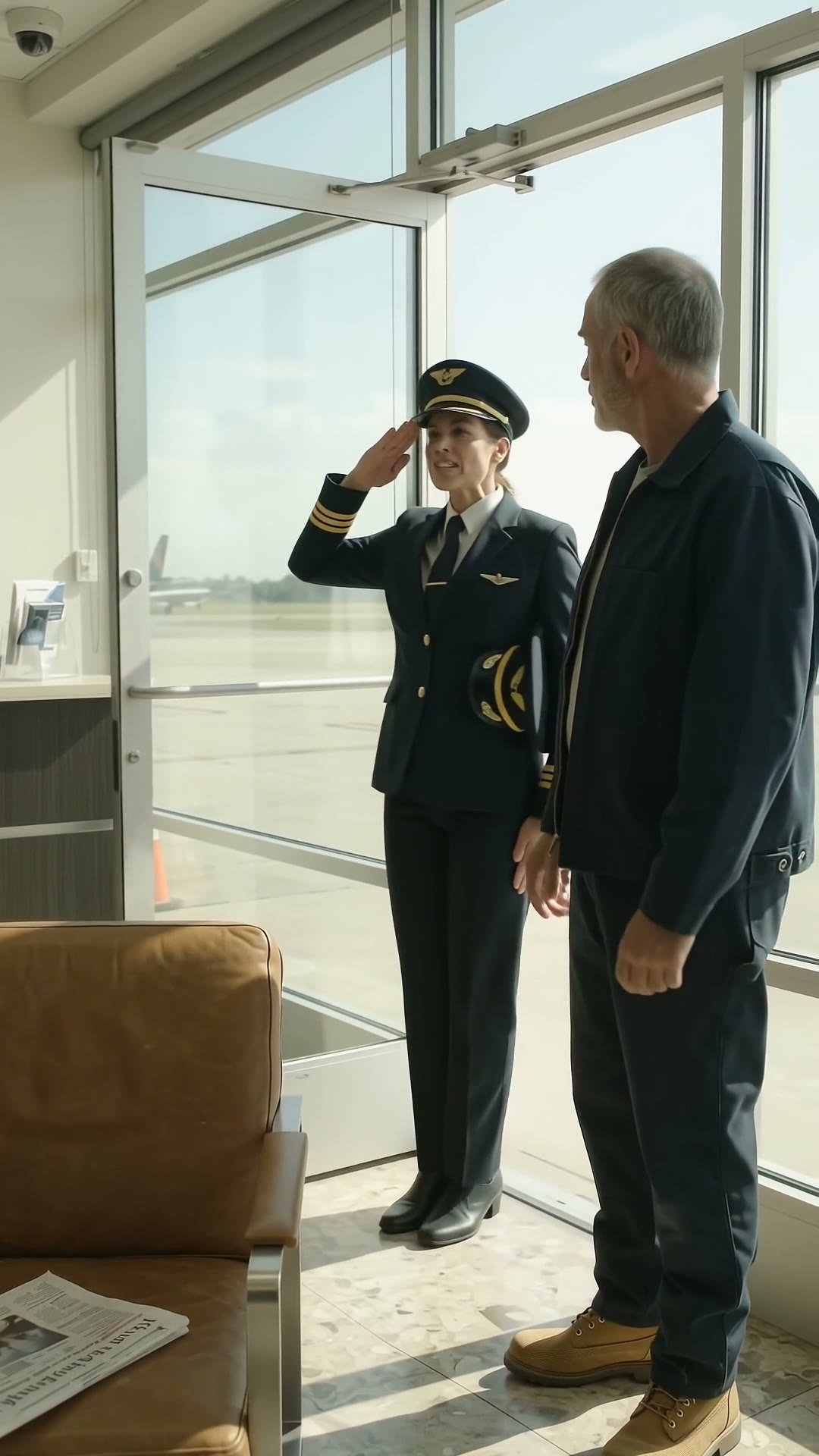
That's when the glass door from the tarmac swung open. Hot desert wind blew in, and Captain Dana Ruiz walked through it in her navy uniform with her cap under her arm. She saw my duffel on the floor. She saw my thermos. She stopped dead.
"Mr. Briggs, sir! Your jet is ready."
Then she did something I have asked her a hundred times not to do. She saluted.
The room went so quiet I could hear the jet engines idling outside. Courtney looked at the captain, then at me, then out the window at the white jet she had been admiring all morning.
"Your jet?" she said. "No. That's not… he wiped the table."
"He usually does," Dana said. "He also owns the table. And the lounge lease. And the charter company you booked with, ma'am."
Courtney's face went from pink to white. Her friend quietly stepped away from her, like bad luck might be catching.
Here is what Courtney didn't know. Her own flight to Aspen, the one she had been complaining was delayed, was on my second aircraft. The delay was because my maintenance crew found a worn seal on a landing gear line that morning and refused to sign off until it was replaced. I had driven out early to look at it myself. Old habit. Engines don't care about your schedule.
She started talking fast. She said she was stressed. She said she thought I was staff. She said it like being staff was a good reason to throw a man's things on the floor.
"Ma'am," I said, "if I were the cleaner, what you did would still be wrong. That's the part I need you to hear."
The agent at the desk, a young woman named Tasha, finally looked up from her keyboard. Her eyes were wet. Behind the coffee station, Rosa Delgado, who really does clean that lounge, and who Courtney had snapped her fingers at twice that morning, was standing very still with a cloth in her hand.
Courtney asked me if her flight was cancelled.
I thought about it. I really did. I could have grounded her with one word, and half the room was waiting for me to do it. But I have spent my whole life making things fly. I'm not in the business of keeping people on the ground.
"Your flight is fine," I said. "The seal has been replaced and the plane is safe. But before you board, I'd like you to do three things."
She nodded like a child in a principal's office.
"Pick up my bag. Apologize to Rosa, not to me. And next time you see someone wiping up your mess, say thank you."
She bent down in her cream blazer and picked up my duffel bag. She handed me my newspaper with shaking hands. Then she walked across the lounge to Rosa, and in a voice so quiet I barely heard it, she said she was sorry.
Rosa just nodded. She has more grace than both of us.
I picked up my father's thermos, tucked it under my arm and walked out the glass door toward my jet. Dana held the door for me, then turned back to the room.
"Mrs. Pell," she said, "your boarding is in fifteen minutes. Gate two. Please don't run."
Later, at thirty-nine thousand feet, Dana came back to the cabin and asked me why I let her go.
"Because she'll remember this flight longer than any punishment I could give her," I said. "And because Rosa got her apology. That was the only thing that ever mattered."
The next week I gave Rosa a raise and a new title: lounge manager. Tasha got the courage to speak up the next time something like that happened. She told me so herself.
And Courtney Pell? She flies with us every month now. She tips the crew. She says good morning to Rosa by name.
People can change. Sometimes they just need to watch the door open.
Would you have let her fly, or sent her home that day?