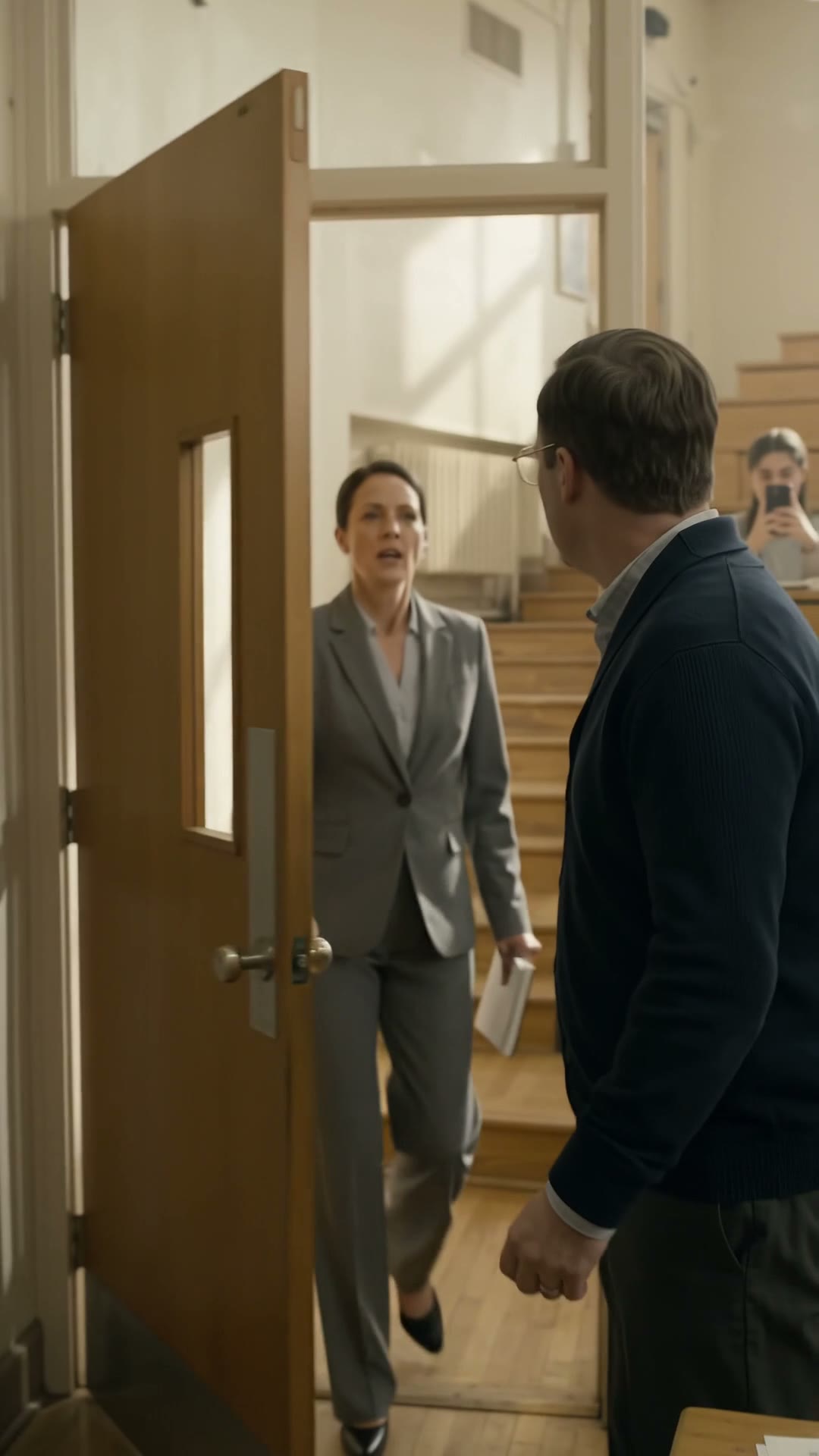
"Janitors mop the halls! They don't sit in my lecture!"
My steel thermos clanged down the wooden steps of Lecture Hall 3, one step at a time, while sixty students watched it roll. My two notebooks flew open on the floor. My secondhand textbook landed spine-up at Professor Wexley's feet.
My name is Walter Briggs. I'm sixty-three, and I had gone back to college to finish the degree I quit at nineteen, the year my father died and I had to go to work to feed my mother and three little sisters.
Every morning I sat in the third row of Professor Harold Wexley's biology lecture. Every afternoon at four, I put on my dark green work jacket and mopped the same floor. I had done that job at Halbrook College for thirty-one years.
That morning I forgot to take the jacket off the back of my chair. Wexley saw the name stitched on the pocket. And something in his face turned ugly.
He walked up the steps and cleared my desk with one sweep of his arm.
Sixty phones came up. I gathered my notebooks, stood up and pointed past him, at the small bronze plaque beside the door.
"Read the plaque by the door, Professor."
He laughed. Then the door swung open and Dean Elaine Porter walked in. She had come to give a short announcement before the lecture. She saw my books on the floor, the thermos at the bottom of the steps, and me standing.
"Harold, stop! You don't know who you're throwing out!"
Wexley straightened his cardigan. "Elaine, this man is a custodian. He's enrolled under some kind of employee program and he's taking a seat from a real student."
The dean didn't answer him. She walked to the plaque and read it out loud, slowly, so every student in the room could hear.
"This building is for everyone who was ever told they didn't belong here. W.B."
She turned around. "Four years ago, an anonymous donor gave this college fourteen million dollars to build this hall. He asked for no name on the building. He asked for a full scholarship fund for first-generation students. He asked for only two initials on that plaque." She looked at me. "W.B. Walter Briggs."
The room was so quiet I could hear the clock on the wall.
Nobody on campus knew. That was the way I wanted it. When I was twenty-five, a retired engineer whose office I cleaned told me something I never forgot: "Spend less than you earn, and put the rest somewhere it can grow while you sleep." So I did. I lived in the same small house for forty years. I drove the same truck until it fell apart. I put every spare dollar into a little plumbing-supply company a friend was starting, then into a few rental houses, then into index funds. I never touched it. When my friend's company sold, my share was worth more than I could spend in three lifetimes.
So I gave most of it to the place that had given me a job when I needed one.
Wexley's face had gone gray. "Mr. Briggs, I… I have walked past that plaque every day for four years. I gave a speech at its dedication."
"I know," I said. "I was in the back, holding a mop."
A few students laughed nervously. Most just stared at him.
"Why didn't you tell anyone?" he asked.
"Because I wanted to see who people are when they think nobody important is watching," I said. "Most people here are kind to me. You were the first to throw my books."
He picked up my thermos from the bottom of the steps, walked back up and set it on my desk with both hands. Then he turned to the sixty students and said the words I never thought I'd hear from him.
"I was wrong. I judged a man by his jacket. I'm sorry, Mr. Briggs. In front of all of you."
The dean asked me later if I wanted a formal complaint. I didn't. I wanted one thing from Harold Wexley, and I told him in his office that afternoon.
"Grade me exactly like everyone else. No favors. No fear. If my paper is bad, write that it's bad."
He kept his word. My first lab report came back covered in red ink. My second was better. On the final exam I got an A-minus. He wrote one line at the bottom: "Earned, every point."
I graduated that spring, forty-four years late, in the same hall I had paid for and mopped. My sisters were in the front row, crying. My mother didn't live to see it, so I wore her old wristwatch under my gown. Professor Wexley stood up and clapped when they called my name.
I still mop the floors at Halbrook on weekday afternoons. I don't need the money. I need the people. And every time I pass that plaque, I touch the two letters with my thumb.
Would you have forgiven the professor, or should he have faced real consequences?