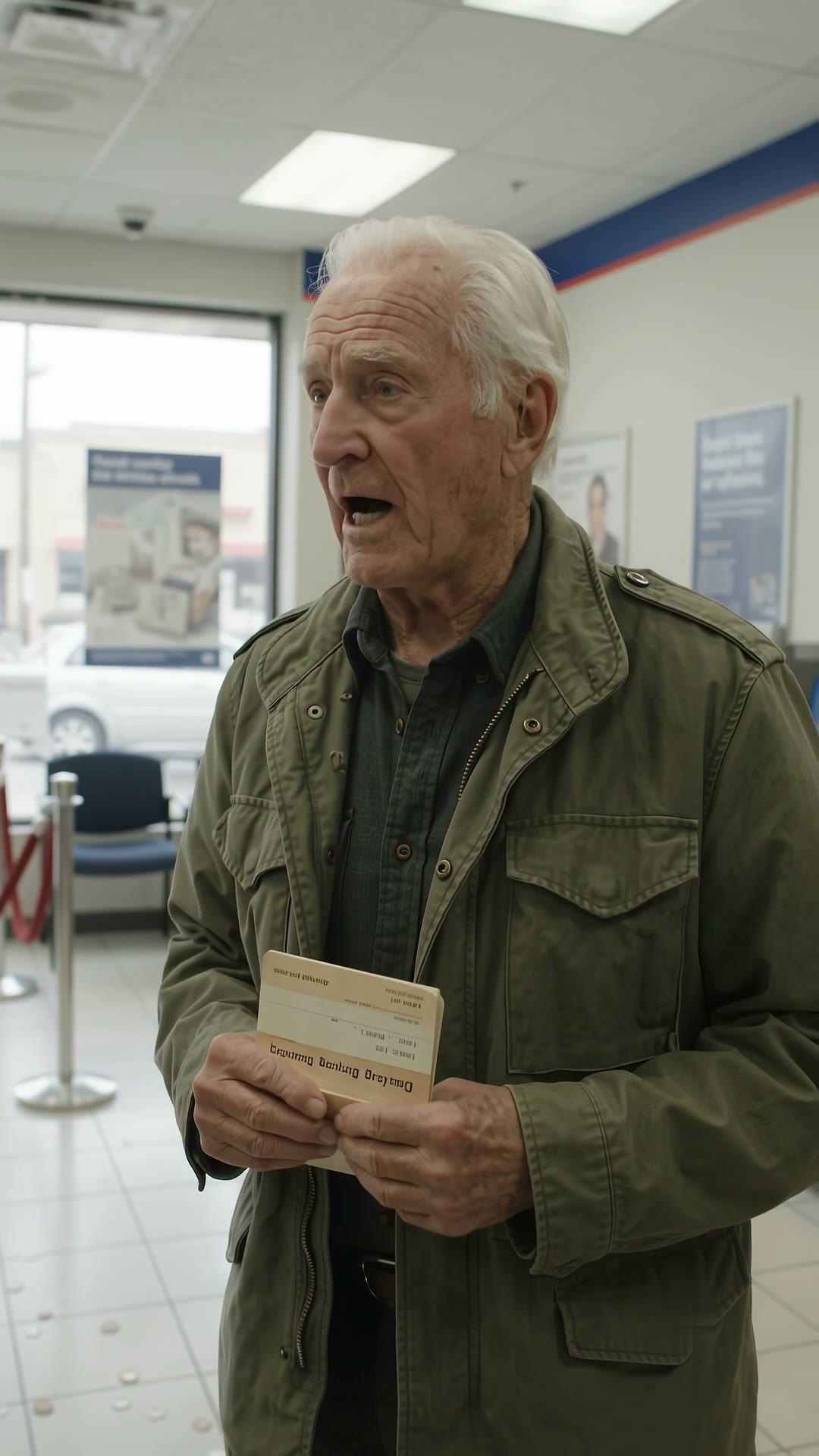
"We don't count coins for beggars! Take your jar and go!"
The big glass jar cracked on the tile floor, and a whole year of coins burst out of it. Quarters, dimes and pennies rolled under the velvet ropes, under the customers' shoes, all the way to the front doors. The two halves of my deposit slip fluttered down after them.
Chad Benson stood behind the counter in a crisp white shirt and navy tie, brushing his hands together like he had just swatted a fly. The line behind me went dead silent. A young mother covered her baby's ears. A woman bent down and picked a quarter off her shoe.
My name is Otis Freeman. I'm seventy-nine. In 1971 I was a twenty-four-year-old steelworker in Pittsburgh, and the big banks downtown wouldn't give men like me a loan for a used car, never mind a house. So eleven of us from the mill put our money together in a coffee can and started a credit union in the back room of a church. I kept the books on a kitchen table.
Eleven members became a thousand. A thousand became a hundred thousand. The credit union became a bank, and the bank grew into forty-two branches across three states. I'm still the chairman and the largest shareholder. I still drive a twelve-year-old truck and wear the same olive field jacket my son gave me in 1998.
My wife, Ada, was the bank's first teller. She worked at that very counter, the one Chad was standing behind, for thirty-one years. She knew every customer by name. She kept a coin jar on her kitchen windowsill, and every year on her birthday she'd carry it to the branch and deposit it into a little savings account for our grandchildren.
Ada passed four years ago. I kept her jar on the windowsill. I kept filling it. And every year on her birthday, I bring it to her counter.
"Son, I opened this branch's very first account." I told Chad.
That's when Patricia Lane walked in.
Patricia is the regional CEO of the bank. Thirty years ago, she was a nineteen-year-old single mother who came in asking about a job, and Ada trained her at that same counter. Patricia always comes to the branch on Ada's birthday. She brings flowers for the counter. That morning, she was carrying white lilies.
She saw the cracked jar. She saw the coins. She saw me holding Ada's booklet.
"Good morning, boss. Is there a problem here?"
The lilies nearly fell out of her hands.
Chad's face went completely blank. "Boss?" he repeated.
"Mr. Freeman founded this bank," Patricia said, and her voice was shaking with anger. "He's the chairman of the board. His wife trained me at that counter. Chad, what did you do?"
The whole line was staring now. The young mother took her hands off her baby's ears. The woman with the quarter laughed out loud and then put her hand over her mouth.
Chad tried to explain. He said coin deposits slow down the line. He said his manager told him to send people to the counting machines at the grocery store. He said he didn't know.
"You didn't need to know who I was," I said. "You needed to know that every coin in that jar was somebody's work. That's all a bank is, son. People's work, trusted to strangers."
Patricia looked at me. I knew what she was asking. She would have fired him before he could take off his tie.
I shook my head.
"Chad," I said, "come out from behind the counter."
He came out slowly, like he was walking to his own trial.
"Now get down here and help me count."
So we did. The two of us, on our knees on that tile floor, while customers stepped around us and Patricia went to find a broom for the glass. We picked up every coin. We stacked them on the counter in little towers, quarters with quarters, dimes with dimes, pennies with pennies. Chad didn't say a word for the first hour. In the second hour, he asked me about Ada.
I told him how she used to slip lollipops to kids whose parents were behind on their payments. I told him about the coffee can and the church basement. He listened.
It took two hours. Four hundred twelve dollars and thirty-seven cents.
Then I did something I had been thinking about for a long time. I asked Patricia to open a new fund in Ada's name: every year, that money and much more would open first savings accounts for kids in the neighborhood, with twenty-five dollars already inside.
And I asked Chad to run it.
He looked at me like I had handed him a live grenade. Patricia raised her eyebrows. But I've been hiring people for fifty years, and I know what shame looks like when it's about to turn into something better.
Chad has run Ada's Fund for two years now. He's opened over six hundred first accounts. He keeps a coin jar on his counter, and when a kid comes in with a pocket full of pennies, he gets down on the floor and counts them with them, coin by coin.
Every year on Ada's birthday, he's the one who meets me at the door.
Was I too easy on Chad, or was that the best lesson he could have gotten?