My name is Tamsin Reyes. I am thirty-four years old, and until the summer I am about to describe, I believed that the worst thing a boss could do was lose your paperwork. I had spent eleven years in restaurant kitchens and call centers. I was tired of being on the phone. When the county highway department posted an opening for a flagger, outdoor work, benefits, a real pension, I put on the orange vest the first morning like it was armor.
The maintenance yard sits at the end of a gravel road behind a chain of salt sheds, concrete barriers, stacked pipe and lime sacks. In July the whole place turns white by noon. The concrete throws the sun straight back into your eyes, and everybody moves slowly and says very little. The crew is about forty people. The yard bosses are two men named Brick and Vaughn, both enormous, both bald, both permanently sunburned, and both very good at smiling.
I noticed the pay problem on my second Friday. My stub said six hours of overtime. My phone, where I log everything out of old habit, said eighteen. I asked the woman next to me on the flag line, a cheerful person called Renata, whether hers looked right. She laughed a small laugh that had no humour in it and said, honey, nobody’s does. Then she told me not to ask again.
Of course I asked again. I am not proud of that or ashamed of it. It is simply who I am. Numbers that do not add up follow me around like a stray dog. So I photographed the sign-in sheets on the side of the barn. I photographed the metal cabinet by the scale house where the real time cards live, the one with a padlock the size of my fist. Then, and this is the part I would undo if I could, I mentioned it politely to Brick.
He listened with his head tilted and his arms folded. He said I was sharp. He said the county was lucky to have someone who paid attention. The next day nothing happened at all, and that should have frightened me more than it did.
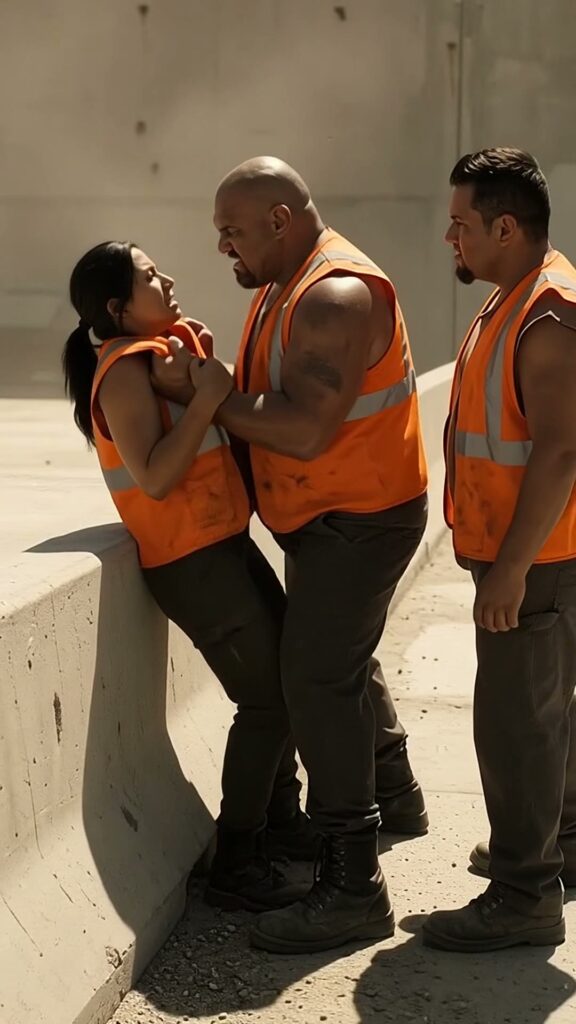
On Wednesday, at noon, I went behind the salt shed to eat lunch out of the sun. That is where they found me. Brick came around the corner first, Vaughn a step behind him, and the light was so white that they looked like cut-outs. I remember thinking, absurdly, that they were not wearing sunglasses. I remember thinking I had never seen Brick’s eyes before.
I do not know exactly how it happened. There was a shove, a step back, and then my shoulders were flat against the concrete barrier and Brick had a fistful of my vest collar under my chin. Vaughn planted himself beside him. Brick did not raise his voice. He asked me, very gently, whether I had my phone with me, and if so, could I show it to him.
Thirty yards away, across the gravel, forty people were loading a truck. I could see every one of them. I could see Renata with a pipe on her shoulder. I watched her look at us and then very deliberately look at the truck. That is a look I will remember on my deathbed. It was not cruelty. It was arithmetic. She had a mortgage.
And then, behind Brick’s shoulder, I saw a woman set a clipboard down on a wooden pallet.
Her name is Joss. She is the surveyor, the quiet one, who spends her days with a tripod at the edge of the yard writing figures in a notebook and has not, to my knowledge, said a full sentence to any of us since May. She is not tall. She wears her orange vest like it is a suit. She walked across the gravel in the full glare without hurrying, sleeves rolled to the elbow, and she did not look at me at all. She looked at Brick’s hand.
Brick turned his head. He said, this does not concern you, surveyor. I have never heard anything quite like the silence that followed. It was not the silence of fear. It was the silence of a very careful person deciding how much to say.
She took one more step. She put her hand on the sleeve of his vest, almost gently, and she said: You have been counting the wrong sacks, Brick…


Join the conversation