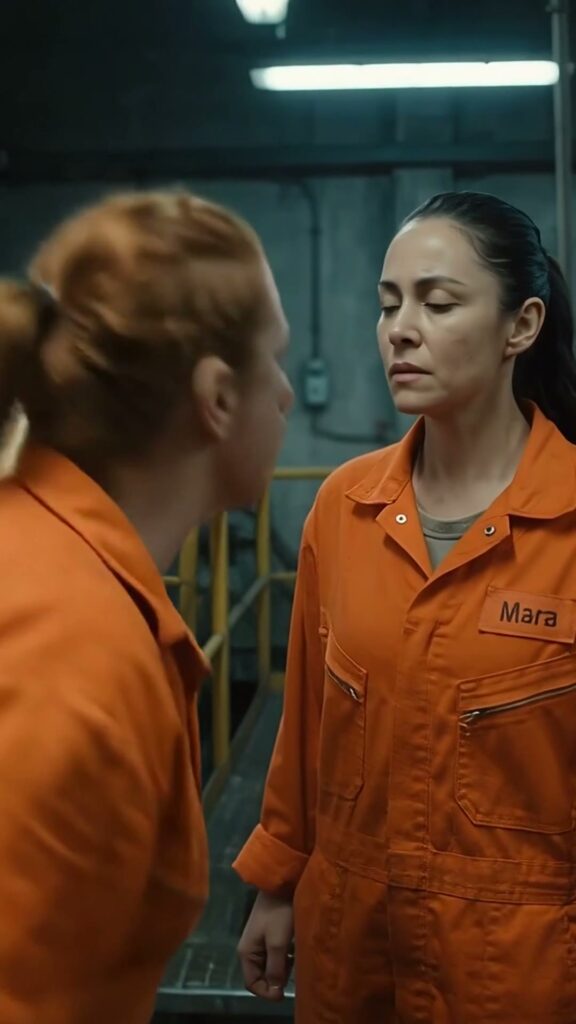
My name is Mara Lindqvist. I am thirty-one years old, and on the ninth day of my job at Halden Recycling I learned why everybody on the night crew walks around the baler catwalk on tiptoe.
The plant sits on the edge of the river yards. Inside it is all teal-grey concrete and steel grating, lit by cold strip lights that hum, and every one of us wears orange coveralls so the forklift drivers can see us. The night foreman is Dot Kowalczyk. Everybody calls her Big Dot, though never to her face. Nobody knows how many years she has been there. Everybody knows she has never lost an argument.
Lina Ferreira had been on the sort line eleven months. She is small, quiet, and always the first one in. For three weeks I had noticed that Dot found a reason to stop beside Lina’s station every shift. A dirty conveyor. A missed bottle. A forty-second delay. I had also noticed that when the overtime tags were handed out, Lina’s tag was always the one that went missing.
On my ninth night I came down the long steel stairs toward the baler, and I saw Lina crossing the landing with a rinse bucket held against her chest. Dot stepped out from behind a pillar and stood in her way.
“You left the sort line dirty,” said Dot.
“I cleaned it,” said Lina. “I cleaned it twice.”
Dot knocked the bucket out of her arms It rang off the rail, and the water went in a wide silver sheet across the grating and down the steps, and Lina dropped to the wet steel with both hands over her face.
Dot bent over her, close, with her hands on her knees, and she started to talk. I could not hear the words. I only heard the tone, the low, patient tone of somebody who has done this many times and has never once been stopped.
I was four steps above them. I stopped. Nobody had told me what to do in that moment, and I did not have a plan. I did the only thing I could think of. I closed my eyes and breathed in once, all the way down, the way my grandmother taught me before she took a big decision.
When I opened them Dot had turned her head. She was looking at me over her own shoulder, jaw set, with wet hair plastered at her temple. “New girl,” she said. “Go back up.”
“No,” I said.
She straightened up slowly. She is six feet tall and as wide as a doorway, and she put her face right in front of mine and told me, quietly and then not quietly, exactly how many nights I would last in that plant.
I did not step back. I did not raise my voice. I said, “Lina is going to stand up now, and you are going to let her.”
For a second nothing happened. Then Dot’s eyes went to the whip of orange behind me, where three or four of the night crew had crept to the top of the stairs and were watching. Her face changed. It was the look of a person who has just noticed that the room is bigger than she thought.
She lunged. She meant to grab me by the collar and pin me to the rail. I had spent two years on a loading dock before this job, and I knew something about a person who charges: all her weight is already in front of her feet. I stepped sideways, just one long step, and let her go past.
Dot’s boots hit the wet grating. There was a squeak of rubber on steel, a wild scramble, and her feet went out from under her. She sat down hard on the landing with her legs stuck out in front of her and her big shoulders heaving. She was not hurt, just very badly surprised. She stared up at me with an expression I will remember for the rest of my life.
I did not say a word to her. I turned my back on her, which took more courage than anything else that night, and crouched beside Lina. “Can you stand?”
“I think so.”
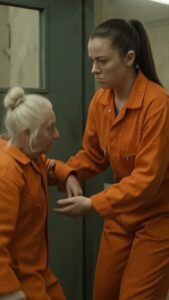
I put my arm under hers and we got up together, slowly, her orange coveralls soaked and cold against mine. We stood side by side on the landing with our heads down, both of us shaking, while the water dripped off the stair edges one drop at a time.
Behind us, nobody spoke. Then one of the men from the top of the stairs came down, picked up the bucket, and held it out to Dot. “Mop’s in the cupboard,” he said.
Dot took a long time to get up. She looked at the bucket. She looked at the wet steel. And then, to everyone’s astonishment, she began to mop.
On Monday, the plant manager, who had been told everything by Lina and by six other people who had been afraid for years, called Dot into his office. She came out twenty minutes later without her foreman’s badge. Lina got every overtime tag she had lost, and a new one that said “Lead, Sort Line” in her own name. Dot works the baler now, at the far end of the plant, and she still nods to me when we pass. I nod back. I have never told anyone that my hands were shaking for two hours afterwards.



Join the conversation