My name is Ines Calder. I am twenty-seven, and until the day I got married I repaired old books for a living, in a cramped workshop above a bakery in Lindmoor.
I met Rafael Lindqvist a year ago, when he brought in a water-stained atlas that had belonged to his grandmother, Odile. He stood at my counter for an hour, watching me lift a single page with tweezers, and asked more questions than any customer ever had. Six months later he asked me to marry him. I said yes before he finished the sentence.
What I did not know was how big his family’s name was in our town. The Lindqvists owned Orchard House, a crumbling manor at the edge of the valley, with a library said to hold twelve thousand volumes. Everyone in Lindmoor had a story about it. Nobody had been inside for years.
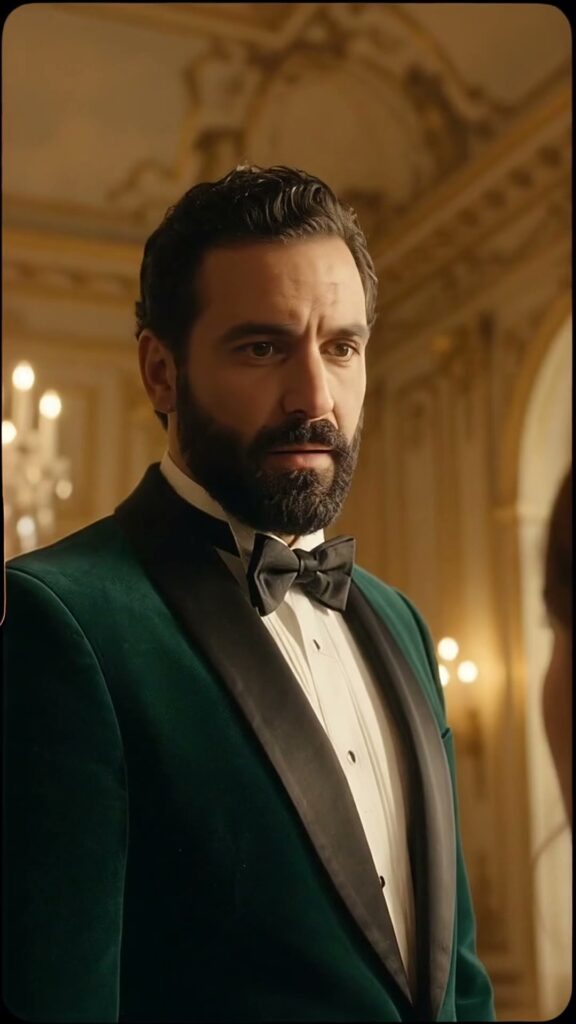
The wedding was held in the glass-roofed orangery of the old Grand Hall, with gold chandeliers, lemon trees in copper pots, and about sixty guests in black tuxedos and champagne gowns. Odile sat in the front row in a silver-grey lace dress, leaning on her cane, and she had not stopped smiling at me all morning.
The contract sat on a walnut writing desk with a gold inkwell beside it. My hands were shaking. Rafael had been oddly quiet all week, and I had put it down to nerves.
Then he leaned toward me, raised one finger, and said in a low, serious voice, “Before you sign, there is one condition.”
My stomach dropped. The room went so quiet I could hear the chandeliers ticking as they warmed.
“The pact?” I whispered. He had never mentioned any pact.
“The family pact,” he said. “Every Lindqvist bride and groom has agreed to it for a hundred and forty years. You cannot sign without it.”
I looked at the guests. Some were leaning forward. A few were smiling in a way I did not understand. I looked at Odile, and she pressed her handkerchief to her mouth.
I closed my eyes. I thought of all the nights I had told myself that nothing this good could be free. And then, strangely, I felt calm. Whatever the pact was, I had said yes to the man, and I meant it. A small smile came over my face before I could stop it.
I picked up the gold pen, set it on the line, and signed my name in one long loop. Rafael signed beside me. When the pen came off the paper, the whole hall broke into applause, and I still had no idea what I had just agreed to.
Rafael turned to me, and his eyes were wet. “Now I can tell you,” he said. “Odile, would you read it?”
Odile rose slowly, refusing every offered arm, and walked to the desk with her cane tapping on the marble. She unfolded a yellowed page from the family Bible. Her voice was thin but steady.
“The Lindqvist Pact. Each generation, the one who joins this family promises three things. To keep the Orchard House library open to anyone who wants to read. To mend what is broken rather than replace it. And to read one book aloud every autumn to whoever is lonely in this town.”
She looked at me. “Ines, my dear, you have been doing the second one in that little workshop for six years. I brought Rafael my water-stained atlas myself, and I told him to find the one person in Lindmoor who would fix it as if it mattered.”
I stared at Rafael. He was laughing and crying at once. “The atlas was never ruined,” he admitted. “Grandmother poured tea on it. She wanted me to meet you.”
The guests laughed, and then someone at the back started clapping again, and the whole room joined in. I laughed so hard my veil shook.
Odile took my hands in her thin, warm ones. “The library has been shut since my husband died,” she said. “The roof leaks. The shelves are dusty. Half the books are falling apart. I have been waiting for someone to love them more than the money. It is yours to keep open now, if you will have it.”
I said yes for the second time that day, and I did not need a pen.
Two weeks after the wedding we opened the tall oak doors of Orchard House together. Dust hung in the sunlight like gold flour, and the smell of old paper rose up around us like a welcome.
That autumn, sixty people came to the first reading. Odile sat in the front, with a blanket over her knees, and asked me to read her favourite poem. By the second verse she had stopped pretending she was not crying.
I have signed many things since then: leases, invoices, and the birth certificate of our daughter, who is named Odile. But the signature I remember is the first one, made with my eyes closed and my heart wide open, when I trusted a man’s raised finger and a promise I could not see.
The library is open every day now. If you ever pass through Lindmoor, come in. There is always a kettle on, and someone is always reading aloud.



Join the conversation