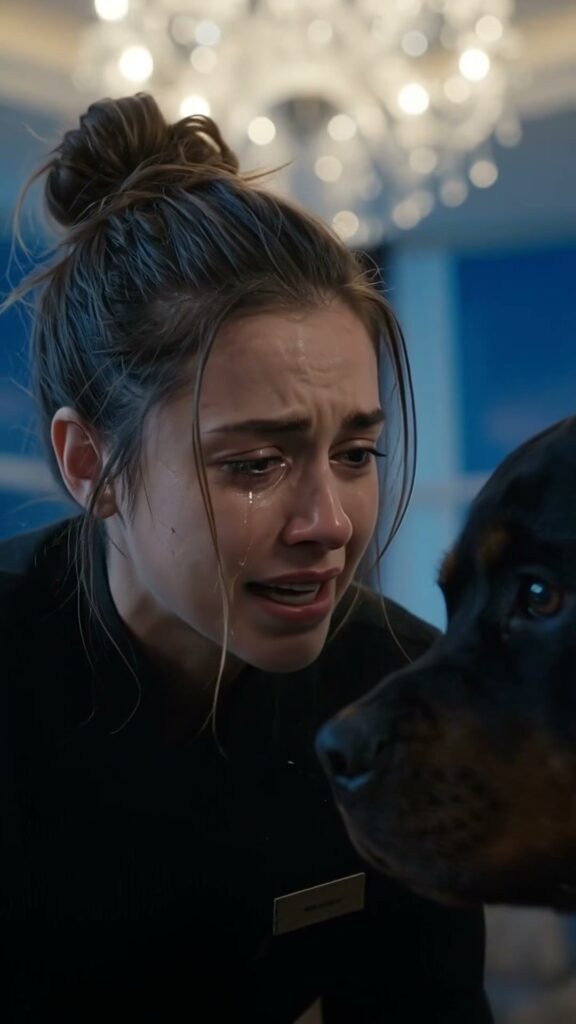
My name is Elena Hale. I am twenty-nine, and until three weeks ago I had no home and no proof that I had ever owned one. My father, Walter Hale, built the company that owned Ashford Tower, and I grew up in its penthouse, doing my homework on the black marble ballroom floor while his Rottweiler, Kaiser, slept across my feet.
Dad trained Kaiser himself and taught him one rule nobody else knew. The dog obeyed exactly one voice: mine, when I said his name softly and told him to sit. Dad called it our family password.
Two years ago my father died. Six months earlier he had married Diane Voss, a polished woman who smiled with every tooth and never once with her eyes. After the funeral she changed the locks and told the staff I had chosen to leave the city. My key cards stopped working. The doorman, who had known me since I was seven, looked at the floor and said he was sorry.
So I found work with a catering company that served the harbour towers, and I waited eleven months for one thing: an event at Ashford Tower.
It came on a cold Saturday in October, a charity gala hosted by Diane. I put on the black server jacket with its small gold badge, tied my hair in a messy bun, and rode the service elevator up to the home where I had been a child. The chandelier, the tall windows over the blue city, the black marble floor: everything was exactly as I remembered.
I kept my head low. Diane would never look at a waitress. My only fear was Kaiser, who had been kept behind a glass door since the funeral, watched by five men in black suits who took orders only from her.
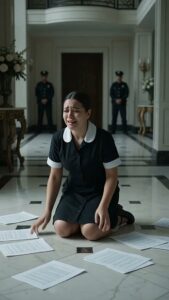
Halfway across the ballroom, my hands began to shake. The tray tilted, the silver cloche slid off, and the crash stopped every conversation. Red sauce, bread and broken plates spread across the marble around my feet.
I heard a chain fall slack behind me. Kaiser came through the door a guard had just opened, enormous, black and tan, in the spiked silver collar my father bought him. Five bodyguards stepped aside and let him pass. Nobody tried to stop him.
I dropped to my knees in the mess, palms flat on the cold floor. His huge head lowered over mine. I could see the drool on his teeth and feel his breath. He growled, and the sound was so deep that the glasses trembled on the tables.
“Please,” I whispered. “Kaiser, it’s me. I didn’t do anything.”
At the top of the marble stairs, Diane stood in her emerald gown, a glass in her hand, smiling. “Look how frightened she is,” she told her guests. “Dogs always know a thief. Someone please escort this girl out.”
Kaiser did not look at Diane. His eyes stayed on my face. Slowly he stepped through the spilled sauce and cracked plates, claws clicking on the marble, until he stood right in front of me.
I did the only thing I had left. I said his name the way my father used to, low and soft. “Kaiser. Sit.”
The growl stopped. Not softened, stopped. He let out a long breath, lowered himself to the floor beside me, and sat perfectly still. Then he turned his head and looked up the stairs at Diane.
A murmur ran through the room. “That dog has never sat for anyone,” someone said. Diane’s smile slipped. “Kaiser! Here! Guards!” she called. The dog turned his head away from her as if she were a stranger.
I stood up, wiping sauce from my hands. My voice was steady now. “My father trained him to obey one person,” I said, loud enough for the whole room. “His daughter. My name is Elena Hale, and this is my home.”
A tall man in a grey suit near the front set down his glass. It was Mr. Adler, my father’s lawyer, whom Diane had told me was retired and abroad. His eyes filled. “I have searched for you for two years,” he said. “Your father left a sealed will and a letter. Diane told the court you renounced everything. I never believed it.”
Diane’s face went white. The guards who had stood like statues all night glanced at one another, then at her, and one by one they stepped away from her side.
Mr. Adler opened his briefcase. Inside, beside the will, was a photograph: my father, me at eleven, and a black-and-tan puppy asleep between us. On the back, in Dad’s handwriting: Only Elena can command him. If anyone else claims the tower, ask the dog.
Kaiser leaned against my leg, and I laid my hand on his head for the first time in two years.
Diane spent that night answering questions from the lawyer and two officers of the estate court about signatures and dates she could not explain. By morning the locks had been changed again, and this time I held the only keys.
It took six months for the court to confirm what the dog knew in a moment. The tower, the company and my father’s home came back to me. I kept the black server jacket folded in a drawer, so I would never forget how it felt to be invisible.
Every night Kaiser sleeps across my feet on the black marble floor, exactly where he slept when I was a child. When the chandelier sways, I whisper our family password just to watch his ears rise. He always answers. He never forgot me, not for a single day.


Join the conversation