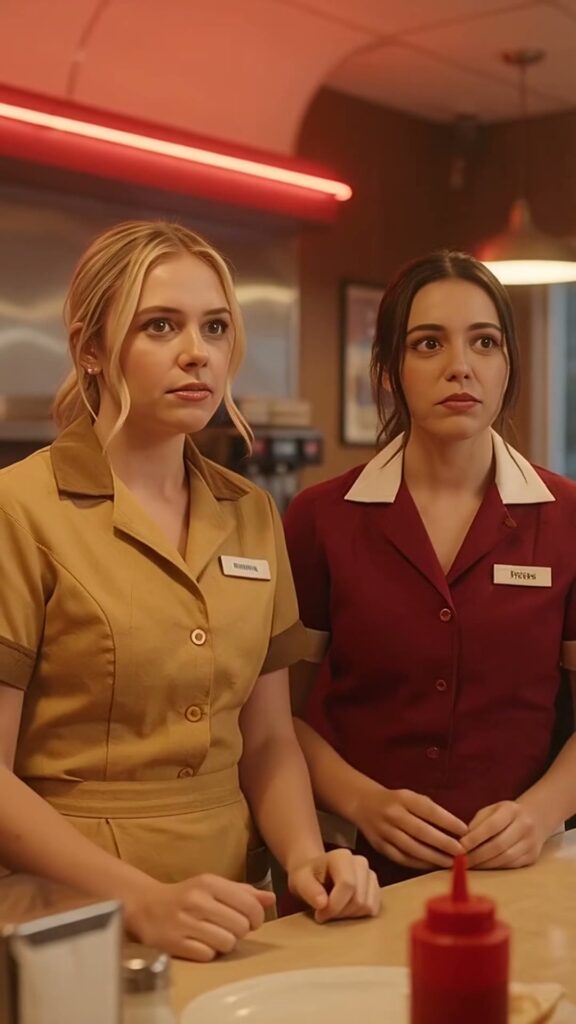
My name is Brooke Dawson. I am twenty, and last summer I worked the counter at Halloran’s Diner, a roadside place off Route 9 with red vinyl stools, gold lamps and a wooden counter older than my parents. I needed the money for my second year of community college, and
That Tuesday afternoon was slow. My friend Tessa and I were folding napkins when an old man came in. He had a grey beard, a brown cap, a tan canvas jacket worn nearly white at the elbows, and a blue plaid shirt with one button missing. He ordered a single cheeseburger and a small coffee, counted out the price in coins, and carried his tray to the far end of the counter.
He did not sit down. He just stood there holding the burger in both hands, looking at it as if it were something that might break.
Tessa leaned close to me and whispered, “Look at him. He is about to cry over a cheeseburger.”
I laughed. I covered my mouth with my hand and laughed, and Tessa did the same, and both of us kept our eyes on him so he would know we were watching.
The old man lowered his head until the brim of his cap hid his eyes. Then he took one slow bite, and he chewed with his eyes closed, like a man tasting something from very far away.
Something changed in the room. I cannot explain it better than that. My smile slid off my face without my permission. Tessa’s went too. We glanced at each other, and neither of us had anything left to say. We turned away and started wiping a counter that was already clean.
Grant, our manager, was watching from the register. He was forty, tired, and always in a black polo shirt with the diner’s badge on it. He had seen the whole thing, and he said nothing. I would think about that silence for a long time afterwards.
The next morning, I was tying my apron when the bell over the door rang. A man in a dark navy suit stepped inside. White shirt, dark tie, brown hair combed back, a leather folder under his arm. He did not look at the menu. He walked straight to the counter and asked Grant if he could speak to the two employees who had worked the afternoon shift yesterday.
Grant’s face lost its colour. I watched it happen from across the room. “May I ask what this is about, sir?” he said.
The man introduced himself as Daniel Reyes, an attorney. He opened the folder and laid it flat on the counter, and Grant stared at what was inside. It was an old black-and-white photograph, a young man in a white paper hat standing proudly in front of a brand new roadside diner, holding a hand-painted sign. Under the photograph was a deed.
“That is Walter Halloran,” Daniel said quietly. “He built this diner in 1974, with his wife Ruth. She wrote the first menu on a napkin. The cheeseburger he ordered yesterday is her recipe.”
My knees felt weak. Tessa gripped the edge of the counter. The man in the tan jacket, the man we had laughed at, was the founder. He had sold the diner years ago to a company, and he had been coming in on the last Tuesday of every month since Ruth passed away, ordering her burger, and eating it slowly, because it was the only place left where he could taste her kitchen.
That was when the bell rang again. Walter came in, the same brown cap, the same tan jacket, and this time he was holding a small paper bag. He stopped in front of Tessa and me. I could not lift my eyes from the floor.
“Miss Dawson,” he said. His voice was gentle, raspy, and not angry at all. “You have kind hands. You fold a napkin better than anyone I have ever hired. I would hate to see them wasted on laughing.”
I started to cry. I told him I was sorry, that I did not know, that it was no excuse. He shook his head slowly. “That is the whole point, dear. You did not know. Nobody knows who is standing at the end of the counter. That is why we are kind to all of them.”
He handed me the paper bag. Inside was a folded, yellowed napkin with a handwritten list of ingredients and a note in faded pencil: For whoever keeps this counter warm.
Walter did not fire us. Instead, he asked Grant to sit down with the three of us, and for the next hour he told us about Ruth, about the first winter the diner almost closed, and about the truck drivers who paid their tabs in coins and never once made him feel small. Then he made us a deal: Tuesdays with him, learning Ruth’s menu and serving every customer as if they owned the place, because one day one of them might.
Grant resigned at the end of the month, and by the fall Walter had set up a scholarship in Ruth’s name for my classes.
Every last Tuesday of the month, an old man in a brown cap still comes in and orders a cheeseburger. Now I set his tray down myself, and I stand at the counter until he takes his first bite. He always tips his cap. And I always smile, the way I should have that first day.
Join the conversation