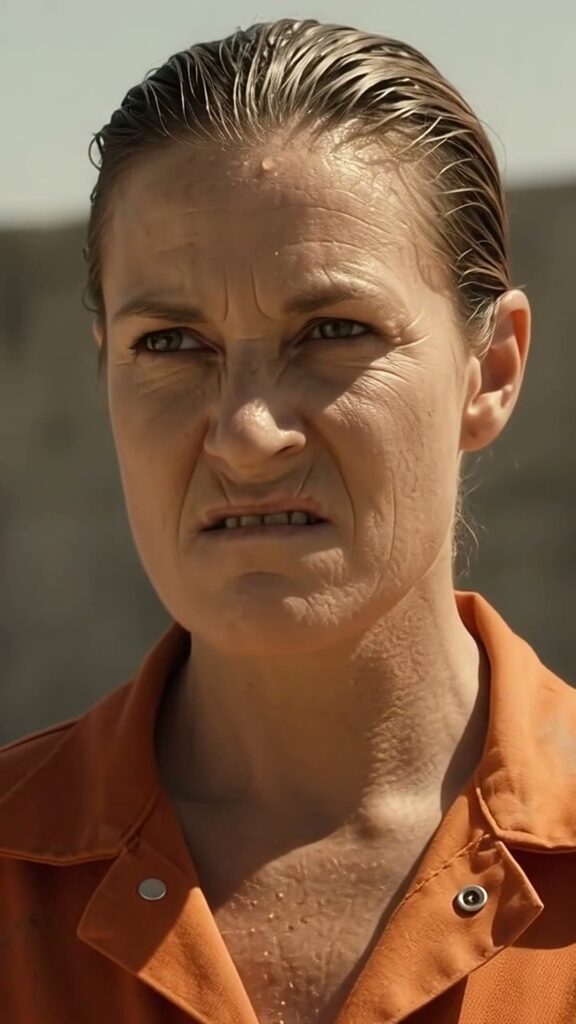
I’m Tessa Quill. I’m twenty-six, and last June I took the only job that would take me: the Salt Creek Pot Works, where the sun bounces off the bleached sand so hard you squint by seven in the morning, and every stacked pot, every canvas apron, every kiln wall is the same burnt orange.
There were thirty of us in that yard, and one rule nobody said out loud. Bea Kowalczyk ran the place. She was forty-four, six feet tall, with slicked-back hair and a way of standing that made other people stand differently. Her enforcer, Pruitt, was broad and bald and did whatever Bea’s eyebrows told her to.
The rule was simple. On your ninth day, you knelt in front of the whole line and scraped the dried clay off Bea’s boots with a rag. Everybody before me had done it. Nobody ever complained, because Bea signed the pay envelopes, and because a woman who complained found her shifts cut to nothing by the end of the month.
On my ninth day, Bea walked me to the middle of the yard, with the towers of terracotta pots behind her and the grey kiln wall behind them. She said nothing. She just planted one boot in front of me. I knelt. I scraped. Pruitt stood behind me and pressed her knuckles into my collar until I could feel my own pulse against them.
Thirty people studied the sand. I understood then that every one of them had been in my place, and that each of them had spent years being ashamed of the same nine minutes. That did not make me angry at them. It made me very, very tired of the rule.
I counted to sixty. I put the rag down. I stood up.
I set my feet the way my father taught me on a boat deck in bad weather, and I turned around, and I looked at Bea and said, in a voice much steadier than I felt, “I’m not doing that.”
The whole yard went so quiet I could hear the kilns tick. Bea looked at my face for a long second, and then she looked at Pruitt. That was all the order Pruitt ever needed.
Pruitt lowered her head and charged, both arms flung wide, and every muscle I owned wanted to run. Instead I did the one thing nobody in the yard expected. I stepped left. I did not lift a hand. I only got out of the way.
Pruitt is a heavy woman, and heavy things do not turn quickly. She went past me with her boots skidding on the sand, straight toward the drainage channel where we wash the dried clay off the boards, still wet from the morning’s rinse and filled with grey slip as thick as porridge. She hit it belly first and slid the whole length of it, arms out, face up, a long grey wave rolling in front of her, all the way to the foot of the pot towers.
Nobody moved. Then from the back of the line came a sound like a cough, and it turned out to be a laugh. Then another. Then the whole crew, thirty people and thirty years of swallowed silence, breaking open at once. Osei, the old kiln man, who had never once looked me in the eye, sat down on an upturned bucket and wiped his face with his apron.
I walked over and stood beside Pruitt. She was flat on her back in the slip with her arms spread, blinking at the sky. I did not say a word. I did not have to. The sun was behind me, and the thirty of them were behind that, and for the first time in that yard nobody was looking at the ground.
Bea never touched me. She took two steps, and then a car door shut on the far side of the fence, and Anneliese Halloran, who owns the Pot Works and had not been on the yard in eleven months, walked through the gate with a folder under her arm. She had come, she said, because twenty-seven people had signed a letter the week before. Osei had written it. Every signature was on the last page, and it had taken them all this long to find someone who would stand up first so they could stand up after her.
Mrs. Halloran read the yard in a single look: the slip, the rag, Pruitt, the crew. She asked Bea one question. Bea did not answer it. By Friday, Bea and Pruitt were gone, and the ninth-day rule went out with them.
They asked me to run the wheel shed in the autumn. I said yes. The first thing I teach every new hire, on the first morning, is where to stand: anywhere they like, and nobody kneels.



Join the conversation