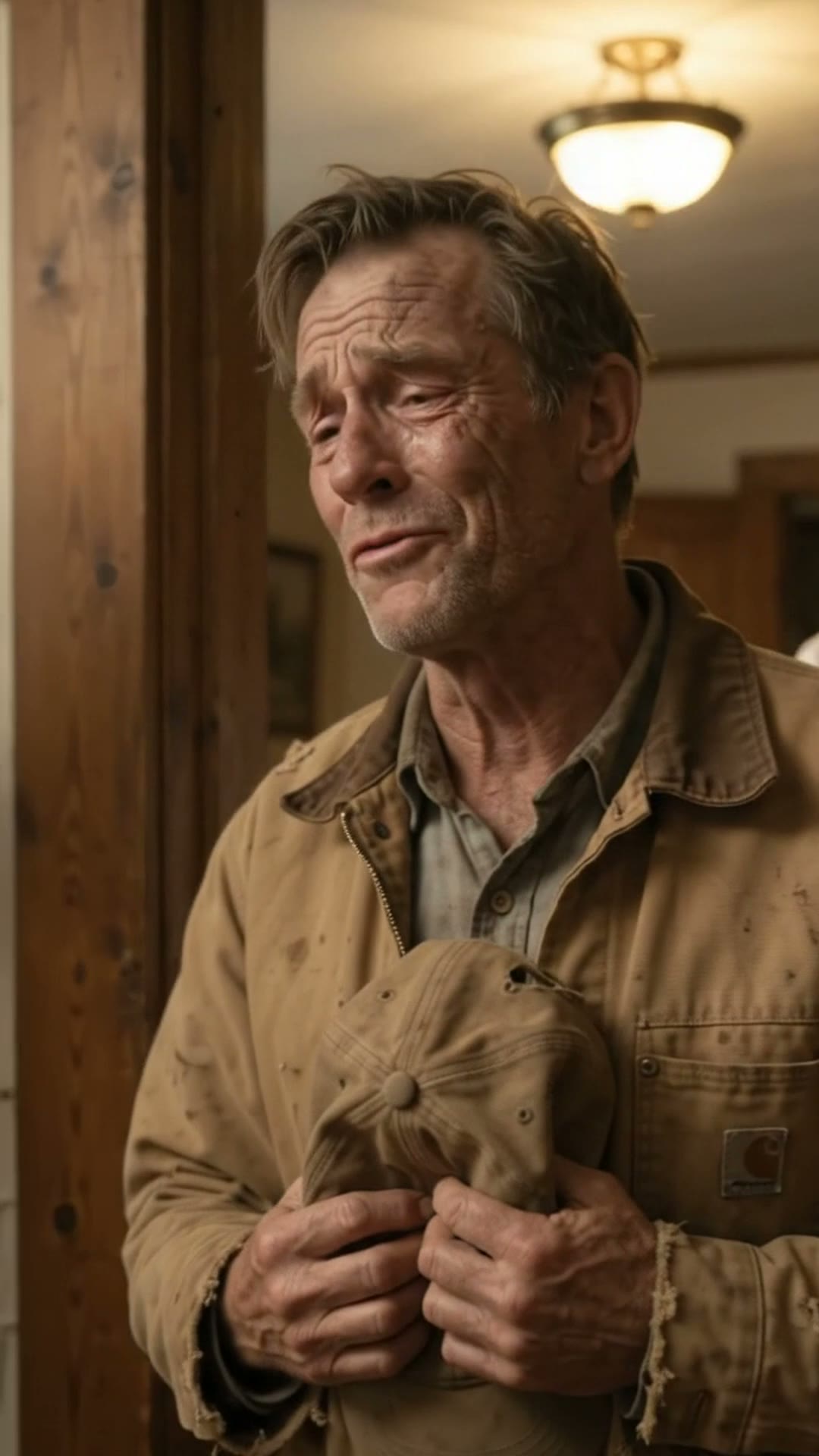
"Nobody here knows my dad digs coal — take your cap and leave!"
My own son Clint said that to me at his engagement dinner, in his fiancée's family's big brick house outside Hazard, Kentucky. Then he grabbed the walnut cutting board I'd made them and my cap and swept them off the end of the table onto the hardwood. The board struck a chair leg and cracked.
I'm sixty-two. I worked underground in Harlan County for forty-one years. I came straight from my shift at the prep plant, still in my canvas work jacket, with my black work cap beside my plate. I spent three weekends sanding that cutting board.
Clint is the first Hensley to finish college. I paid for it with overtime and a bad back. Somewhere in there he started telling people his father "worked in energy." Whitney's family had never asked more than that.
His fiancée was outside collecting her parents. There was no one between us.
So I didn't argue with my boy. I picked my cap up off the floor, turned toward the door, and the way I always do when my voice threatens to break, I started to sing under my breath, the old hymn my mama sang.
"Shall we gather at the river, the beautiful river…"
Then a cane struck the hallway boards. Whitney's grandfather, eighty-eight years old, was standing in the doorway, white as a sheet, staring at me.
"Sing that again. Where did you learn that hymn?"
His name is Clarence Boggs. Everybody at that table called him Pop. He had built the family's three car dealerships from nothing, and I found out later he rarely left his room anymore when they had company.
He shuffled right up to me on his cane, put his hand flat on my chest like he was checking that I was real, and asked me if I had been at the old No. 4 section in the spring of 1983.
I had. I was nineteen. My first year underground.
On April 11, 1983, the roof came down on a section of No. 4, and five of us were sealed off behind it for sixty-one hours. No light after the first day. One water jug. The shift foreman had a crushed leg and was out of his head with pain and fear. I was the youngest one there and I was scared to death, so I did the only thing my mama ever taught me to do when I was scared. I sang. That hymn, over and over, for two and a half days, until the rescue crew's drills broke through. He was carried out first, and I never heard from him again.
Clarence was that foreman. He did not recognize me from a hymn alone. He asked which shift I had worked, and I described the foreman's broken watch and the words we had shouted toward the rescuers. He held up the watch, still stopped at the time of the fall.
He told the whole table, with his voice shaking, that he had looked for "the singing boy" for years. He'd called the union hall, the company, the churches. Nobody remembered which kid it was, and I had never told anyone, because I didn't think it was anything special. He said he lost his leg below the knee, left mining, and started over selling used cars, and that every hard day of his life since, he heard that hymn in his head and kept going.
"Without this man," he said, pointing at me with his cane, "there is no Boggs Motors. There is no house. There is no Whitney."
Nobody at that table moved. Whitney's father put his napkin down and looked at the floor. Whitney started crying. And my son Clint just stood there next to the broken cutting board, looking at me like he had never seen me before in his life.
Clarence asked me to sit next to him at the head of the table, and I did, in my work jacket. He asked me to sing it one more time, and I did. By the second verse, Whitney's mother was singing with us.
After dinner Clint found me on the porch. He didn't make a speech. He picked up the two halves of the cutting board, sat down on the step, and said, "I was ashamed, Dad. I wanted to seem like one of them. You didn't owe me a rescue story to deserve a place at this table." He tried to fit the split board together, but his hands kept slipping.
Whitney's father called the next week to apologize for the way I had been treated in his house. He offered help with my back. I thanked him but did not accept a decision about surgery from anybody except my doctor. Clarence called separately. We talked about the men who had pulled us out, not about owing each other a debt.
Clint and Whitney got married that October, not at the country club the way her mother planned, but at my little Baptist church in Harlan, because Whitney asked for it. Clint asked me to be his best man. I wore a suit, but I kept my cap in my pocket.
When the preacher finished, Clarence stood up from the front pew on his cane, and he and I sang that hymn together, an old foreman and an old miner, while the whole church joined in.
I glued the cutting board back together. Whitney keeps it on her kitchen counter. She says the crack is her favorite part.
Have you ever been ashamed of a parent and later realized they were the bravest person you knew?