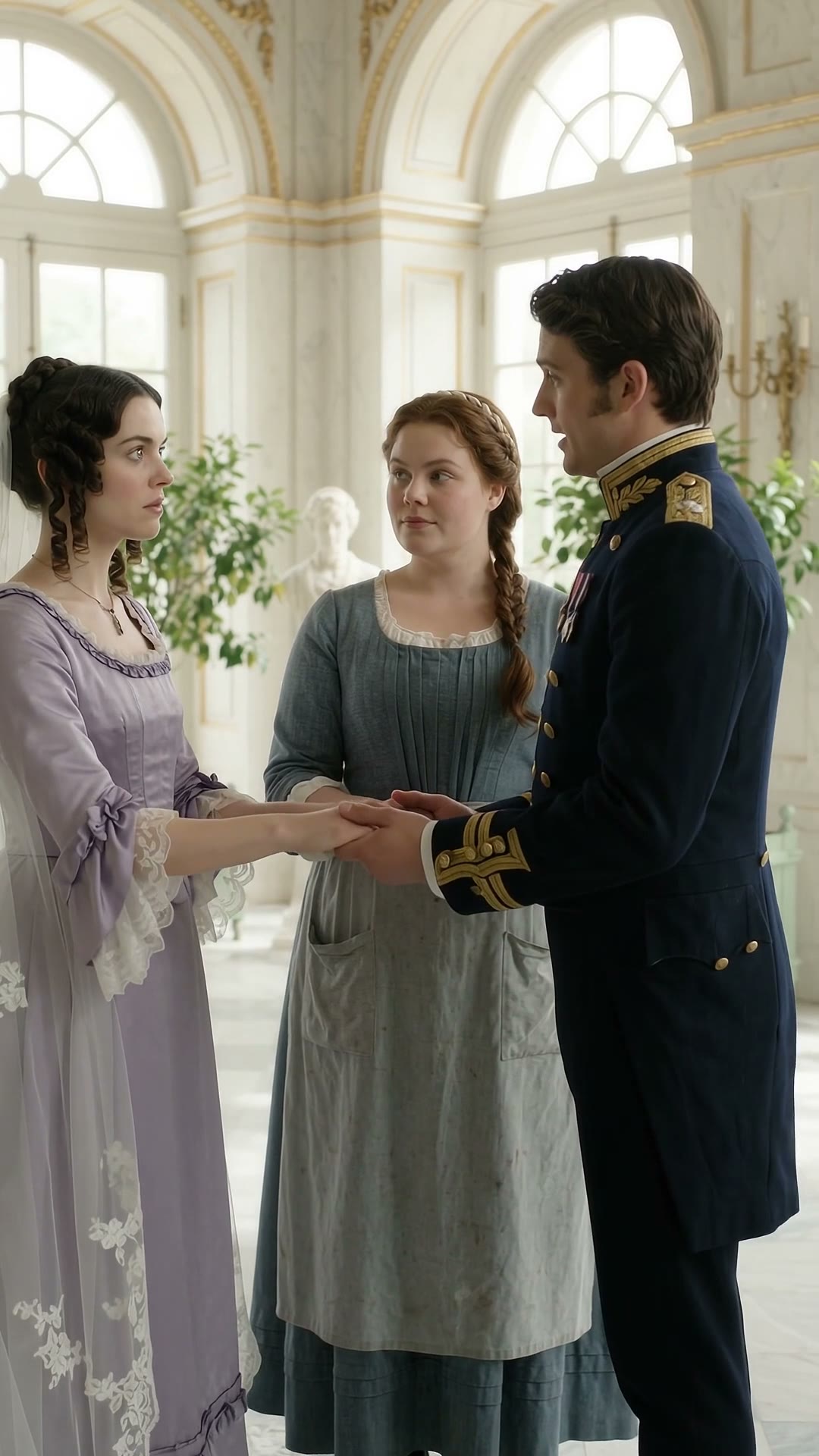
Then look at our hands, Your Highness. Both of us.
Mabel Quinn said it quietly, but in that orangery it sounded like a bell. Only moments before, Lady Philippa Vance had gathered the court among the lemon trees and lifted a long white lace veil, the most delicate thing anyone there had ever seen. "Four months of my own work," she told Prince Lucien. "For my wedding day." The ladies sighed, because everyone knew which wedding she meant.
Then Philippa noticed Mabel standing by the door with a sewing basket, and her smile turned sharp. "Fat fingers like hers could never sew lace this fine."
The ladies laughed behind their fans, and Mabel's face went hot. She did not argue, and she did not explain. She stepped forward and slowly held out both of her open hands, palms up, toward the prince.
The laughter stopped. Lucien looked at Mabel for a long moment. Then he reached out and took Philippa's hand. White. Soft. Perfect. He let it go and took Mabel's. Her fingertips were rough and covered in tiny pinpricks. He did not let go of that one. "Yours are smooth, my lady. Her hands made this veil."
Nobody breathed. Lady Philippa went pale, and the beautiful veil sagged in her grip. The prince was not finished, and she knew it.
Mabel Quinn was the palace seamstress, a big, soft-spoken country girl who sat in the back workroom from dawn until the candles went out. The ladies of the court liked to laugh at her, and Mabel let them. She was happiest with a needle in her hand and a length of lace across her knees, working on something no one else had the patience to finish.
Mabel had come to the palace at sixteen from a farming village in the valley, carrying one trunk and her late mother’s thimble. The old lace mistress noticed her hands on the first day and taught her every fine stitch the palace had kept for generations. Mabel never asked for praise. She asked only for enough light to see the lace by, and the back workroom, with its single window, was the only place she had ever been given.
Philippa had a reason to want that veil, and it was not vanity. The Queen had let it be known that she wanted a daughter-in-law skilled with her own hands, and a bridal veil of that quality could make the difference in a betrothal. Philippa could not sew a fine seam herself. So she went to the back workroom in secret and found the one seamstress in the palace who could.
She paid Mabel a few coins to make the veil, stitch by stitch, over four months. Then she made sure the seamstress understood the cost of talking. If Mabel ever spoke of it, Philippa would have her dismissed from the palace and her name removed from the workrooms for good. There was no promise of reward, only a few coins and a threat.
For four months the veil was the only thing that mattered in the back workroom. Mabel worked through the long afternoons, and the candles burned lower each night. Philippa came by twice to check on the progress, always with a fresh purse of coins and a reminder about the cost of talking.
Mabel kept quiet. She bent over the lace every afternoon, and the veil grew finer with every stitch. The pinpricks on her fingertips were the price of the work, and she paid it without complaint, because no one had ever asked her what it cost.
The prince had a good eye for fine work. In the moment after Philippa held up the veil, he had noticed that its stitches were tighter and more even than anything she had ever produced at her embroidery frame. He said nothing about it then, but he remembered the thought, and it was the thread that led him to the truth.
When the prince asked the palace's old lace mistress to examine the veil, she confirmed what everyone was too stunned to say aloud. The stitching was Mabel's, the same tight, even work the old woman had taught her as a girl. She also produced the order Philippa had signed for the veil's materials, and the prince read it aloud before the court. The lie could not be denied.
The Queen, who had hoped to see skill rewarded in her son's choice of bride, made her feelings plain before the court. She would not have a bride who bought her talents, she said, and a lady who could not sew should not pretend that she could. Her decision was final, and no one in the gallery dared to argue with it.
Philippa was struck from the list of brides, and her family was sent away from court in disgrace. Her friends turned their backs, and the same ladies who had laughed at Mabel now went quiet when they passed her.
Mabel did not celebrate. She went back to her window, sat down, and finished the last row of lace she had started for a bride she would never meet. She had never wanted a title or a place at court. She had wanted only for her work to be seen, and for the first time in her life, it had been seen by everyone who mattered.
Mabel was given her own royal workshop, with good light, a proper worktable and her name painted on the door. The prince began visiting it every afternoon, though he had no gown to order and no reason he was willing to admit. The soft-spoken seamstress who had once been laughed at now stitched the finest lace in the palace, and everyone who walked into that room learned to respect the hands that had made the veil.