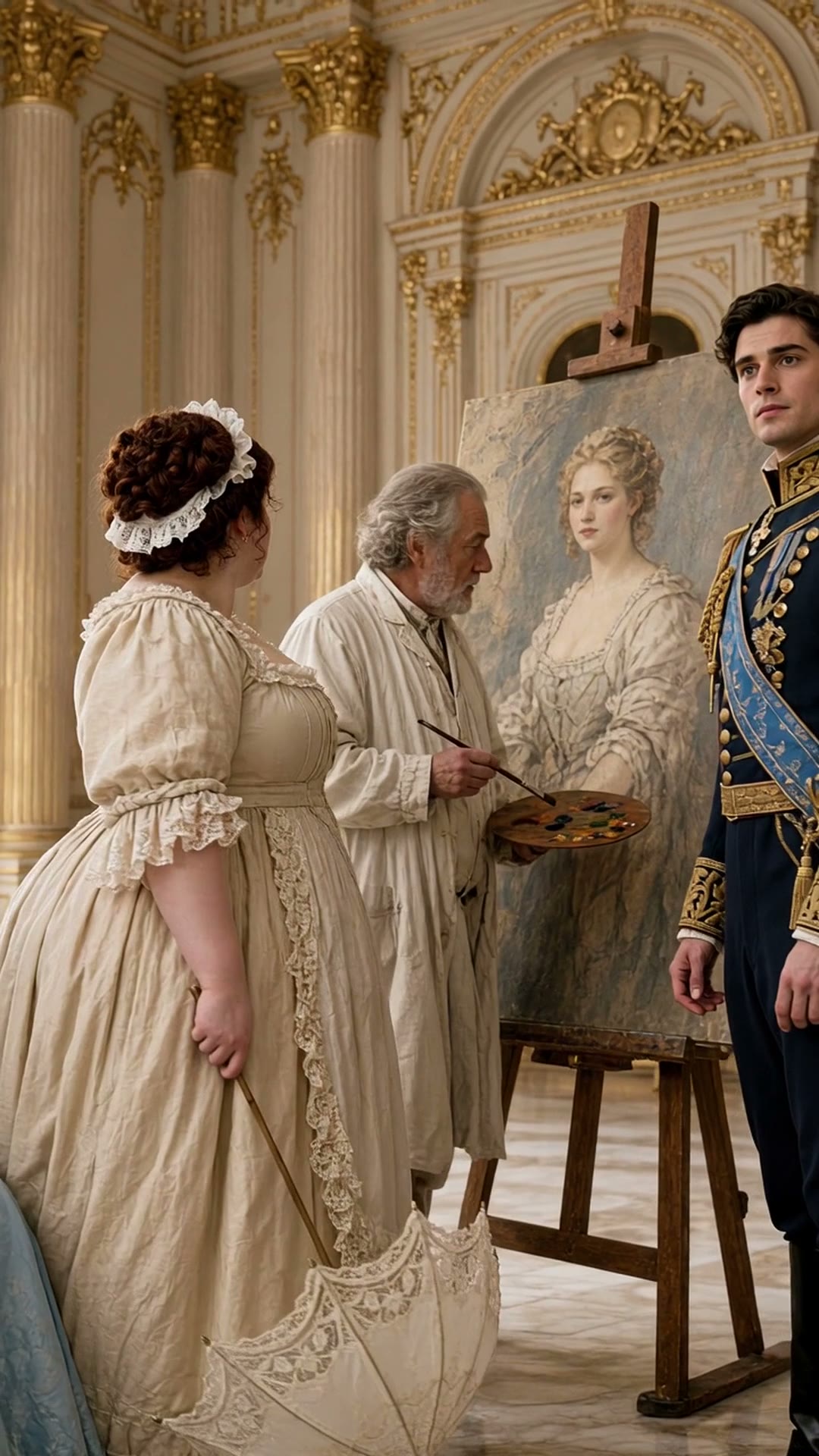
The portrait hall of the palace was the brightest room in the kingdom. Tall windows poured morning light over white marble and gold, and every noblewoman who wanted to be remembered sat there, by the largest window, while the court painter worked.
That morning it was Lady Vivienne Ashcombe. Everyone knew why. Her grandfather had once been the most powerful Chancellor the kingdom had ever known, and her family had spent years arranging her betrothal to Prince Julian. The portrait was meant to hang in the long gallery on the day of the announcement.
The painter was Clara Penhallow. She was twenty-nine, plump and soft-spoken, always a little paint on her fingers and a brush stuck in her pinned-up hair. She had come to the palace at eighteen as an apprentice, and for eleven years she had painted the court's faces with patience and love. The ladies liked her work. They did not like her. She was too large, too plain, too common to be worth a second glance.
Clara had stepped closer to the window to see how the light fell on Lady Vivienne's pearls. That was all.
"Move, cow. You're blocking my light."
The ladies along the wall laughed behind their fans. Clara felt the heat climb into her face. She knew she could answer. She knew she would not.
"Forgive me, my lady," she said, and stepped back out of the sun.
But one man in the room was not laughing. Lord Harrowgate was eighty years old and leaned on a cane, and fifty years earlier he had carried the train of Princess Eleanor on the day she married the King. When Clara stepped back, the light caught her face from the side for one moment: the high forehead, the small cleft in the chin, the grey eyes set a little too far apart.
The old man went white. "Your Highness," he said, "she has the late Queen's face."
Prince Julian had been standing beside him, bored, waiting for the sitting to end. He looked at the painter for the first time. Then he said quietly, "Turn to the light."
Clara did not understand. She turned anyway, lifting her face into the window. And the whole hall saw it. The face of Queen Eleanor, who had died nineteen years ago, the face that hung in the long gallery, was looking back at them from under a painter's untidy hair.
Lord Harrowgate spoke the name that had been forbidden in that palace for twenty-nine years. "Rosalind."
Queen Eleanor had not been an only child. She had a twin sister, Princess Rosalind, as alike to her as one drop of water to another. At twenty, Rosalind fell in love with the young court painter, Thomas Penhallow, and married him in secret in the palace chapel, with only the old chaplain as witness.
The Chancellor of that time was Lord Ashcombe, Lady Vivienne's grandfather. He had wanted Rosalind for his own son, and above all he wanted her dower lands, the rich river estates in the south. When he learned of the marriage, he tore the page out of the chapel register and announced that Princess Rosalind had died of a fever while travelling abroad. Her lands passed to the Ashcombe family "in trust." Thomas and Rosalind fled with nothing and lived quietly in a market town, where Thomas painted shop signs and Rosalind taught village girls to read.
Rosalind died when Clara was four. Thomas raised his daughter alone, taught her everything he knew about paint, and before he died he gave her a small portrait of her mother. He told her it was "a lady I loved." He never told her the rest. He was afraid of what the Ashcombes would do.
But the old chaplain had been afraid too, and so he had kept a copy of the torn page. After his death it lay forgotten among his papers in the chapel library, until Prince Julian ordered every box opened that same afternoon. The copy was there, signed and sealed: Rosalind, Princess of the Realm, married to Thomas Penhallow, painter.
Clara brought her mother's little portrait from her room. Prince Julian held it next to his own mother's. They were the same face.
The Ashcombe "trust" was dissolved within the month. The river estates went back to their rightful heir, and the Ashcombe family was ordered to repay every coin of income they had taken from them over twenty-nine years. It left them nearly ruined. Lady Vivienne's betrothal was quietly ended, and she left court for her family's last small house in the north. Her unfinished portrait was never hung.
Prince Julian came to the portrait hall the next morning and found Clara at her easel, as if nothing had happened. He asked her what she wanted most.
"To finish one painting," she said.
Three months later it hung in the long gallery: two young women, side by side, with the same face, one in a queen's crown and one in a painter's smock. Underneath, a small gold plate read: Queen Eleanor and Princess Rosalind, by their niece and daughter, Lady Clara Penhallow.
She stayed the court painter. But now, when she walked into the portrait hall, the ladies rose.