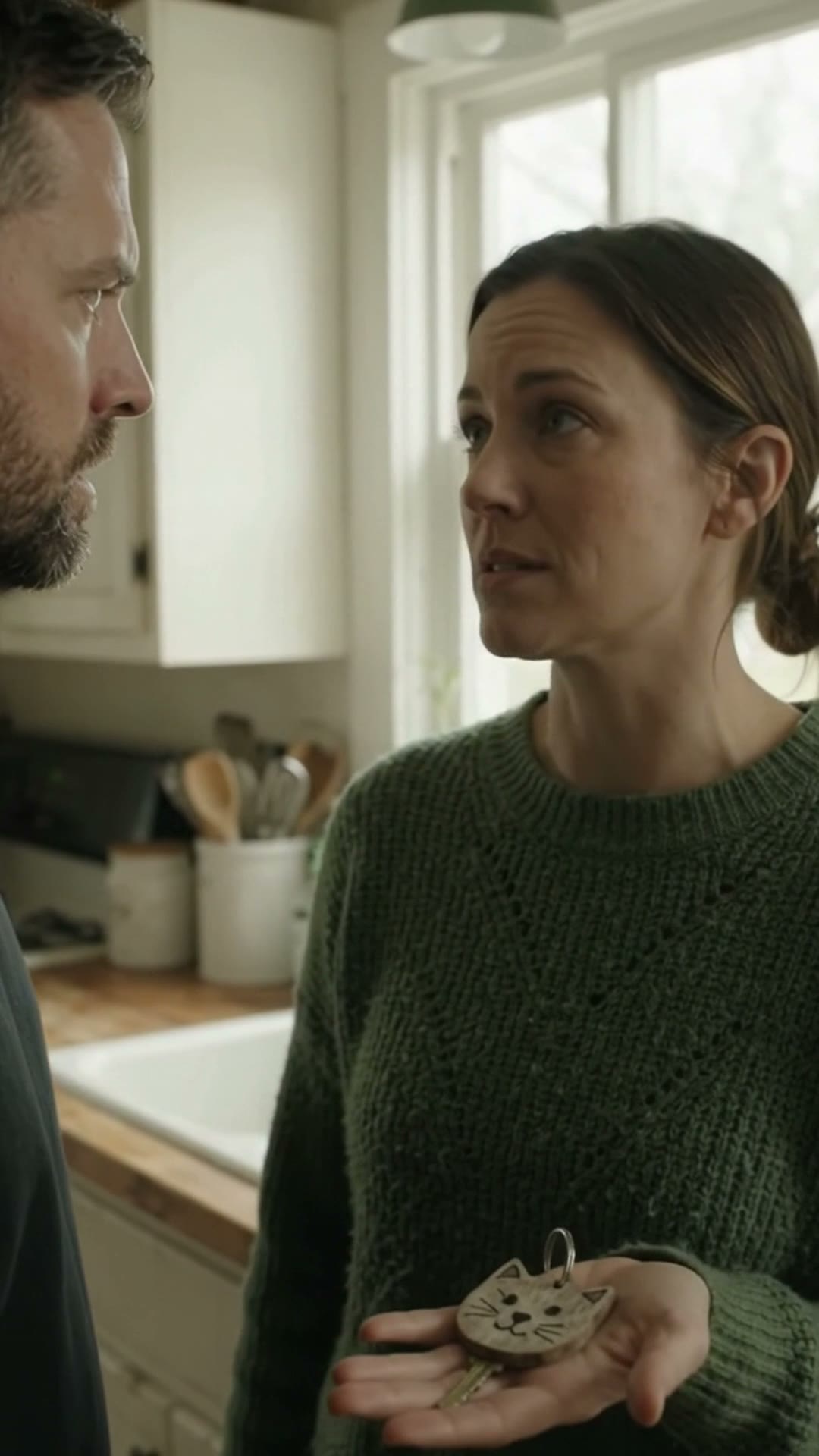
"Stop snooping! A spare key doesn't mean I'm having an affair!"
Simon threw the empty laundry bag across the kitchen. I had found the key in his trouser pocket while checking the washing. Its little cat-shaped tag was not one of ours. I asked whose it was before I asked anything else.
For weeks he had been late after work. He said he helped friends with a flat and that I made every favour sound suspicious. I was not checking his movements on a map. I wanted an ordinary answer about a key he had brought home and apparently intended to keep.
He said it belonged to a colleague, then said he could not remember which one. When I asked why a spare door key had no name in his memory, he accused me of searching his pockets to start an argument. I held it still so he could see the same object I was asking about.
"It came out with the washing. I asked whose door it opens."
His sister Rosa arrived to collect a baking dish. She stopped when she saw the tag.
"Simon, shall I tell Kate who I made that key tag for?"
Rosa made it for her friend Ruth after she moved into a new flat. She had made several small housewarming things, including the tag. She recognized the uneven ear she had trimmed twice. That did not prove an affair by itself. It gave us a name Simon had just said he could not remember.
Rosa asked him why he had Ruth's key. He first repeated the account about helping with repairs. Then he stopped. He admitted he had been seeing Ruth for several months. She knew he was married. He told her we were living separately, although he came home to me each night and had never proposed a separation.
I did not go to her flat or use the key. I did not need access to someone else's home in order to decide what his admission meant. I put it on the counter and asked him not to make another statement about my supposed imagination while we discussed something he had now acknowledged doing.
Rosa said she had not known. I believed her. She did not have to produce a photograph of them together to earn that belief, and she did not owe me a report on every friend she knew. What mattered was that when she recognized something in the room, she refused to help him pretend the question was unreasonable.
Simon said he had not wanted to hurt me. I asked which part of refusing a name, inventing uncertainty and shouting about the washing had been meant to spare me. Avoiding the conversation had spared him discomfort while leaving me to wonder why ordinary questions kept causing explosions.
We separated our immediate living arrangements before deciding anything permanent. I spoke privately with people I trusted and obtained independent advice about practical decisions. I did not agree to every proposal simply because he wanted the affair to become a tidy account of two people who had already drifted apart.
There were problems in the marriage before that morning. I could discuss my part in those without taking responsibility for his decision to begin another relationship and deny it. Those were not interchangeable conversations.
Rosa returned the baking dish another day. We had coffee without making her choose which of us she could still call. I appreciated that she did not treat being his sister as a reason I should forgive him faster.
The key left with Simon. My own stayed on the hook by the door, which was a small ordinary thing I could still recognize in a house where much else had changed.
Would you have tried to rebuild the marriage after that admission, or found the effort to make you doubt the question harder to forgive than the affair itself?