The rain wasn’t just falling; it was driving, a relentless gray curtain that turned the rural backroads into slick, hazardous ribbons of asphalt. For Elias, a freelance delivery driver already two hours behind schedule, the weather was a curse. He gripped the steering wheel, his knuckles white, squinting through the windshield wipers thumping furiously against the deluge. He was in a “quiet corner” of the county, miles away from the bustling city center, a place where cell service was spotty and traffic was nonexistent.
He almost missed her.
It was a flash of tan against the dark, wet tarmac that caught his eye near mile marker 7. At first, his brain registered it as a discarded burlap sack, soaked and abandoned by the roadside. But as his headlights swept over the object, a sickening realization hit him. It wasn’t a sack. It was a dog.
Elias slammed on the brakes, his van skidding slightly on the waterlogged road. He threw the vehicle into park and burst out into the storm, the rain instantly plastering his shirt to his skin.
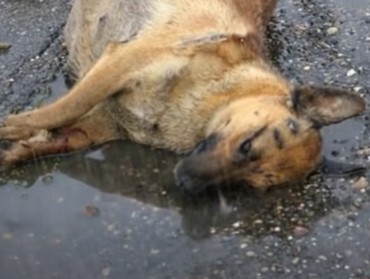
There she lay, just as the image that would later circulate the community showed: a heavily pregnant tan mix, collapsed right on the white shoulder line, her body half-submerged in a freezing puddle. She was motionless, her eyes barely open slits against the pounding rain. She looked utterly defeated, a portrait of raw vulnerability abandoned to the elements.
Elias knelt in the mud, his delivery schedule forgotten. He touched her side. She was intensely cold, and her breathing was shallow, ragged gasps. Beneath his hand, he felt the distinct, frantic movement of unborn life. She wasn’t just fighting for her own life; she was fighting for a litter that was dangerously close to arriving in a watery grave.
“Hang on, girl,” Elias whispered, his voice shaking. He knew he couldn’t move her alone without hurting her.
He scrambled back to his van and managed to get a single bar of service. He dialed 911, who connected him to local animal control. But the twist was the weather; the dispatcher warned that flash flooding had blocked the main route. Help was at least forty-five minutes away.
Elias knew she didn’t have forty-five minutes. He needed immediate, local help. He ran to the nearest farmhouse, pounding on the door until a startled elderly couple, the Millers, answered. Explaining the situation breathlessly, he saw their hesitation turn to resolve. Mrs. Miller grabbed blankets; Mr. Miller grabbed a heavy-duty tarp.
They returned to the roadside scene, joined moments later by Sarah, a volunteer from a small local animal welfare group who lived nearby and had heard the emergency scanner chatter. The quiet corner was beginning to rally.
The dog hadn’t moved, but her whimpers were growing fainter. The group knew they had to get her out of the freezing water immediately.
Using the tarp as a makeshift stretcher, Elias, the Millers, and Sarah carefully lifted the heavy, trembling animal. She let out a low groan of pain that tore at Elias’s heart. They loaded her into the back of Sarah’s SUV, which was already equipped with a crate and heating pads.
The drive to the nearest vet clinic was a white-knuckle ordeal. The storm had intensified, washing gravel across the road and turning shallow ditches into rushing torrents. Sarah navigated the treacherous roads with grim determination, while Elias sat in the back, rubbing the dog with dry towels, trying to surge warmth back into her limbs.
They arrived at the clinic just as Dr. Albright, who had been alerted by Sarah, was unlocking the front door. The dog, whom Elias had silently named “Stormy,” was rushed into the surgery room.
The situation was dire. Dr. Albright’s initial assessment revealed severe hypothermia and exhaustion. Worse, Stormy was in active labor, but she was too weak to push. The puppies were distressed; their heart rates were dropping on the ultrasound monitor.
“We have to perform an emergency C-section right now,” Dr. Albright announced, her voice tight. “Or we lose them all.”
The surgery began, a tense ballet of medical intervention performed under the humming fluorescent lights. Outside in the waiting room, Elias paced, his clothes still damp. The Millers sat holding hands, praying silently.
Then came the complication that nearly ended it all.
Mid-surgery, Stormy’s blood pressure bottomed out. The trauma of the cold, the exhaustion, and the surgery was too much. “She’s crashing!” Dr. Albright yelled. “We need whole blood, now! Does anyone have a large dog in their car?”
It seemed impossible. They were in a rural clinic late at night during a storm. But fate had one more twist. The clinic door burst open, and a burly man in mechanic’s coveralls rushed in, holding a bleeding hand. He had cut himself working in his garage down the road. Behind him trotted a massive, calm Great Dane.
“He’s universal,” the mechanic grunted, seeing the panic in the vet tech’s eyes. “Take what you need.”
Within minutes, a transfusion line was running from the Great Dane, named ‘Tiny,’ to the fading mother on the table. The fresh blood was the jumpstart Stormy’s failing system needed. Her vitals stabilized, just enough.
One by one, Dr. Albright carefully extracted the puppies. They were limp and silent at first, but vigorous rubbing by the vet techs elicited tiny, squeaking cries that sounded like the sweetest music to everyone in the building.
Seven puppies. All alive.
It took hours for Stormy to fully recover from the anesthesia and the ordeal. When she finally blinked open her eyes, she wasn’t on cold asphalt anymore. She was buried in warm blankets, a heating lamp casting a golden glow over her. And nestled against her belly, clean and nursing greedily, were her seven miracles.
The quiet corner of the community had done more than just rally; they had facilitated a miracle against the odds of weather, time, and biology. Elias looked at the scene, the cynicism of his day completely washed away by the rain and the resilience he had witnessed.
Stormy’s story didn’t end in that clinic. The picture of her recovery went viral locally. The “quiet corner” wasn’t so quiet anymore; donations of food, blankets, and money poured into the small animal welfare group that Sarah volunteered for.
The Millers adopted two of the puppies when they were old enough. The mechanic who owned Tiny, the life-saving Great Dane, took another.
And Elias? The delivery driver who was always running late found a new reason to be on time. He finished his route that night, soaked to the bone and hours behind, but with a lightness in his chest he hadn’t felt in years. Two months later, after Stormy had fully recuperated and weaned her pups, Elias walked into the shelter. He wasn’t there to deliver a package. He was there to pick up his new co-pilot. Stormy hopped into the passenger seat of his van, her tail wagging, ready for the road ahead.