He was a dog lying in a pile of garbage, motionless beneath scraps of plastic and torn cardboard.
From a distance, he looked like something already discarded — another shape among refuse, something the city had decided was no longer useful. His ribs pressed sharply against thinning skin. His legs were twisted at unnatural angles. His breathing was shallow enough that you had to look closely to see his chest move at all.

His eyes were closed.
Anyone passing by could have assumed it was too late. That whatever had happened had already finished its work. It would have been easy — painfully easy — to keep walking.
One man did not.
He slowed. He looked again. He noticed the faint rise and fall beneath the dirt and debris. And instead of convincing himself it wasn’t his responsibility, he made a call that would determine whether that fragile breath continued.

A Dog Found Collapsed in the Trash
The rescuer behind meowinspace still remembers the phone call clearly.
“A kind man called me and told me that he had found a collapsed dog in the garbage.”
There was urgency in his voice, but also uncertainty — the kind that comes when someone stumbles into a situation they were never prepared for. He didn’t know what was wrong with the dog. He didn’t know if he was dying. He only knew he couldn’t leave him there.
When she arrived, the scene was exactly as described.
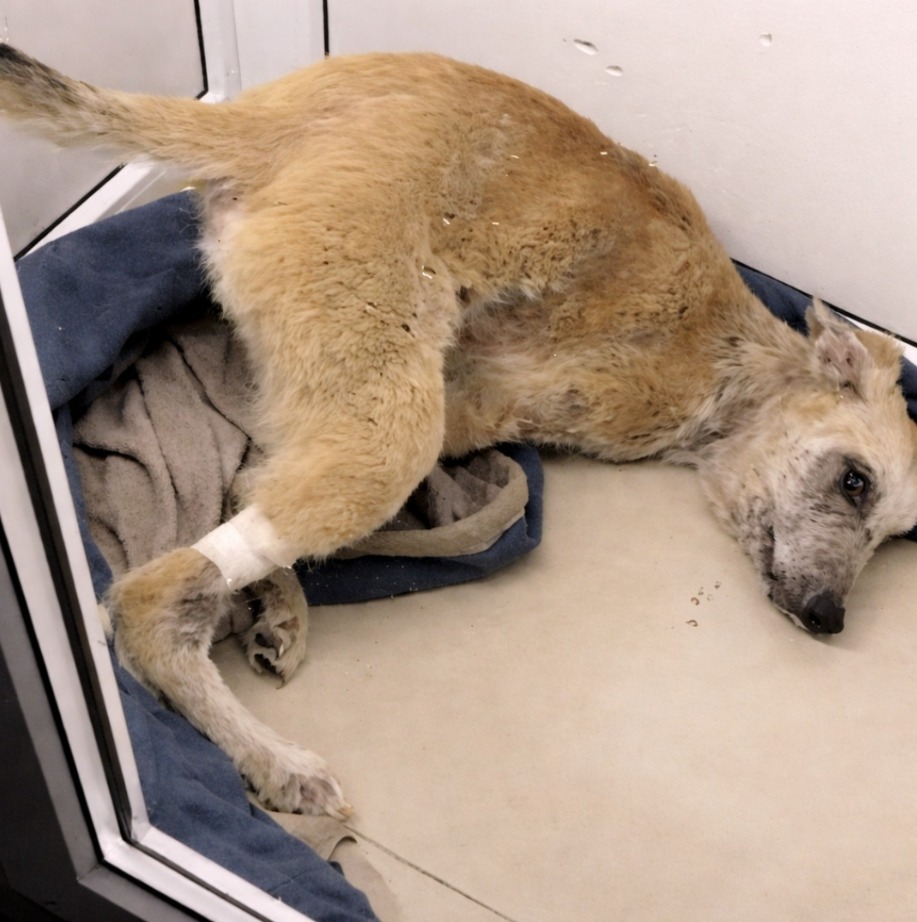
The dog lay limp where he had been found. His muscles offered no resistance when she touched him. He could not lift his head. He could not reposition his body. There was no growl, no flinch, no attempt to crawl away.
He was alive.
Barely.
The man who found him had gently lifted him out of the garbage and was cradling him in his arms. He had stayed the entire time, watching for any sign of breathing, unwilling to abandon him the way someone else already had.
That decision — to stay — made all the difference.
She named him King.
Not because he appeared powerful or majestic. In that moment, he looked anything but strong. She named him King because dignity should not be reserved for the healthy. Every life deserves to be addressed with respect, especially when it is most vulnerable.
What Veterinarians Found at the Clinic
King was rushed immediately to a veterinary clinic. There was no time to waste. His body was too fragile for delay.
The examination unfolded slowly. Every movement had to be careful. His bones felt thin beneath the skin. His limbs were visibly deformed, bent in ways that suggested long-term structural damage rather than a recent injury. When the veterinary team tested his reflexes, his nervous system did not respond as expected.
This was not an accident that had happened overnight.
This was the result of prolonged neglect.
Blood tests and imaging began to reveal the underlying cause: a severe calcium deficiency that had compromised his skeletal development.
According to the MSD Veterinary Manual, rickets is a rare disease in young, growing animals that leads to soft and deformed bones. Without proper nutrition — particularly balanced calcium and phosphorus — bones cannot mineralize correctly. They bend under normal weight. They twist as growth continues. Eventually, the body can no longer support itself.
In puppies, the consequences are especially severe. Compendium Continuing Education for Veterinarians explains that nutritional secondary hyperparathyroidism develops much more quickly and with more serious consequences in puppies than in adult dogs. Young bodies grow rapidly. When that growth is unsupported by proper nutrients, deformities can progress in weeks rather than years.
King’s legs reflected exactly that pattern. They curved outward and forward, unable to bear his weight. His muscles had atrophied from disuse. The collapse in the garbage was not a sudden event — it was the final stage of months of silent deterioration.
For readers unfamiliar with nutritional bone disease, this explains why some dogs appear to “suddenly” fail. The damage builds quietly. Bones soften gradually. Weakness increases incrementally. Then one day, the body simply can’t compensate anymore.
The veterinarians outlined a plan: medication to manage pain and inflammation, nutritional correction to address deficiencies, careful monitoring, and supportive care.
They also explained their expectations.
Given the severity of his deformities and neurological weakness, they believed his body would likely continue to decline.
When Survival Was Not Expected
King remained at the clinic as options were explored.
Shelters were contacted.
One after another, they declined.
Not because they lacked compassion. Because they lacked capacity. King required constant monitoring, medical oversight, specialized nutrition, and long-term support. Many shelters operate at or beyond their limits. A dog with complex medical needs can overwhelm already strained resources.

So King stayed at the clinic.
The rescuer listened to the prognosis — guarded at best — and made her decision.
“I told them I would take care of him until the end.”
It was not a promise of recovery. It was a promise of presence.
If his life was going to be short, it would not end in a cage without comfort. It would end with warmth, with gentle hands, with someone speaking softly to him. It would end with dignity.
The Daily Care That Kept Him Alive
There was no dramatic turning point at first.
No sudden surge of strength. No miraculous overnight improvement.
Instead, there was routine.
She visited every day. She brought appropriate food recommended by the veterinary team. She sat beside him and spoke to him, believing that even if he could not move, he could still hear her. She learned the rhythm of his breathing. She noticed small changes in his posture. She memorized the way his eyes shifted when he recognized her voice.
She spent her savings on his treatment.
Critical cases like King’s often hinge on stability rather than rapid improvement. When stress decreases and consistent care is introduced, the body sometimes stops deteriorating. It doesn’t heal immediately — it simply holds steady.
After several days, that is exactly what happened.
King did not worsen.
His vitals, once precarious, remained stable. His breathing grew more regular. His appetite, though assisted, improved slightly.
The veterinary team took note. They adjusted medications. They rechecked bloodwork. The numbers were not perfect, but they were no longer spiraling.
Two weeks after being found in a pile of garbage, King left the clinic alive.
That alone felt monumental.
What Stabilization Really Means
Stabilization is often misunderstood. It does not mean cure. It means the body has stopped losing ground.

In cases involving skeletal deformities and neurological compromise, improvement is measured in increments. Pain control must be consistent. Nutrition must be balanced and carefully monitored. Muscles require gradual strengthening without placing strain on weakened bones.
King still could not walk.
His front legs buckled when he attempted to bear weight. His coordination was limited. But his eyes were open now. He tracked movement in the room. He responded to touch. He ate willingly.
Those changes mattered.
They indicated awareness, engagement, and the return of something even more powerful than muscle tone — spirit.
Adjusting to Life After Critical Injury

When King transitioned into home care, his transformation continued in subtle but meaningful ways.
He slept deeply, no longer curled in tension. He ate with enthusiasm rather than hesitation. He began reacting to other dogs in the home — watching them, attempting to follow their movements.
His tail moved.
That small gesture — a hesitant wag — felt larger than any medical report.
He tried to stand. He tried to play. His body could not yet cooperate, but the desire was unmistakable. His spirit had resurfaced before his strength had.
To provide additional support, the rescuer experimented with bandaging his front legs, offering temporary structure to reduce strain. It provided limited help, but it was not enough to restore mobility.
So she searched for another solution.
Mobility aids can dramatically change quality of life for dogs with structural or neurological impairments. According to the Academy of Orthopaedic Physical Therapy, wheelchairs are commonly chosen for dogs experiencing significant difficulty walking due to injury, illness, degenerative conditions, or neurological disorders.

King was fitted with a wheelchair.
The first time he used it, something shifted.
For the first time, he could move forward without collapsing. His legs no longer had to carry his full weight. The strain on his bones decreased. Pain lessened. Freedom, even partial, returned.
Movement changed his world.
King Today
Today, King lives peacefully in the home of the woman who refused to leave him behind.
He wakes up in a safe space. He eats balanced meals tailored to his needs. He moves comfortably with his wheelchair, navigating rooms with confidence. He plays gently without the strain that once overwhelmed his body.

His days are structured around comfort and stability.
The dog once discarded in garbage now lives surrounded by care.
His deformities have not vanished. His bones will never look typical. But his life is no longer defined by neglect.
It is defined by adaptation.
Why King’s Story Stays With People
King’s rescue was never about a guaranteed cure.
It was about refusal.

Refusal to treat a life as disposable. Refusal to accept that collapse meant conclusion. Refusal to measure worth by physical perfection.
He survived because someone stayed when walking away would have been easier.
His story, shared through the first-person account of his rescuer at meowinspace, reminds people that compassion does not require certainty. It requires commitment.
Sometimes survival begins long before bones strengthen or muscles rebuild. It begins when someone decides a life is worth time, money, effort, and heartbreak if necessary.
If you ever encounter a pet collapsed or injured, contact a local veterinarian, animal control, or a rescue organization immediately. Quick intervention can mean the difference between decline and stabilization.
King’s body may always carry the marks of what he endured.

But he no longer lies unseen in a pile of trash.
He moves forward — supported, protected, and treated like exactly what his name declares him to be.
She Was Left in a Box to Fade Away, But Junie Chose to Fight
The field was empty.
No houses broke the horizon. No traffic hummed in the distance. Only wind moved through tall grass beneath a heavy gray sky, bending the stalks in slow, restless waves. It was the kind of place people pass without looking twice — open land, quiet, forgettable.
Inside a small cardboard box placed among the weeds, Junie lay still.

She did not lift her head when rescuers approached. She did not whimper. She did not try to crawl away. Her body was cold to the touch, so thin it felt almost weightless when they first reached for her. Her fur had been dyed an unnatural purple, as if someone had treated her life like an object to decorate and discard. Worms crawled across her frail body, moving freely where strength had vanished.
Whoever left her there did not expect her to survive the night.
For a long moment, even experienced rescuers stood in silence. They had handled severe neglect before. They had seen starvation, injury, cruelty. But this was not slow deterioration hidden behind closed doors. This was deliberate abandonment in an empty field, a quiet decision to leave a living being to fade alone.
Those first minutes mattered more than anyone watching could fully understand.
Junie was fading quickly. Without warmth, without fluids, without intervention, her body would not last long enough to reach a hospital. Hypothermia and dehydration were already taking hold. Every second exposed to wind and cold pushed her closer to the edge.
What happened next would determine whether she lived long enough to fight.
Where Junie’s Rescue Story Began
Junie’s rescue was later shared publicly by NYC Second Chance Rescue, whose team responded when she was found. Footage of those early moments eventually appeared through Dog Haven’s YouTube platform, allowing viewers to witness the urgency and disbelief written across rescuers’ faces.
The video shows the field. The box. The stillness.
Rescuers did not debate what to do. There was no time for discussion. Junie was lifted gently but swiftly from the box, wrapped to preserve what little body heat she had left, and rushed toward emergency care in Valor.
Even during transport, they monitored her breathing constantly, watching for signs of decline. Her chest rose faintly. Her eyelids remained closed. Her limbs hung limp.
They had seen critical cases before.
This one felt different.
The Medical Reality Inside the Emergency Room
At intake, veterinary staff moved immediately. There was no waiting room pause, no paperwork delay beyond necessity. Junie was placed on warming support at once.
Her body temperature was dangerously low. She was severely dehydrated. Bloodwork painted a grim picture: kidney failure, significant anemia, and systems under immense strain. Her organs were struggling to maintain function. Circulation was weak. Mucous membranes were pale.
According to the American Red Cross, signs of hypothermia in dogs can include body temperature below 98.5°F, decreased heart rate, pale or bluish gums, dilated pupils, shivering, wobbliness, unconsciousness, and weak pulse. Junie displayed several of these markers, placing her in immediate, life-threatening danger.
Dehydration compounded the crisis. When a dog goes without water for too long, blood volume decreases, organ perfusion suffers, and kidneys begin to fail under the strain. The VCA Animal Hospitals notes that dehydration is particularly dangerous in small dogs, where even moderate fluid loss can destabilize the body quickly.
Junie’s case was not moderate.
It was extreme.

Fluids were administered carefully through intravenous lines. Her body was warmed gradually to avoid shock. Electrolytes were monitored closely. Every decision had to be measured — too rapid a correction could cause further complications.
The prognosis came quickly and quietly.
Medically speaking, Junie was not expected to survive.
The Moment That Shifted Everything
Then something happened that shifted the emotional atmosphere of the room.
Junie opened her eyes.
It was a small movement, barely perceptible at first. But to the team surrounding her, it felt seismic. Her gaze was unfocused but present. One rescuer later described the look as if Junie were saying, “I’m here. I’m still here.”
That single moment changed the tone of care from guarded effort to unwavering determination.
Critical care is not only medication and machines. It is vigilance — adjusting fluids hour by hour, monitoring urine output, tracking blood pressure, assessing neurological response. It is sitting beside a fragile body through long stretches of uncertainty because leaving feels impossible.
The rescue team remained close. They took short shifts of rest. They watched her breathing. They whispered encouragement she may or may not have understood.
They later admitted they had “spent all our money on her” to sustain the level of care required. But once Junie had opened her eyes, stepping back was no longer an option.
Two Nights That Could Have Gone Either Way
For two long nights, Junie hovered in a space between life and loss.

Her kidney values fluctuated. Her energy dipped and rose in small waves. At times she seemed to stabilize; at others she drifted back toward fragility. The room felt suspended in time, every monitor beep amplified.
Waiting became its own trial.
Then, slowly, lab results began to show improvement. Her hydration levels rose. Her temperature normalized. Her pulse strengthened.
Stabilization does not look dramatic. It looks like numbers creeping in the right direction. It looks like fewer alarms. It looks like staff allowing themselves the smallest exhale.
Junie was not out of danger.
But she was no longer slipping away.
When Junie Took Her First Steps
The first time Junie stood, the room fell silent again.
Her legs trembled violently. Muscles long weakened from malnutrition struggled to hold her weight. She swayed, nearly losing balance.
But she remained upright.

That fragile stand meant her body was responding to treatment. It meant neurological signals were functioning. It meant she was reclaiming control over muscles that had nearly failed her.
As she stabilized, the extent of her parasite burden became clearer. Worm infestations were significant — another consequence of prolonged neglect. Heavy intestinal parasites often contribute to anemia, weight loss, weakness, and dehydration.
The American Kennel Club notes that signs of intestinal worms in dogs can include dehydration, anemia, poor growth, weight loss, and lethargy — symptoms Junie had endured simultaneously.
Treatment for parasites had to be timed carefully to avoid overwhelming her already fragile system. Medication was introduced gradually, under close supervision.
Despite everything, Junie leaned into gentle hands.
She did not snap. She did not recoil. Trust emerged faster than anyone expected.
The Personality That Emerged
As her strength increased, so did glimpses of her personality.
Junie was gentle. She sought eye contact. She responded softly to voices. Even in recovery, she showed curiosity — watching movements in the room, following sounds, exploring cautiously once she had enough energy.
Staff members began to notice how easily she bonded. She rested her head against arms. She accepted affection without hesitation.

Fear did not define her.
There was no lingering aggression, no defensive posture. Instead, there was openness.
People at the hospital fell in love with her — not because she was fragile, but because she radiated kindness.
Cleared for Discharge
The day the words were spoken, no one rushed to celebrate.
Junie was cleared to leave the hospital.
There were quiet smiles, relieved laughter, and tears no one tried to hide. Staff gathered as she prepared to depart. They had watched her teeter on the edge. They had braced for loss. Now they were witnessing survival.
Her discharge was not simply a medical milestone.
It was proof that she had defied expectations.
She had survived kidney failure, hypothermia, anemia, dehydration, and severe parasite infestation. She had endured abandonment in an empty field.

And she was walking out.
A Permanent Home and a Different Life
Junie did not transition to a temporary foster placement.
A permanent home had already stepped forward — someone who saw her not as a medical case, not as a rescue project, but as family.
She now lives in warmth. She eats balanced meals. She rests in safety rather than cardboard. She plays. She explores. She belongs.
The purple dye has faded. The worms are gone. Her body has filled out with healthy weight. Her eyes are bright.
This is what survival looks like now.
It is not dramatic. It is ordinary in the best possible way — morning routines, soft bedding, gentle affection, security.

Junie’s recovery is rare.
But it was not accidental.
Why Junie’s Story Still Matters
Junie’s story illustrates the physical consequences of abandonment in stark detail: hypothermia that slows a heart, dehydration that strains kidneys, parasites that steal nutrients, anemia that weakens muscles. It shows how quickly a body can fail when deprived of care.
But it also demonstrates what focused intervention can repair.
Recovery does not happen all at once. It unfolds in breaths regained, in temperatures stabilized, in the first shaky stand, in trust returning to a pair of once-closed eyes.
Junie’s life changed because people refused to look away in a field where it would have been easy to do exactly that.
They chose urgency. They chose commitment. They chose to invest resources even when survival seemed unlikely.

Sometimes that choice is enough.
If Junie’s story moved you, share it with someone who believes compassion still matters. Stories like hers remind us that rescue work is not abstract — it is hands in tall grass, a box lifted, a body warmed, and a life carried back from the edge.
Fufy’s Journey: From Misdiagnosed Pregnancy to Recovery and New Beginnings in Lahore
In the town of Chadara in Lahore, a stray dog wandering the streets caught the attention of local residents for an unusual reason. At first glance, many assumed she was pregnant. Her abdomen was enormously swollen, and her movements were slow and labored, as though she was carrying a heavy burden inside her. People watched her with a mix of curiosity and concern, believing that she might soon give birth. But as days passed, it became clear that something was very wrong.

The dog’s condition continued to worsen. Instead of showing the typical signs of pregnancy, she appeared increasingly uncomfortable and distressed. Her breathing was shallow, her steps unsteady, and her energy rapidly fading. Sensing the urgency of the situation, compassionate locals recorded videos of the dog and shared them with veterinarians, hoping for guidance on how to help her.
When veterinary professionals reviewed the footage, they immediately recognized that this was not a pregnancy. What they saw was far more alarming. The dog’s abdomen was dangerously distended, a classic sign of severe fluid buildup rather than developing puppies. This condition, known medically as ascites, often points to serious underlying issues such as liver failure, kidney disease, heart problems, or advanced infection. The situation was critical, and the dog required immediate medical intervention.
Rescuers wasted no time. The dog was carefully transported to a veterinary clinic, where she was examined right away. Up close, the severity of her condition became even more apparent. Her abdomen was tight and stretched, causing her visible pain with every movement. She was lethargic, weak, and clearly exhausted from carrying the excess fluid for what veterinarians suspected had been months.

Although fluid buildup was the most obvious symptom, the medical team knew they needed definitive answers. To determine the root cause of her condition, they conducted a series of diagnostic tests, including X-rays and extensive blood work. As the team worked, the dog’s condition continued to deteriorate. She became increasingly lethargic, barely lifting her head, her body struggling under the strain.
This was a true medical emergency. Without intervention, the pressure from the fluid could compromise her organs further and ultimately prove fatal. Understanding the urgency, the veterinary team decided to act immediately to relieve her pain while awaiting test results.
As an emergency measure, they began draining the excess fluid from her abdomen. The procedure required precision and care, as removing too much fluid too quickly can be dangerous. Slowly and methodically, the veterinarians worked, watching closely for any signs of distress. What they encountered was astonishing.
Liter after liter of fluid was withdrawn—far more than anyone initially expected. In total, approximately 10 liters were removed from her abdomen. As the fluid drained away, the true condition of her body became visible. Beneath the swollen exterior was an extremely thin dog, her skeletal frame starkly apparent. The sight was both shocking and heartbreaking. It became painfully clear just how much suffering she had endured while living on the streets, carrying a burden that had masked her severe malnutrition.

As the pressure eased, an incredible transformation took place. The dog, who had been tense and visibly distressed, began to relax. Her breathing slowed, her body loosened, and for the first time in a long while, she appeared comfortable. Remarkably, she soon drifted into sleep right there on the clinic table, finally experiencing relief from months of unrelenting pain.
One of the veterinarians stayed close by her side, carefully monitoring her condition as additional fluid continued to be collected. “I’ll stay here at the clinic with her,” the vet said, determined not to leave her unattended during such a critical moment. The team remained vigilant, promising to provide updates as her condition evolved.
Once stabilized, the dog was given a name—Fufy. It was a simple but meaningful gesture, marking the beginning of a new chapter in her life. No longer just another suffering stray, she was now an individual with a future and a team of people invested in her survival.

In the days following the procedure, Fufy showed encouraging signs of improvement. With the fluid removed, her appetite slowly returned, and her energy levels began to rise. Medications were administered to address the underlying cause of her condition, and her diet was carefully managed to support her recovery. The veterinary team continued to monitor her blood work closely, adjusting treatment as needed.
What amazed everyone involved was Fufy’s resilience. Despite the pain and neglect she had endured, she responded positively to care and kindness. As her strength returned, so did her personality. She began to show curiosity about her surroundings, lifting her head to watch people pass by, her eyes brighter and more alert.
Soon, Fufy began to play again—something no one could have imagined when she first arrived at the clinic. She wagged her tail, explored her space, and even started forming tentative friendships with other dogs under care. Each small interaction was a sign of healing, not just physically but emotionally as well.
For a dog who had likely spent her life struggling to survive on the streets, these moments of joy were deeply significant. Fufy was rediscovering what it meant to feel light, comfortable, and safe. The trauma of her street life had not disappeared, but it was slowly being replaced by trust and happiness.
Her caregivers watched her transformation with a mixture of relief and pride. Seeing her playful nature emerge served as a powerful reminder of why rescue work matters. Beneath every suffering animal is a spirit waiting for the chance to live fully.

Fufy’s journey toward recovery was not achieved by medical care alone. It was made possible through the compassion of an entire community. From the locals who noticed something was wrong, to the individuals who shared her story, to the veterinarians who worked tirelessly to save her life, each played a vital role.
A heartfelt thank you was extended to everyone who supported Fufy along the way. Their concern, generosity, and commitment ensured that she did not become another silent casualty of street life. Instead, she became a symbol of hope and the incredible difference timely intervention can make.
Today, Fufy embodies the joy and resilience she always deserved. Her playful spirit shines through, a testament to her strength and the care she received when she needed it most. Though her recovery journey continues, she is no longer suffering alone. She is safe, loved, and finally free from the pain that once defined her days.

Fufy’s story is a powerful reminder that appearances can be deceiving, and that compassion saves lives. What was once mistaken for pregnancy turned out to be a life-threatening condition—but thanks to swift action and dedicated care, it became a story of survival, healing, and renewed happiness.
From Tragedy to Triumph: A Mother Dog’s Journey of Resilience and Hope
Sinead’s life took a heartbreaking turn shortly after she became a mother. What should have been a time filled with nurturing, warmth, and protection instead became a period of unimaginable suffering. Only days after giving birth, Sinead was struck by a car, an accident that left her severely injured and unable to use her back legs. In a single, devastating moment, her world was shattered.

For many animals, such injuries would mean the end. But Sinead was driven by something stronger than pain—her love for her puppies. Despite the trauma to her body, she refused to give up. With her hind legs dragging helplessly behind her, Sinead pulled herself forward using only her front paws. Each movement was slow, exhausting, and agonizing, yet she pressed on, fueled by a powerful maternal instinct and the desperate need to find her babies.
She dragged herself through the streets, her body scraping against the pavement, her strength fading with every passing hour. She searched tirelessly, her nose low to the ground, listening for familiar cries that never came. Hunger gnawed at her, dehydration weakened her further, and pain radiated through her injured spine. Still, she did not stop.
To those who passed by, her struggle was painfully obvious. She lay by the roadside, unable to stand, her cries filled with distress and sorrow. Yet day after day, people walked past her. Cars drove by. Life continued, indifferent to the suffering of a mother who had already lost almost everything. Each hour that passed drained her strength, and her cries grew weaker, tinged with exhaustion and despair.

Even in unbearable pain, Sinead’s thoughts never left her puppies. She had no way of knowing where they were or whether they were safe, but her heart refused to let go. Her body was failing, but her determination endured. She wanted only to protect them, to nurse them, to keep them warm. That instinct—to love and protect her young—was unyielding, even as her own survival became uncertain.
For a long time, the world seemed unmoved by her plight. She lay exposed to the elements, vulnerable and alone, her body bruised and broken. Each night brought colder temperatures and deeper loneliness. Each morning arrived with the same unanswered hope—that someone would finally see her, truly see her, and care.
That moment finally came when one compassionate stranger noticed Sinead lying helplessly by the roadside. Unlike so many others, this person did not look away. They stopped. They saw not just an injured dog, but a suffering mother in desperate need of help. Unable to ignore her pain any longer, the stranger approached carefully, speaking softly to reassure her.
Though frightened and weak, Sinead did not resist. It was as if she understood that this human was different—that help had finally arrived. With great care, the stranger gently lifted her fragile body and carried her to a nearby animal shelter, offering her something she had not felt in a long time: hope.
At the shelter, Sinead was finally safe. For the first time since the accident, she was no longer exposed to danger, hunger, or indifference. Shelter staff immediately recognized the severity of her injuries and rushed to provide medical attention. Veterinarians examined her carefully, confirming that the impact from the car had caused serious damage to her back legs, leaving her paralyzed.
Pain relief was administered, and her wounds were cleaned and treated. Soft bedding replaced cold pavement, and fresh water and food were placed within reach. Shelter workers stayed close, offering gentle words and comforting touches, letting her know she was no longer alone.
Beyond medical care, Sinead received something just as important: emotional support. The staff understood that her trauma extended far beyond physical injury. She had lost her mobility, her independence, and—most painfully—her puppies. Her eyes reflected deep sadness, a grief that could not be soothed overnight.
Yet as days passed, something began to change. Surrounded by warmth, kindness, and consistent care, Sinead’s frail body slowly started to recover. Though she could not walk, her strength returned in other ways. She began eating regularly. She slept more peacefully. The tension in her body eased, and the fear that once filled her eyes softened.
The shelter became a place of healing. Volunteers sat with her, speaking softly and offering affection without expectation. They learned her personality—gentle, quiet, and deeply loving. Though she still searched faces and listened intently, as if hoping her puppies might somehow appear, she also began to accept the comfort around her.

The loss of her puppies remained a deep ache, one that could not simply be erased. There were moments when Sinead seemed lost in thought, her gaze distant, her expression heavy with longing. But alongside that grief, something new began to grow: trust. Trust that she was safe. Trust that the humans around her cared. Trust that her life, though forever changed, was not over.
In the shelter, Sinead discovered new things she had not known during her time on the streets—compassion, consistency, and comfort. She learned the feeling of a soft blanket beneath her body and the gentle rhythm of daily routines. She learned that hands could heal rather than harm, and that rest was allowed.
As she rested in the shelter’s cozy surroundings, thoughts of her babies and dreams of better days filled her mind. Days marked not by pain and fear, but by hope and healing. Days where she would no longer struggle alone, no longer cry unheard. Even without knowing what the future held, Sinead began to sense that she was finally somewhere she belonged.
Her caregivers remained committed to giving her the best life possible, despite her paralysis. They explored treatment options, mobility aids, and long-term care solutions to ensure that Sinead could live comfortably and with dignity. To them, she was not defined by her injuries, but by her strength, resilience, and capacity to love.
Sinead’s tale is one of profound heartbreak, but also extraordinary resilience. It is the story of a mother who refused to give up, who fought through unbearable pain for the sake of her puppies, and who survived long enough for kindness to find her. It is also a reminder of how easily suffering can go unnoticed—and how powerful it is when someone chooses to stop and help.
A single act of compassion changed everything for Sinead. One person’s decision to care transformed her fate from silent suffering to safety and healing. Though her journey is far from over, she no longer faces it alone.
Her story serves as a powerful reminder that animals experience deep emotions—love, grief, fear, and hope—and that they rely entirely on humans to notice their pain. Sinead’s resilience stands as a testament to the strength of maternal love and the difference that empathy can make.

Today, Sinead rests surrounded by care instead of chaos, warmth instead of cold, and kindness instead of indifference. Her body may be broken, but her spirit remains strong. And in that quiet shelter, she holds onto the promise of better days—days shaped by compassion, dignity, and the assurance that her life still matters.