Clara Whitmore had not spoken a full sentence in eleven months.
Not since the night her mother’s car was pulled from the river. Not since her father, Grant Whitmore, decided that grief was something a man could outrun with money and closed doors. Doctors came to the house. Specialists flew in from other countries. Clara nodded, shrugged, drew pictures of a woman with long dark hair, and said nothing at all.
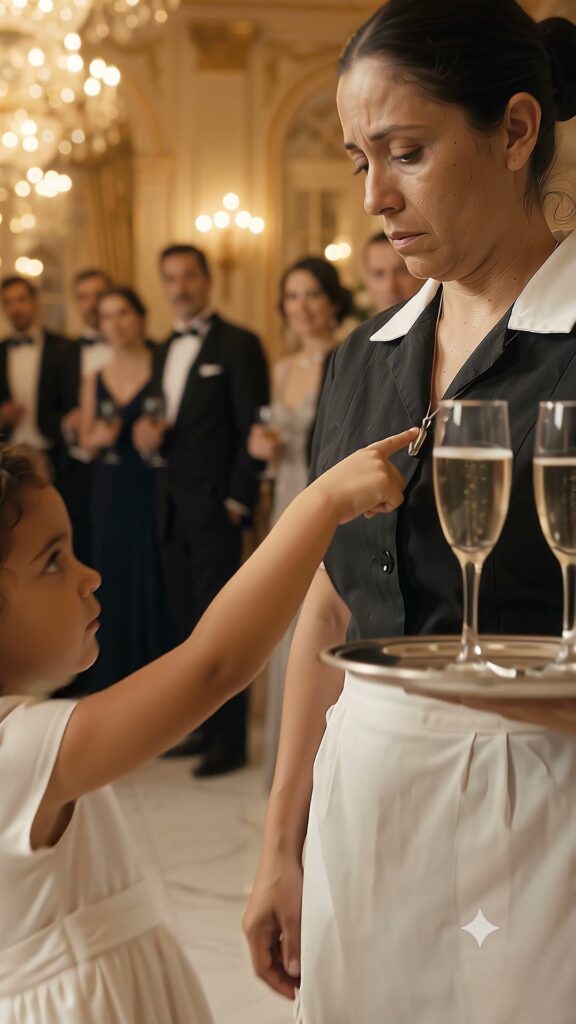
So when she let go of her nanny’s hand at the Whitmore Foundation gala and walked across the ballroom, every head turned.
Every guest in black tie watched a six-year-old in a white dress pass the string quartet, pass her own grandmother, and stop in front of a maid.
Marisol Reyes was forty-one, exhausted, and wearing a uniform two sizes too big. The agency had sent her that morning because the caterer was short-staffed. She was carrying a tray of champagne flutes and praying nobody would look at her.
Clara pointed at the small silver locket that had slipped out from under Marisol’s collar.
“That’s Mommy’s,” she whispered.
The tray trembled. One glass slipped and shattered on the marble, and the whole room went still.
Grant crossed the floor in seconds. “Where did you get that?” His voice cracked. “My wife wore a locket like that the night she died. I thought it went into the river with her.”
Marisol’s hands shook as she lifted the chain over her head. “My sister gave it to me,” she said. “Six years ago, the week Clara was born. She told me to keep it safe until someone asked.”
“What sister?” Grant asked.
“Elena,” Marisol said. “Elena Reyes.”
Grant felt the floor tilt. Elena Reyes was the name on his wife’s birth certificate, the name she had dropped when she married him and never explained. She had told him she had no family.
Marisol opened the locket with her thumbnail. Inside were two tiny photographs. On the left, two little girls on a beach, laughing, one holding the other’s hand. On the right, a baby wrapped in a yellow blanket.
“That baby,” Marisol said softly, “is Clara. Elena mailed me that photo, and the locket, the week she was born. She wrote to me every month for six years. Eleven months ago she stopped answering, and I never knew why.”
Grant’s mother, standing behind him, had gone the color of paper.
It took only one question. Grant turned to her and asked, “Did letters ever come to this house for Elena?”
She did not answer. She did not have to. Later that night, in the study, she admitted that she had burned every envelope Marisol ever sent to this house, including the last one asking why Elena had gone silent, because a maid’s sister was not the kind of family she wanted for her son’s wife.
Grant sat in silence for a long time. Then he did something he had not done in eleven months: he cried in front of his daughter.
Clara climbed into his lap, put her small hand on his cheek, and said her second sentence in almost a year.
“Daddy, now Auntie Marisol can stay.”
She did. Marisol never wore a oversized uniform again. She moved into the guest room that week, and Clara started talking in the mornings, first in whispers, then in whole stories about the woman with the long dark hair.
On the anniversary of the accident, the three of them walked down to the river. Clara opened the locket, held it out over the water, and said, “Mommy, we found your sister.”
This is a work of fiction. Names, characters and events are imaginary, and the images are AI-generated.




Join the conversation